
Why a Fortress Had to Be Taken Instead of Simply Bypassed
Why a fortress in the rear could be more dangerous than an enemy standing in front of the army.
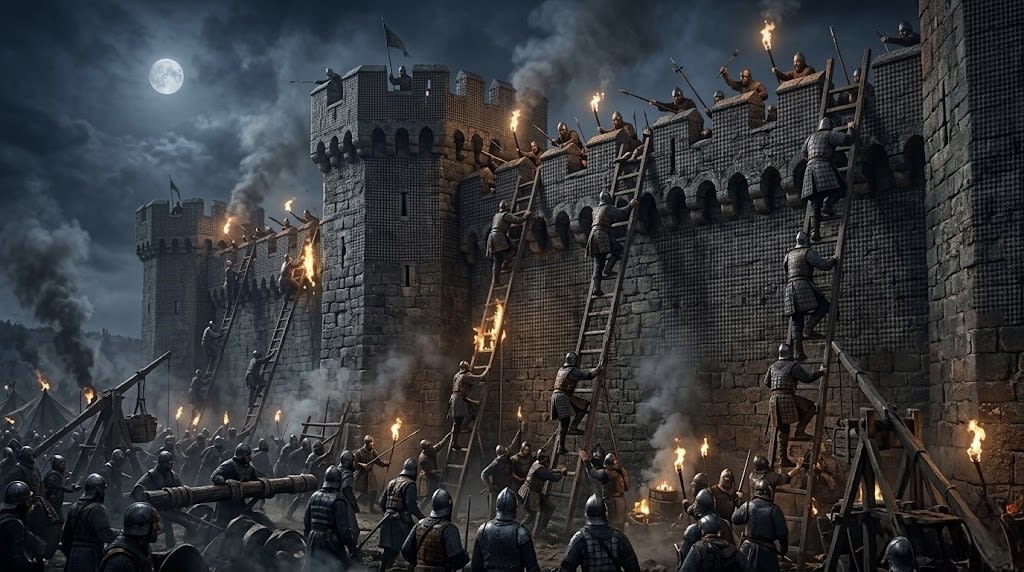
A point on the map, but in reality a castle that controlled everything around it
If you look at a map, the idea seems obvious: there is a fortress — go around it and keep moving. Why waste weeks or months on a siege, lose men in an assault, if you can simply leave it behind? But in real war, that logic almost never worked. A fortress was not just stone walls. It was a center of control over the surrounding territory. It did not stand in a random place, but at key points: near crossings, on roads, in narrow passes, beside towns. And if you marched past it, you were leaving behind you not an empty spot, but an active threat.
Logistics: an army cannot exist without supplies

The main reason fortresses could not be ignored was logistics. A medieval army did not live by itself. It constantly needed food, water, fodder for horses, weapons, arrows, and replacement equipment. All of that moved along roads — the very roads that fortresses often controlled. If an enemy garrison remained in the rear, it could at any moment cut supply trains, set up an ambush, burn provisions, or simply block the route. As a result, the army that had moved ahead would quickly begin to weaken. Hunger and disease killed soldiers far more reliably than swords. That is why commanders understood a simple fact: to leave a fortress behind was to put their own army at risk.
The enemy does not disappear just because you “went around” him

There is another important point that is often overlooked. A fortress was not just a defensive structure, but a base. Inside it were a garrison, weapons, and supplies. It was a point from which action could be launched. If an army moved on, the garrison did not sit quietly and watch. It could strike at the worst possible moment — when the main force was already far away, when the army had stretched out, when it was occupied with another battle. Then the blow would come from the rear. This is one of the most dangerous situations in war: when the enemy is both ahead and behind you. That is why fortresses were usually either taken or at least blockaded.
War is also about power, not only movement

There was also a more political reason. War was not simply an army on the march, but the seizure and holding of territory. And territory in the Middle Ages was not lines on a map, but concrete points: towns, castles, and fortresses. If you marched past a fortress, you did not control that land. Another authority remained there, with its own taxes and its own people. Formally, it might look as if you had advanced, but in reality you had secured nothing. That is why the strategy of pushing forward without looking back worked poorly. Victory in war meant not merely passing through, but taking control of the key strongpoints.
Siege was preferred to assault, because assault was almost suicidal
It is important to understand that taking a fortress did not mean immediately storming it. An assault was considered the most dangerous option. The defenders had enormous advantages: walls, height, and preparation. The attackers’ losses could be immense. That is why siege was usually preferred. The fortress was surrounded, food and water were cut off, and then people waited. Sometimes this lasted for weeks, sometimes for months. The people inside were simply driven toward hunger, disease, and despair until they surrendered. It was slow, but far more reliable than a frontal attack.
But fortresses were sometimes bypassed — and it was always a risk
There were situations when there was no time for a siege. For example, if an army was marching toward a decisive battle or trying to strike quickly at a capital, a fortress might be left behind. But this was always a dangerous choice. The commander was effectively accepting the risk that at any moment a problem could arise in the rear. Sometimes it worked, but often it led to serious consequences.
So a fortress was not an obstacle, but a node that could not be ignored
In the end, the answer becomes simple. A fortress was not bypassed because it did not merely obstruct movement — it controlled everything around it. To leave it behind meant to leave the enemy in your rear, endanger your supplies, and lose control over the territory. That is why in medieval wars, commanders more often chose a long and difficult siege rather than a quick but dangerous attempt to move on. In that world, speed rarely defeated control.
About the Creator
Enjoyed the story? Support the Creator.
Subscribe for free to receive all their stories in your feed.
Comments
There are no comments for this story
Be the first to respond and start the conversation.