
Who Was the First Human? The Incredible Story of Our Evolution
From an asteroid that destroyed the dinosaurs to the rise of Homo sapiens, discover the extraordinary journey that eventually created modern humans.

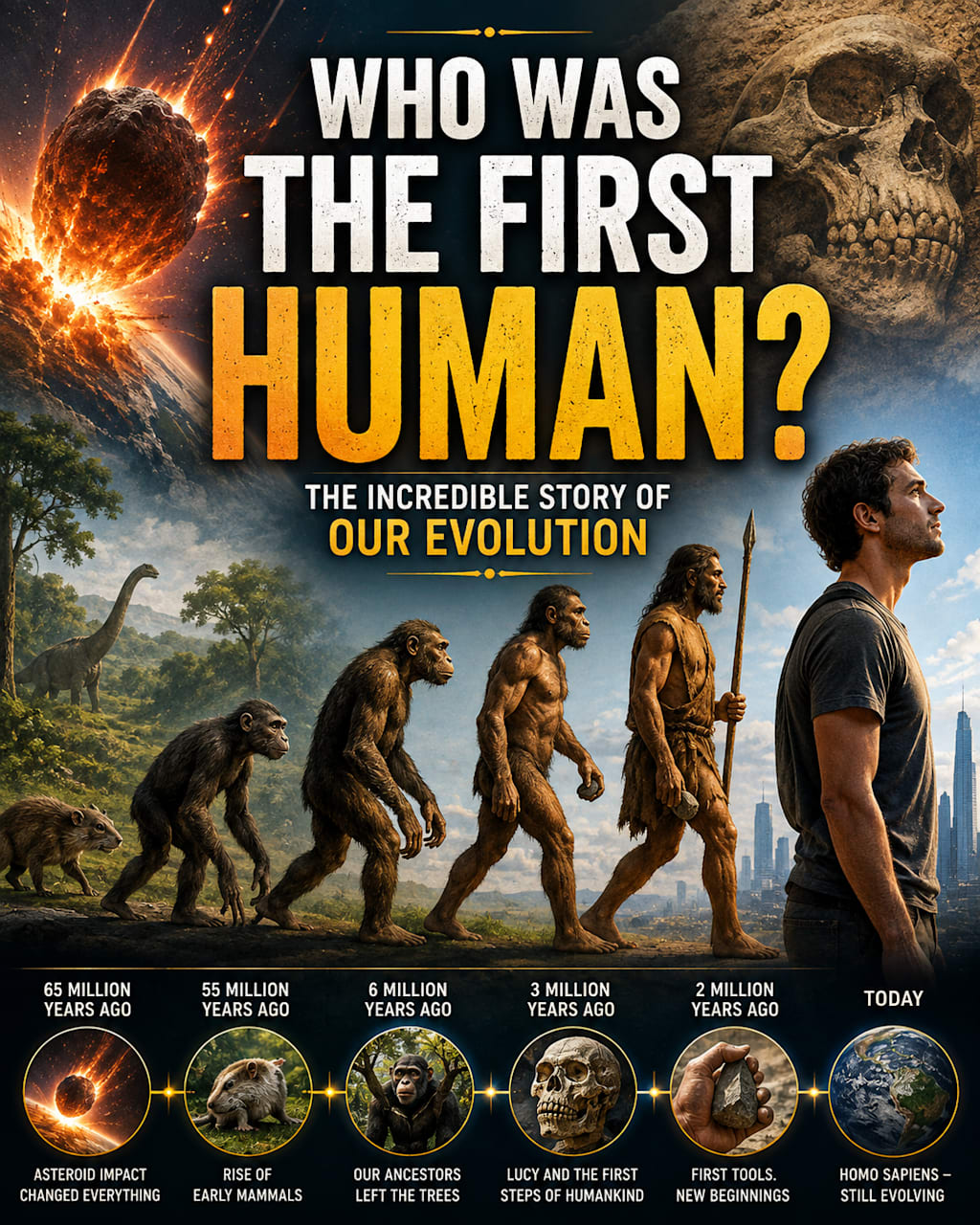
Where did humans come from?
It is one of the oldest and most fascinating questions in history. Were our ancestors really monkeys that slowly learned to stand upright, or is the truth far more complicated?
Many people believe that humans evolved directly from the monkeys we see today. However, evolution does not work like a straight ladder. Humans and modern apes are more like two branches growing from the same ancient tree. We share distant ancestors, but each branch followed a different evolutionary path.
Finding the “first human” is therefore not as simple as identifying one man or woman. Human evolution was a gradual process that unfolded over millions of years. There was no single morning when an ape-like creature suddenly woke up as a human.
To understand our origins, we must travel back approximately 65 million years—to a world ruled by dinosaurs.
The Disaster That Made Human Life Possible
Near what is now Mexico’s Yucatán Peninsula, a massive asteroid roughly ten kilometres wide crashed into Earth at an unimaginable speed.
The impact released an enormous amount of energy. Dust, ash and debris entered the atmosphere, blocking sunlight from reaching the planet’s surface. Temperatures fell, plants died and food chains collapsed.
Around 75 percent of life on Earth disappeared, including most dinosaurs.
It was one of the greatest disasters in the history of the planet. However, this tragedy also created an unexpected opportunity.
Had the asteroid never struck Earth, large reptiles might have continued dominating the planet. Mammals may never have received the chance to expand, diversify and eventually produce primates and humans.
While enormous animals struggled to survive, small mammal-like creatures hid beneath the ground, inside tree trunks and within protected areas. They were not especially powerful or intelligent, but they possessed one crucial advantage: adaptability.
Their small bodies required less food and energy. They could survive on insects, roots and whatever remained available during the dark period following the impact.
When the atmosphere slowly began clearing and sunlight returned, these survivors emerged into a transformed world.
The Rise of Early Mammals
With the dinosaurs gone, mammals entered a new evolutionary age.
These early mammals may have resembled small rats or shrews. Their warm blood and protective fur helped them survive changing temperatures. Over millions of years, their descendants developed into countless different species.
Whales swimming through the oceans, bats flying through the night, horses running across fields and humans building cities all belong to the mammalian family tree.
Approximately 55 million years ago, some mammals began adapting to life in trees. These early primates lived in the growing forests of Africa and Asia.
Tree life changed their bodies. They developed hands capable of holding branches and eyes positioned to provide better depth perception. Judging distance accurately helped them move between trees and later contributed to important human abilities such as hunting and toolmaking.
However, these creatures were still far from being human.
Another major environmental transformation was needed.
When Our Ancestors Left the Trees
Millions of years ago, geological changes began transforming Africa. Mountains formed, rainfall patterns shifted and large forested regions started becoming dry grasslands.
For tree-dwelling primates, this created a serious survival challenge. They could either remain inside shrinking forests or adapt to life on the ground.
Some gradually began standing upright.
One possible early member of the human evolutionary family was Sahelanthropus tchadensis, which lived around seven million years ago in what is now Chad.
Its skull still contained many ape-like features. However, the position where its spinal cord connected to its skull suggested that it may have been capable of holding its head above an upright body.
This does not mean it walked exactly like a modern human. It represents an early stage in a long evolutionary transition.
Standing upright may have allowed our ancestors to see across tall grass, carry food, protect children and travel longer distances. Most importantly, walking on two legs eventually freed the hands for other activities.
Did Darwin Say Humans Came From Monkeys?
Charles Darwin is frequently associated with the statement that humans came from monkeys. However, the idea is usually oversimplified.
Darwin’s argument was that humans and other primates likely shared common ancestors.
Imagine a tree splitting into multiple branches. One branch continues developing into various ape species, while another branch eventually produces early humans. Humans did not evolve from the monkeys currently living around us. Both groups inherited characteristics from much older ancestors.
Human evolution was not a straight line. It was a complicated tree filled with many branches, some of which survived while others disappeared.
Lucy and the Mystery of Walking Upright
One of the most important discoveries in human evolutionary history was made on November 24, 1974.
Donald Johanson and his team discovered the remains of an ancient female in Ethiopia. The skeleton was approximately 3.2 million years old and around 40 percent complete.
She became known as Lucy.
Lucy belonged to a species called Australopithecus afarensis. Her body contained a fascinating mixture of human-like and ape-like features.
Her hips and leg bones showed that she could walk upright on two legs. However, her long arms and curved fingers suggested that she could still climb trees, possibly to escape predators or sleep safely above the ground.
Lucy demonstrated something extremely important: our ancestors learned to walk upright before they developed large human brains.
Walking on two legs was not the final stage of becoming human. It was one of the earliest major steps.
The First Toolmakers
Approximately 2.4 million years ago, a species known as Homo habilis appeared.
The name is often translated as “handy man” because this species is associated with some of the earliest stone tools. By striking stones together, these early humans created sharp edges that could cut meat, break bones and process food.
The tools may appear simple today, but during that period they represented a revolutionary development.
Instead of depending entirely on natural teeth, claws or physical strength, our ancestors began using objects to increase their abilities.
They were no longer simply adapting their bodies to nature. They were beginning to adapt nature to their needs.
Fire Changed Everything
Later came Homo erectus, one of the most successful early human species.
Homo erectus had a more human-like body, walked efficiently on two legs and travelled beyond Africa into other parts of the world. Most importantly, it became associated with the controlled use of fire.
Fire offered warmth, protection from predators and light during darkness. It also transformed food.
Cooked food was softer, safer and easier to digest. The body did not need to spend as much energy breaking it down. This may have allowed more energy to support the development of a larger brain.
Fire also brought individuals together. People could gather around it, share food, protect one another and possibly communicate in increasingly sophisticated ways.
In many ways, the campfire may have become one of humanity’s earliest social spaces.
Why Human Babies Need So Much Care
The development of a larger brain created a serious physical challenge.
Walking upright changed the structure of the human pelvis, while the growing brain made babies’ heads larger. Human childbirth consequently became more difficult and dangerous than it is for many other animals.
A deer may stand and walk shortly after birth. A human baby remains dependent on adults for years.
At first, this appears to be a major weakness. However, dependence may have helped create one of humanity’s greatest strengths: cooperation.
A mother could not always protect and raise a vulnerable child alone. Families and communities needed to work together. This encouraged emotional bonds, shared responsibility, communication and social organisation.
Human survival became dependent not only on individual strength but also on the strength of the group.
We Were Not the Only Humans
Around 100,000 years ago, Homo sapiens were not the only humans living on Earth.
Neanderthals lived across parts of Europe and Asia. Denisovans occupied other regions, while smaller human species lived in isolated environments.
Different kinds of humans existed at the same time.
So why are Homo sapiens the only surviving human species today?
The answer may involve competition, environmental changes, migration and interbreeding.
Evidence from genetic research suggests that Homo sapiens and Neanderthals did not simply fight each other. They also formed relationships and had children together.
Many people with ancestry outside Africa still carry small amounts of Neanderthal DNA. Some inherited genetic traits may have helped early populations adapt to colder climates and unfamiliar diseases.
The disappearance of other human species was therefore not necessarily a story of complete replacement. In some cases, parts of them continued living within us.
The Power of Human Imagination
Physically, early Homo sapiens looked much like modern humans. But appearance alone did not make them capable of building civilisations.
The greatest transformation may have occurred in the mind.
Humans began creating art, decorating their bodies and burying the dead with care. They developed complex language and learned to communicate ideas that were not physically present.
They could speak about the future, unseen dangers, spiritual beings, tribal identities, laws and shared goals.
This ability to believe in common ideas allowed large numbers of strangers to cooperate.
A group of people could unite under the same story, symbol, religion or system of rules. Over time, this cooperation contributed to the rise of villages, kingdoms and civilisations in places such as Mesopotamia, the Indus Valley, China and Greece.
Human imagination became as important as physical strength.
There Was Never One “First Human”
So, who was the first human?
Science does not provide the name of a single individual because no clear dividing line existed. Every generation was only slightly different from the generation before it.
A child was always born to parents belonging to essentially the same population. But after thousands of generations, small differences accumulated into major evolutionary changes.
Humanity did not begin with one sudden birth. It emerged through millions of years of survival, adaptation, cooperation and environmental pressure.
We are descendants of tiny mammals that survived a planetary catastrophe. We carry the legacy of primates that learned to move through trees, ancestors who stood upright, toolmakers who shaped stone and explorers who controlled fire.
Our history is not a simple journey from monkey to human. It is a vast and complicated story filled with extinct relatives, environmental disasters, biological changes and extraordinary acts of adaptation.
Modern humans may use smartphones, explore space and build artificial intelligence, but the desire that guided our earliest ancestors remains alive within us—the desire to survive, understand and discover.
We are not separate from nature’s history.
We are one of its most remarkable chapters.
About the Creator
parwinder singh
🎬 Movie & Entertainment Writer sharing reviews, ending explanations, story breakdowns, plot twists and hidden details from Bollywood, Hollywood, South Indian cinema, Korean dramas and OTT releases.
Enjoyed the story? Support the Creator.
Subscribe for free to receive all their stories in your feed.
Comments
There are no comments for this story
Be the first to respond and start the conversation.