
Where the Ban on Pork in Islam Came From: The Reason Turned Out to Be Older Than the Qur’an
Why the Islamic ban on pork goes back not only to the Qur’an, but to a much older religious tradition.
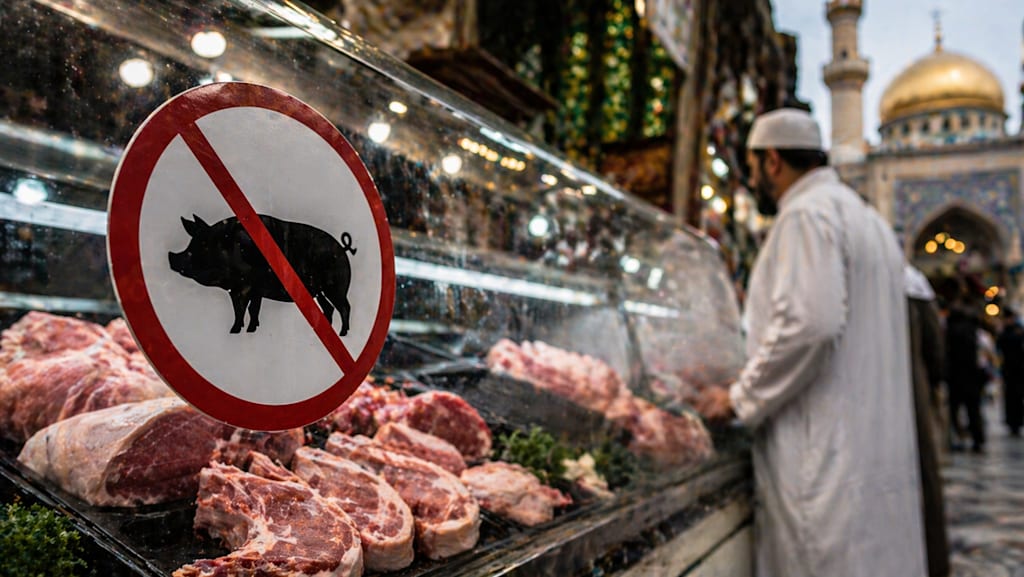
When a person first encounters Islamic dietary rules, the question of pork arises almost immediately. Why is chicken allowed, beef allowed, but pork forbidden? And why has this ban remained in place for 1,400 years? Many people explain it through heat, dirt, or disease. But the main reason is different: the prohibition is written directly into the Qur’an. And if you look more broadly, it becomes clear that this ban is older than Islam itself and goes back to a much older religious tradition.
What the Qur’an says
The ban on pork is mentioned in the Qur’an more than once. The best-known passages are in Surah Al-Baqarah (2:173), Al-Ma’idah (5:3), and An-Nahl (16:115). The meaning is the same in each case: Muslims are forbidden to eat carrion, blood, the flesh of swine, and anything slaughtered in the name of someone other than Allah. For a Muslim, that is already sufficient. The ban does not need to be additionally explained through medicine or everyday life. If the Qur’an says something is forbidden, then it is haram — prohibited.
This ban existed before Islam
Islam arose in the seventh century, but the ban on pork appeared much earlier. It already existed in Judaism, which means it is at least 2,500 to 3,000 years old. In the Torah, in the Book of Leviticus (chapter 11), clean and unclean animals are listed. The pig is called unclean because it has split hooves but does not chew the cud. It is stated directly there that its meat must not be eaten. Muhammad lived in Arabia, where there were Jewish tribes. So the very idea of dividing food into clean and unclean was not new to the region. Islam did not simply repeat Judaism, but entered the same Abrahamic tradition in which such a ban already existed.
What historians and archaeologists say
Historians and archaeologists trace the roots of this ban even deeper. In settlements of the ancient Kingdom of Israel, around 1000 BCE, pig bones are almost never found. Among neighboring peoples, however, such as the Philistines, they appear frequently. This matters because in the ancient world, food was not only a domestic issue, but also a way of separating “us” from “them.” People distinguished themselves from others partly through what they ate. So Islam did not introduce something entirely new here. It rather reinforced a rule that had already existed in the Middle East for a long time.
Why the explanation based only on sanitation does not work
People often say that the whole reason lies in the hot climate. Pork really can spoil quickly, and pigs can carry dangerous parasites, for example Trichinella, which causes trichinosis. All of that is true, and such factors may have strengthened aversion to pork. But sanitation alone does not explain the ban. If the issue were only meat preservation or parasites, then with the arrival of refrigerators, veterinary medicine, and modern kitchens, the prohibition would long ago have lost its meaning. That did not happen. For Islam, the ban remains a ban not because the meat is difficult to store, but because it is a religious command.
How Islam reinforced this prohibition
After the death of the Prophet Muhammad, Islamic scholars developed detailed rules of what is permitted and forbidden. The four main Sunni schools of law — Hanafi, Maliki, Shafi‘i, and Hanbali — are united on the question of pork. There was almost no disagreement here. Even when Muslims spread far beyond Arabia — into Persia, Syria, Egypt, and Spain — the ban remained. For example, in Muslim Spain there was plenty of pork around, because Christians ate it freely. But Muslims did not adopt that custom.
How it works today
Today, the ban on pork functions exactly as it did before. Muslims observe it both in countries where pork is an ordinary part of the diet and in countries where it is rarely found. In some states, the prohibition is also supported by law. In others, pork is sold, but separately and mainly with non-Muslims in mind. At the same time, Islam makes an exception for extreme situations. If a person is dying of hunger and there is no other food, he may eat what is otherwise forbidden in order to survive. This too is stated directly in the Qur’an, in Surah 2:173: if a person is compelled, then there is no sin upon him.
What it comes down to
The prohibition on pork among Muslims exists first of all because it is a direct command of the Qur’an. For Islam, that already settles the matter. But historically, the ban is much older. It existed in Judaism, was part of an older Near Eastern religious tradition, and, judging from archaeology, had taken shape long before Islam. Heat, parasites, and problems of preservation may have played a role, but they are secondary. They help explain why such a ban could take root, but they do not explain it fully. The main reason is that for Muslims, pork is not simply “undesirable” food, but religiously forbidden food.
About the Creator
Enjoyed the story? Support the Creator.
Subscribe for free to receive all their stories in your feed.
Comments
There are no comments for this story
Be the first to respond and start the conversation.