
What if Israel and Iran had never become enemies?
They had been quiet allies for thirty years. One man changed all that with a single speech. The world is still paying the price.

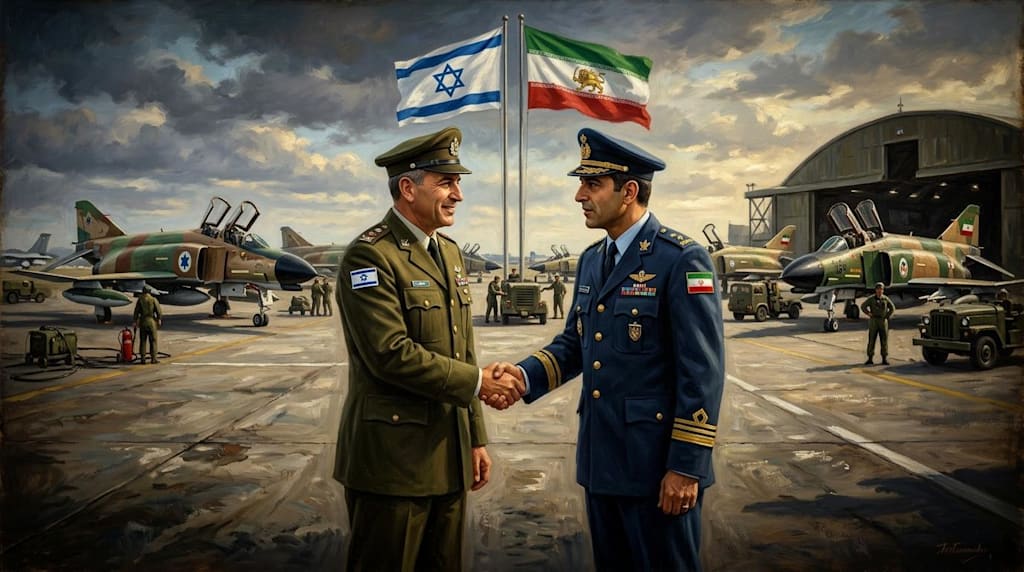
The Israeli Embassy in Tehran closed on 17 February 1979.
It had been open since 1950.
The staff left in a hurry. Files were burned. Within days, the building was handed over to the PLO. Yasser Arafat flew to Tehran in person to receive the keys.
Nobody in Washington expected it to last.
Yet it has now lasted forty-seven years.
What everyone forgets
When people think about Israel and Iran, they tend to think of the axis of confrontation: nuclear threats, proxy wars, drone strikes and rhetoric about wiping states off the map.
They do not think about Operation Flower.
In the mid-1970s, Israel and Iran were running a joint ballistic missile development programme. Israeli engineers worked inside Iran. Iranian officers were trained on Israeli bases. The two countries also shared intelligence on Soviet movements and Arab states that threatened them both.
It had a name. It had a budget. It produced results.
This was not a secret flirtation. Rather, it was a functioning strategic partnership between two non-Arab states in a region dominated by Arab nationalism. Israel needed Iran's oil and geographical location. Iran needed Israel's technology and its back channel to Washington.
The logic was so clear that a treaty was almost unnecessary.
Then Khomeini landed in Tehran.
The Hinge
Here's something about 1979 that history tends to skip over.
The revolution was not necessarily anti-Israeli. There were factions within it — nationalists, leftists and secular modernisers — who were not particularly interested in establishing enmity with Israel as a founding principle of the new state.
Khomeini chose to make it one anyway.
Not because Israel had wronged Iran. Nor because there was a territorial dispute or historic grievance. Rather, it was because anti-Zionism gave the revolution a global identity — a cause that resonated across the Muslim world and a unifying enemy that transcended Iran's internal divisions.
It was a political decision dressed as a religious one.
One speech. One framing. One night.
Now ask: what if he hadn't?
The Chain
A nuclear programme requires an existential enemy to justify its existence.
Without a nuclear programme, there are no sanctions. No sanctions means no economic isolation. This would mean 85 million educated young people, sitting on the fourth-largest proven oil reserves on Earth, would be plugged into the global economy instead of being cut off from it.
That would be a significant change.
It would be like rewriting the entire Middle East.
An Iran without sanctions would meet an Israel that had just invented drip irrigation and was building the foundations of what would become one of the world's most concentrated startup ecosystems. Israel also had agricultural and water technology that a large, arid country like Iran — which is water-stressed — desperately needed.
The money would flow. Engineers meet. Deals are signed.

What Breaks Next
Saudi Arabia's entire strategic value to Washington rested on scarcity.
It was the only stable, powerful and reliable partner in the region. You chose Riyadh because there was nobody else. Remove that scarcity, however, and give Washington a functioning Iran-Israel axis as an alternative anchor, and the calculation shifts.
Riyadh knows this. The oil weapon becomes more complicated. OPEC fractures differently. The petrodollar is under pressure, not because of hostility, but because the region no longer needs the same guarantees.
Go further.
Hezbollah is an Iranian project. Its funding, ideology and military doctrine all stem from revolutionary Iran, which has defined itself through opposition to Israel. Without this driving force, Hezbollah would not exist. But it would become something smaller. It would become a Lebanese political faction with militias and a complicated history rather than a regional force capable of opening a second front in any future war.
The weapons pipeline into Gaza would look different.
The regional architecture would look different, too.
None of this makes the Palestinian question disappear. Nothing can do that. However, the pressure system surrounding it — the external forces that have made it intractable for decades — has changed entirely.

The uncomfortable part
This is where the alternative history becomes uncomfortable.
A powerful Iran–Israel axis would not make the Middle East peaceful. It makes it a different kind of powerful place. Turkey recalculates. Iraq is squeezed from both sides. The Gulf states, suddenly less essential and more exposed, find themselves facing a region they can no longer control through oil leverage alone.
Power does not disappear when it is rearranged. It just takes on new forms.
And there is something else.
In this version of history, the Israeli-Palestinian conflict loses its most powerful external supporters. This could lead to pressure for a resolution. However, it could also mean that the stronger party, with fewer external constraints, moves faster and harder in the opposite direction.
Alternative history is not wish fulfilment. Remove one pressure and you will not achieve peace. You get a different set of pressures.

The real question: forty-seven years of confrontation. Hundreds of billions have been spent on proxy wars, sanctions enforcement, nuclear monitoring, missile development and regional destabilisation on both sides.
These are two countries that, within living memory, were running joint missile programmes and sharing intelligence.
The distance between that world and this one is not geographical. It is not religion. It is not ancient hatred.
It is one political decision made in a speech in February 1979 by a man who understood that a revolution needs an enemy to remain revolutionary.
He was right about that.
The question is what the cost was.
Both sides are still counting the cost.
About the Creator
Chronicle and Void
Every collapse has a cover story. Every war has a cause that didn't make it into the history books. History is not an accurate record of what happened. It's a record of what they allowed to survive.
Enjoyed the story? Support the Creator.
Subscribe for free to receive all their stories in your feed.
Comments
There are no comments for this story
Be the first to respond and start the conversation.