
Unit 731 Explained: Japan’s Secret WWII Human Experiments and Biological Warfare
Inside the horrifying history of Unit 731, Shiro Ishii’s secret Japanese military laboratory in Manchuria, where biological warfare and deadly human experiments were conducted during World War II.

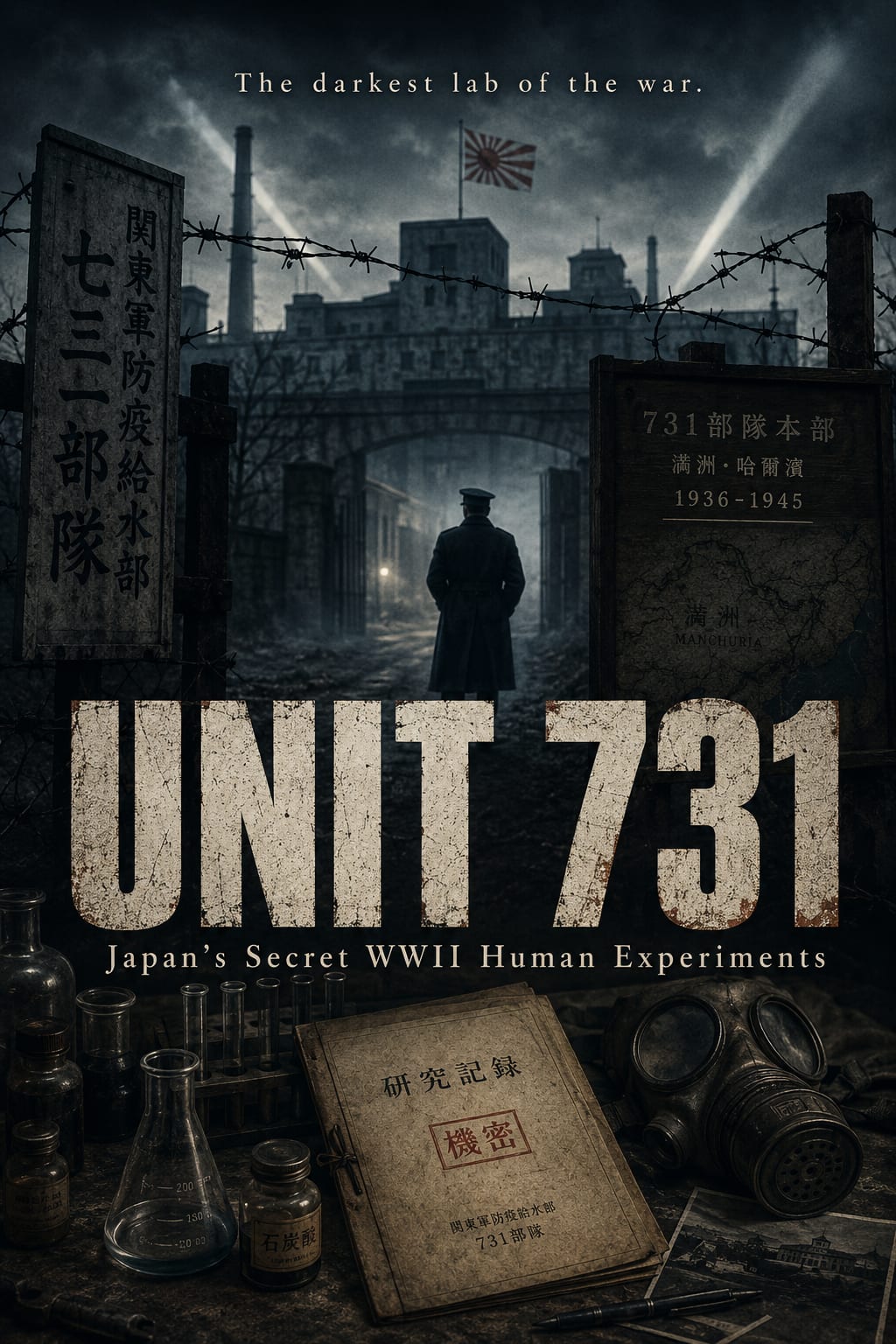
Wars are usually remembered through battles, tanks, bombs and soldiers. But some of the darkest chapters of war took place far away from the battlefield, behind locked doors where ordinary people became unwilling subjects of military experiments.
One of the most disturbing examples was Unit 731, a secret biological and chemical warfare program operated by the Imperial Japanese Army in occupied China.
Its activities have become one of the most infamous examples of unethical human experimentation during the Second World War.
What Was Unit 731?
Unit 731 was connected to Japan’s biological warfare program and operated primarily from the Pingfang district near Harbin in Japanese-occupied Manchuria, now part of northeastern China.
The program was led by Japanese military doctor and microbiologist Shiro Ishii.
Official records examined by the U.S. National Archives confirm that Ishii headed Unit 731 and that American investigators examined his biological-warfare experiments after World War II.
Although the organization operated under names connected with epidemic prevention and water purification, its secret activities went much further.
Researchers investigated diseases, biological weapons and the effects of extreme physical conditions on the human body.
And many of their subjects were not volunteers.
Why Did Japan Create Unit 731?
After World War I, military powers around the world were increasingly interested in new kinds of weapons.
Chemical warfare had already demonstrated how devastating non-conventional weapons could be. Biological weapons offered another terrifying possibility: instead of destroying an enemy with bullets or bombs, disease itself could potentially become a weapon.
Japan expanded its military presence in Manchuria during the 1930s, giving its researchers an isolated territory in which secret military programs could operate.
Shiro Ishii became one of the central figures in Japan’s biological-warfare research.
The secret complex eventually became known as Unit 731.
Human Experiments Inside Unit 731
This is the part of the story that makes Unit 731 so notorious.
Prisoners and civilians were subjected to medical and military experiments without meaningful consent.
Historical accounts describe prisoners being deliberately exposed to infectious diseases so researchers could observe how illnesses developed inside the human body.
Other experiments investigated extreme cold and frostbite.
People were exposed to freezing temperatures so Japanese military researchers could study tissue damage and possible methods of treatment.
There were also experiments connected with weapons and battlefield injuries.
The purpose was military research—but the human cost was enormous.
The National WWII Museum notes that thousands of Chinese and Korean civilians were subjected to gruesome medical experimentation by Unit 731.
Biological Warfare Experiments
Unit 731 was not simply a medical research center.
It was part of a wider Japanese effort to investigate biological warfare.
Researchers studied infectious agents and explored methods by which diseases could potentially be spread against enemy populations.
Declassified U.S. records contain extensive material relating to Japanese biological warfare, including documents associated with Unit 731 and wartime human experimentation. The U.S. National Archives says around 1,400 selected documents concern Unit 731, biological warfare experiments and biological attacks during World War II.
This means the story of Unit 731 is not simply based on wartime rumors. A substantial documentary record survives.
Who Was Shiro Ishii?
Lieutenant General Shiro Ishii was the Japanese military physician most closely associated with Unit 731.
He believed biological warfare could give Japan a powerful military advantage.
Under Ishii's leadership, research expanded into infectious diseases, biological weapons and human experimentation.
His name therefore became inseparable from Unit 731 and its atrocities.
U.S. archival records specifically mention postwar investigations of Ishii and his experiments as head of Unit 731 during the Sino-Japanese War and World War II.
What Happened When Japan Lost World War II?
Japan surrendered in August 1945.
As Soviet forces entered Manchuria, the secret biological warfare program began collapsing.
Evidence was destroyed and facilities were abandoned or demolished as Japanese personnel withdrew.
But the story did not end there.
Some members associated with Japan’s biological warfare program were captured by Soviet forces.
In 1949, twelve Japanese defendants were tried during the Khabarovsk war-crimes trials in the Soviet Union over biological warfare activities. U.S. archival material also records these proceedings.
Why Were So Many Unit 731 Figures Never Prosecuted?
This is one of the most controversial parts of the entire story.
After the war, both the Soviet Union and the United States were interested in information generated by Japan’s biological-warfare research.
Instead of the story ending simply with war-crimes prosecutions, geopolitical and scientific interests complicated the search for accountability.
Declassified American records show that U.S. military and scientific investigators questioned Ishii and investigated Unit 731 after the Japanese surrender.
The episode has therefore remained controversial not only because of what happened inside Unit 731, but because of what happened to those responsible afterward.
How Many People Died Because of Unit 731?
Exact casualty numbers remain debated.
Thousands are believed to have died directly in experiments conducted by Unit 731 and related facilities, while biological warfare operations in China may have caused many additional deaths.
Because wartime records were destroyed, incomplete or deliberately hidden, historians have struggled to produce one universally accepted total.
That is why extremely specific claims—such as exactly 500,000 deaths—should be treated cautiously unless accompanied by a clear scholarly source.
Unit 731’s Legacy
For decades, Unit 731 remained far less internationally known than many other atrocities of World War II.
That gradually changed as survivors spoke publicly, historians conducted further research and previously classified documents became available.
In 2018, Japan disclosed a list containing thousands of people associated with Unit 731, bringing renewed attention to the organization and its wartime activities.
Today, the surviving site in Harbin serves as a reminder of what can happen when scientific research becomes separated from medical ethics and basic human rights.
Why the Story of Unit 731 Still Matters
Unit 731 is more than a disturbing story from World War II.
It raises questions that remain relevant today.
How far should governments be allowed to go in the name of national security? What happens when scientific knowledge is pursued without consent or ethical limits? And should information obtained through atrocities ever be considered valuable enough to protect the people responsible for producing it?
Modern medical research is governed by ethical principles precisely because history has repeatedly demonstrated the consequences of ignoring them.
Unit 731 remains one of the darkest warnings.
Scientific progress without humanity is not progress at all.
About the Creator
parwinder singh
🎬 Movie & Entertainment Writer sharing reviews, ending explanations, story breakdowns, plot twists and hidden details from Bollywood, Hollywood, South Indian cinema, Korean dramas and OTT releases.
Enjoyed the story? Support the Creator.
Subscribe for free to receive all their stories in your feed.
Comments
There are no comments for this story
Be the first to respond and start the conversation.