
Trapped Behind the Iron Curtain: How One City Almost Started World War III
Berlin - the Epicenter of the Cold War

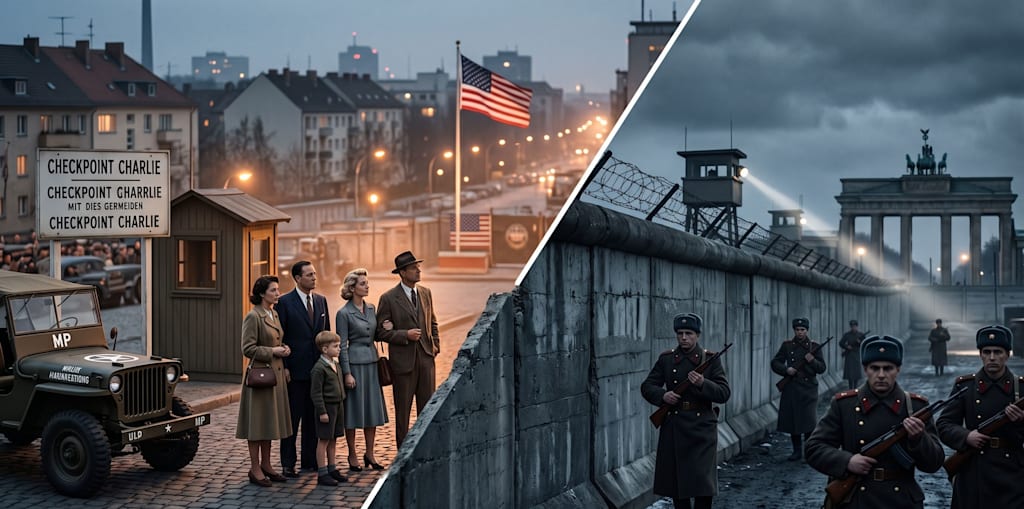
Before the rubble of World War II could even settle, a single overlooked detail in the division of Berlin transformed the ruined capital into the world's most dangerous nuclear powder keg.
The War Ends, The Standoff Begins
On the seventh of May 1945, Germany surrendered to Allied Forces, this would bring an end to the Second World War in Europe. The fight between fascism and the free world had ended. Now, the fight between capitalism and communism began. The city of Berlin was a hotspot and would not get a chance to recover from wounds of war before it would become the center of a new conflict known as the Cold War. After the fall of Nazi Germany, the disputed territory of Berlin played a crucial role in escalating political and military tensions during the Cold War due to major events and actions such as the city’s division, the Blockade of Berlin, and the construction of the Berlin Wall.
A Fatal Flaw: The Poorly Planned Partition
Dividing Germany’s capital into an east and west sector opened the door for hostilities in Berlin and set the precedent that Berlin would become the epicenter of tensions between the Soviets and the Americans. The split of the city was first drawn up during World War Two. The European Advisory Commission (EAC) would propose the plan to the Big Three, Roosevelt, Churchill, and Stalin and it would be approved at the Yalta conference in 1945. Berlin would be split into four sectors, one belonging to the United States, Great Britain, France, and the Soviet Union. Prior to this going into effect, the planning of division was poor, arguments between military and political leaders prevented collaboration and the nations involved never came to a complete agreement. This resulted in the occupants of West Berlin to overlook the most crucial aspects of the deal. How would they have access to Berlin? The Soviet Union occupied East Germany which surrounded Berlin. In Berlin on the Brink, Daniel F. Harrington discusses why this issue occurred. He says, “Yet the main reason why access seemed unimportant was that Westerners did not expect the Soviets to make trouble.” The issue that the planners focused on was not dealing with Russia, but rather preventing Germany from rising up again. This small issue that was overlooked made West Berlin vulnerable to being cut off from West Germany. A deal for access to Berlin would be made, but it would not hold up. In 1948, Stalin would order Soviet troops to cut off West Berlin from the western world leaving millions trapped.
Operation Vittles: The Siege and the Great Airlift
The Soviet entrapment of West Berlin increased the divide between the east and west and was the catalyst for political actions that would shape the rest of the century. The occupants of the three western zones in Berlin planned to merge their sectors and create a currency for all of West Berlin. The Soviets claimed that all of Berlin belonged to Eastern Germany and is under Soviet control. With the city surrounded, the west could leave and lose the city, forcefully push to West Berlin with a chance to start another war, or they could attempt to conduct an airlift operation to supply all of West Berlin. The Berlin Airlift began, also known as Operation Vittles, and was the west’s way of saying that they would not back down to Soviet pressure. During the eleven month blockade, The North Atlantic Treaty Organization (NATO) was formed to create an alliance that would serve as a balance of power against the Soviet Union and her satellite states. This alliance would put pressure on Eastern Europe and would later lead to the formation of the Warsaw Pact, which would be the opposition to NATO. The west’s resilience caused the blockade to be lifted. They sought to begin restoring their part of Germany and created a new government. The Soviets would respond and form theirs a few months later. Hans Speier explains this in his book Divided Berlin when he says, “In consequence, the Federal Republic of Germany emerged in the Western part of the country and the communist puppet regime of the so-called German Democratic Republic in the Soviet Zone.” West Berlin was the front line of the Federal Republic of Germany and would become the one place behind Winston Churchill’s “Iron Curtain” where people could escape from communist tyranny. Berlin would model the rest of Germany. The city would remain divided with no chance of uniting.
Standoff at Checkpoint Charlie: The World on the Brink
The Berlin Crises of 1958 and 1961 prevented progress from being made and would bring the world powers to the brink of war. In November of 1958, the Soviets put out an ultimatum calling for the western powers to demilitarize and leave Berlin within six months. This ultimatum created a lot of commotion within NATO when the Soviets stopped a U.S. convoy. Plans were put in place on how to combat the situation, in The Berlin Wall Crisis, the authors discuss President Dwight D. Eisenhower’s plan saying, “He argued instead for escalating political moves in which ‘gradual increasing of pressure such as withdrawal of Ambassadors, breaking of relation, issuing an ultimatum, etc. before major military action is resorted to.’ Only then would a political and military basis have been laid for coalition war.” This proves that tensions were building and the governments of NATO were prepared to slowly justify an escalation of force. Just three months after it began, the West’s resistance made the Soviets lift their ultimatum. During the Kennedy Administration, tensions rose and a new approach to fighting the Soviets was made focusing on conventional forces. President Kennedy asked for a $4 Billion defense budget and to move six more U.S. Army divisions to Europe. At this point people were fleeing from the east to the west, the German Democratic Republic built a wall to seal the border and stop the flow of people. The construction of this wall affected more than those trying to leave East Berlin. A U.S. official trying to reach the Embassy in East Berlin was stopped at Checkpoint Charlie. As a result, tanks were brought in and a standoff occurred for multiple days. The Berlin Wall had only been up for a month and was already proving to be an instigation for more conflict.
The Battle of Words: Arguments, Ultimatums, and Détente
The actions within Berlin were not the only events that escalated tensions, but simple discussions and attempts at negotiation about the city led to increased political pressure. Arguments over which side of Berlin was the capital of Germany and which new nation rightfully claimed Berlin created small conflicts to push at each other. The German Democratic Republic claimed that Berlin was the capital while the Federal Republic claimed that Berlin was the capital of all of Germany once it is reunited. These arguments over ownership of Berlin persisted and threats were made mainly from East Berlin. The Soviets saw the reunification of Germany as an attempt to get rid of the GDR. Relations between the world powers did not improve for nearly a decade and Berlin was still a contested area. Eventually, agreements were attempted to be made. It was not until the Nixon Administration that the escalation of tensions was throttled. The policy of Détente, or the ease of hostility, was adopted. President Nixon, with the help of Henry Kissinger, worked to develop the Four Powers Agreement also known as the Quadripartite Agreement on Berlin. The agreement was between the United States, Great Britain, France, and the Soviet Union and pushed to eliminate tensions. The guidelines said that all disputes should be solved in a peaceful manner and it laid down the rules for access to West Berlin from the Federal Republic ensuring that a blockade would not happen again. The agreement helped ease political tensions, but the city of Berlin remained divided. It would take eighteen more years of work and negotiations to tear down the Berlin Wall and reunite the city. Shortly afterward, West and East Germany merged to become a single German country.
The Symbol of a Divided World
Through the entire Cold War, Berlin served as the border between the western powers and eastern powers. The city was seen as a symbolic and strategic objective for both sides. To lose their foothold in Berlin would be seen as a sign of weakness. As a result, the events that played out in Berlin increased political tensions and threatened to start a conflict. Berlin would host many world leaders including U.S. Presidents and Soviet Premiers in an attempt to negotiate the fate of the city and settle disagreements. However, not until the Berlin Wall fell in 1989, did Berlin leave the spotlight of the Cold War. Berlin has been a crucial city throughout history and will be remembered as the city stuck in the middle of the Cold War.
Bibliography:
Gearson, John P. S., Schake Kori N., ed. The Berlin Wall Crisis : Perspectives on Cold War Alliances. New York : Palgrave Macmillan, 2002.
Harrington, Daniel F. Berlin on the Brink: The Blockade, the Airlift, and the Early Cold War. University Press of Kentucky, 2012.
Haulman, Daniel L. “Operation Vittles: The Berlin Airlift.” Air Power History 64, no. 3
(Fall 2017): 47–48. https://search.ebscohost.com/logon.aspx?direct=true&db=30&AN= 125094343&site=eds-live&scope=site.com (accessed April 6, 2019).
Reeves, Christopher. “Making the Best of a Bad Job?: The Nixon Administration and the 1971
Four Power Berlin Agreement.” Politeja, no. 32 (2014): 308. DOI:10.12797/Politeja.11. 2014.32.16 (accessed April 7, 2019).
Speier, Hans. Divided Berlin. The RAND Corporation, 1960.
About the Creator
Sam Shroyer
I am an active-duty Engineer Officer in the US Army with a BS in Environmental Engineering from West Point. My previous positions include the following:
- Assistant Training Officer
- Sapper Platoon Leader
- Company Executive Officer
Enjoyed the story? Support the Creator.
Subscribe for free to receive all their stories in your feed.
Comments
There are no comments for this story
Be the first to respond and start the conversation.