
Ticker tape parades.
The history of this iconic American celebration.


This beloved tradition, which dates back to 1886, is a classic celebration of achievement, where confetti and shredded paper, known as "ticker tape," are showered down upon the streets of Lower Manhattan to herald the triumphant return of a hero, whether it be a victorious sports team, a celebrated astronaut, or a ...hero.
The route is known as the "Canyon of Heroes," where more than 200 ticker-tape parades have been held.
The History of New York’s Ticker-Tape Parades
The history of these events is a long and fascinating one.
Ticker-tape parades evolved from New York City’s earliest public celebrations. In the colonial era, soldiers displayed their colors in ceremonial reviews. Following the American Revolution, parades commemorated events of national importance such as Evacuation Day and Independence Day. The city staged parades to mark the completion of the Croton Aqueduct, the Erie Canal, the Brooklyn Bridge and other great public works achievements of the 19th century. Parades sponsored by political parties, immigrant groups, and labor organizations became a regular feature of city life. Parades afforded more than just free entertainment; they helped unify a diverse immigrant population in a rapidly growing city. Ticker tape and skyscrapers added new excitement to New York City parades.
Invented in 1867, ticker tape was a one-inch-wide ribbon of paper on which the “ticker” machine recorded telegraphed stock quotes. Brokerage firms using the ticker machine proliferated in Lower Manhattan, then as now the City’s financial district, and provided an abundant supply of scrap paper. In the latter part of the 19th century, skyscrapers replaced low buildings and turned the narrow downtown streets into stone canyons. Office workers quickly discovered that ticker tape sent swirling into the air created a dramatic effect. Contemporary accounts of the earliest ticker-tape parades describe the cascade of scrap paper as a spontaneous gesture on the part of spectators inspired by the festivities outside their windows. As the practice grew, city officials recognized the promotional value of ticker-tape parades and began to plan them as a function of municipal government. From 1919 to the present day, the mayor of New York City has decided who will receive a ticker-tape parade.
The first officially organized ticker-tape parades welcomed home the victorious soldiers of World War I. New York City customarily greeted important foreign visitors with great fanfare. In the 1920s, with ticker tape seen as a modernization of the ancient ritual of strewing flowers before conquerors, it became routine to hail arriving heads-of-state with a paper shower. The city started a tradition of recognizing champion athletes with the ticker-tape parade for the American Olympic team in 1924. The massive reception for pioneering aviator Charles Lindbergh in 1927 attracted millions of spectators to lower Manhattan, and made the ticker-tape parade famous around the world.
The city staged 130 ticker-tape parades from 1945 to 1965. More than half of these events greeted visiting heads-of-state, usually at the request of the U.S. State Department. Often times these parades were direct or indirect extensions of U.S foreign policy objectives — particularly at the height of the cold war. Patriotic display, an important element in all parades, prevailed in ticker-tape receptions of this era. Returning World War II leaders, troops sent to fight in Korea, retiring high-ranking military personnel and foreign dignitaries all received ticker-tape parades that prominently featured men and women of the armed services during this period.
The city perfected the art of an efficient ticker-tape parade during this period, when as many as three were held in one week (May 8-10, 1950). Coordinated by the Mayor’s Office, with assistance from the Police Department and other New York City municipal agencies, the parades formed at the Battery. This practice dated from the time when travelers to the city arrived via ocean liner. The parade started at noon in order to take advantage of lunch-hour crowds. Marching bands from one or more branches of the military service, or from departments of city government, led the parade. Accompanied by the City’s chief of protocol, and escorted by motorcycle-riding New York City police officers, the featured guest rode up Broadway in an open limousine. A luncheon banquet at a mid-town hotel usually followed the City Hall ceremony.
By the early 1960s, there had been so many ticker-tape parades that they came to be viewed as synthetic and routine. The city had to deliver confetti and shredded paper to buildings along Broadway to ensure an appropriate cascade of paper for the occasion. Businesses in lower Manhattan complained of disruptions. The parades seemed anachronistic to many Americans who were beginning to question authority.
When Mayor John Lindsay, New York’s youthful new mayor, took office in 1966, he announced that his administration would discontinue the ticker-tape parade in favor of more informal receptions tailored to the special interests of the guest. Lindsay did not give up parades completely. The spectacular success of America’s Apollo space program cried out for ticker-tape celebrations. Lindsay happily obliged a jubilant city on two occasions. He broke with tradition, however, and rode with the Apollo astronauts in their motorcades. Previous mayors had waited at City Hall to greet the guests who were escorted up Broadway by the City’s chief of protocol.
As the 20th century drew to a close, the ticker-tape parade regained some of the excitement and spontaneity of its earlier years. Lindsay’s 1969 parade for the World Series champion Mets established a new tradition for baseball teams who won the World Series. The parades for the Korean and Vietnam war veterans, though organized many years after the fact, acknowledged a growing revival in patriotism. The parade for the Gulf War soldiers recalled the custom of welcoming home the troops. The numbers of spectators, estimated in the millions, thronging lower Manhattan to hail the sports stars of recent years, have not been seen since the days of the aviators in the 1920s. After more than a century, the New York City ticker-tape parade remains a phenomenon familiar throughout the world.
Canyon of Heroes.
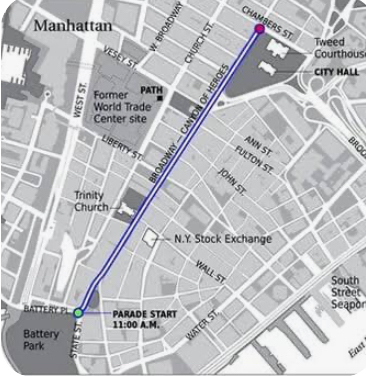
Since 1886, New York City has honored politicians, generals, organizations, military veterans, athletes, and others with ticker-tape parades. Parades are traditionally held along a section of Broadway, known as the "Canyon of Heroes", from Battery Park to New York City Hall. Beginning in the early 2000s, each of the ticker-tape parades has been commemorated by the Alliance for Downtown New York with a granite strip located on the sidewalks along the parade route, which is inscribed with the date of the parade and a brief description. The eight-inch-wide (20 cm) and three-inch-deep (7.6 cm) granite strips have two-inch (5.1 cm) stainless steel letters; markers have been installed for 200 parades.
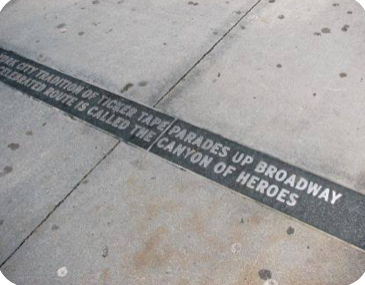
Canyon of Heroes is a celebrated 1-mile stretch of Broadway in Lower Manhattan, running from Battery Place to City Hall in the Financial District. It is famous as the traditional route for New York City's historic ticker-tape parades and is permanently marked by over 200 granite plaques embedded in the sidewalks.
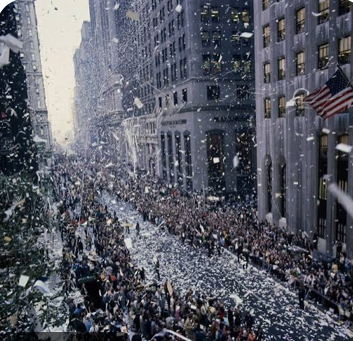
Origins and NamingThe name "Canyon of Heroes" is a play on the route's environment. The "canyon" refers to the towering skyscrapers and dense buildings of the Financial District that enclose the street. The "heroes" represent the dignitaries, astronauts, military veterans, and championship sports teams honored with parades.Sidewalk MemorialsTo commemorate the tradition, the Alliance for Downtown New York installed black granite and stainless-steel plaques in the sidewalks along Broadway.Details: Each plaque lists the name of the honoree and the date of their historic parade.
Placement: The plaques are arranged in chronological order, spanning from the south (Battery Place) toward City Hall.Blank Strips: The sidewalks include several blank placeholders for future parades.
About the Creator
Guy lynn
I’m interested in history, space travel and the possibilities, Americana,( where I live now), Africa (Southern Africa, where I was born and raised), and I write about things that interest me ( bead history) and I hope will interest you.
Enjoyed the story? Support the Creator.
Subscribe for free to receive all their stories in your feed.
Comments
There are no comments for this story
Be the first to respond and start the conversation.