
They Said Einstein Was ‘Useless’... Until THIS Happened
They Said Einstein Until THIS Happened

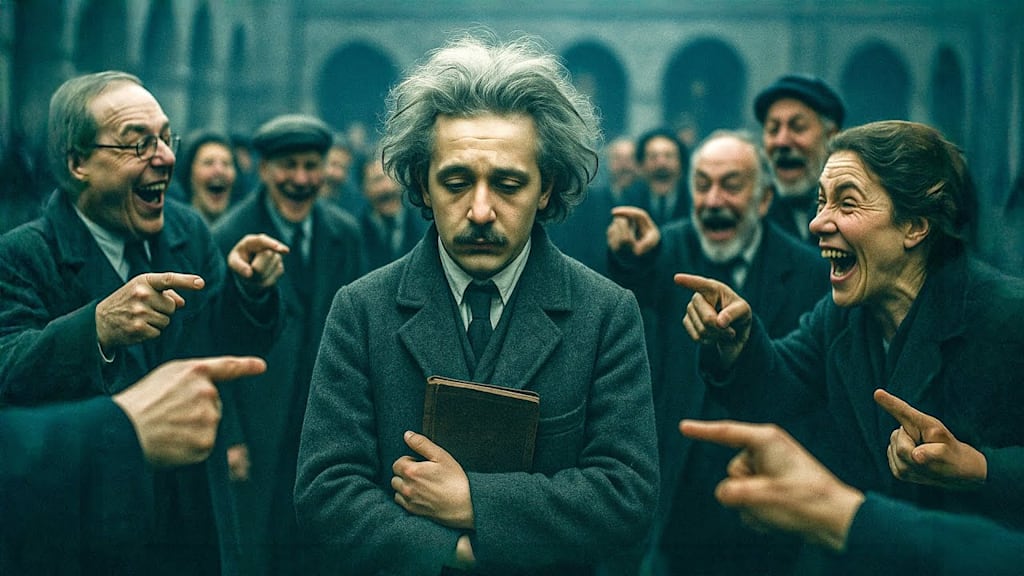
Albert Einstein, whose theories changed the world of science forever, once went through a period where he struggled for 9 years just to find a job. In fact, among all his classmates, he was the only one who remained unemployed.
Who could have imagined that the boy considered the slowest learner in school would one day receive an offer to become the President of Israel?
Einstein was born in 1879 in the city of Ulm, Germany. As a child, people saw him as unusual because he wasn’t like other kids. He was a slow learner, started speaking late, and teachers considered him an average or weak student.
But the real reason was different: Einstein looked at everything with curiosity. Instead of memorizing things, he tried to understand concepts deeply. Because of this, he often lagged behind in school.
He was creative from an early age—something that seemed like a weakness at first but later became his greatest strength.
Einstein’s early education took place in Munich, but he disliked the strict German schooling system. Eventually, he left school and moved to Switzerland with his family to pursue a more liberal education.
He wanted to study physics and mathematics at the Zurich Polytechnic. In the entrance exam, he solved the math and physics sections easily, but failed badly in other subjects like literature and politics.
A professor, impressed by his math and physics answers, asked where he had learned all that. Einstein replied that he had taught himself.
Still, he was told he needed to spend another year preparing other subjects before he could be admitted. He did so, and the next year, he finally passed and got admission.
Even in college, Einstein’s habits didn’t change. He skipped boring lectures, studied on his own, and didn’t try to impress professors.
As a result, when he graduated in 1900, his professors refused to recommend him for jobs. At that time, recommendations were crucial for academic careers.
Although Einstein was brilliant, he had no strong references or mentors. His classmates, who were academically weaker, secured good positions because they had support from professors.
Einstein applied everywhere—universities, schools, research institutes—but was rejected repeatedly.
In his letters and diary, he expressed frustration:
“It feels like the world has no need for me.”
“Every door seems closed.”
In a letter to his girlfriend Mileva Marić, he wrote:
“I feel like I have become a useless person. I live only for physics, but the world listens only to those who fit into its system.”
This period affected his personal life too—financial struggles, stress in relationships, and self-doubt.
Eventually, he worked as a private tutor. Later, on a friend’s advice, he applied for a job at the patent office in Bern.
In 1902, he got the job as a patent examiner. It was a low-level government job, but it provided stability.
While working there, he continued his research during nights and weekends.
Then came 1905, his “miracle year.” He published four groundbreaking papers:
Special Relativity
Photoelectric Effect
Brownian Motion
Mass-energy equivalence (E = mc²)
These works revolutionized science and made him famous across Europe.
In 1909, nine years after graduating, he finally got a job as an assistant professor at the University of Zurich.
Later, Einstein moved to the United States after Adolf Hitler rose to power in Germany, as Einstein was Jewish.
He became a professor in Princeton and gained global recognition—not just as a scientist but also as a cultural and political figure.
In 1952, after the death of Israel’s first president Chaim Weizmann, Einstein was offered the position of President of Israel.
The offer was conveyed through a letter sent by Abba Eban on behalf of Prime Minister David Ben-Gurion.
Einstein declined the offer.
In his reply, he wrote that he was deeply moved but could not accept it. He said:
He had spent his life dealing with objective matters (science)
He lacked the experience and ability to deal with people and official responsibilities
At age 73, he felt he was not suitable for political leadership.
He also didn’t want to be in a position where he might have to make decisions that went against his conscience.
Eventually, Yitzhak Ben-Zvi became Israel’s second president.
About the Creator
Imran Ali Shah
🌍 Vical Midea | Imran
🎥 Turning ideas into viral content
✨ Watch • Share • Enjoy
Enjoyed the story? Support the Creator.
Subscribe for free to receive all their stories in your feed.
Comments
There are no comments for this story
Be the first to respond and start the conversation.