
The Wicked Wife Who Probably Wasn’t
History’s favourite villain

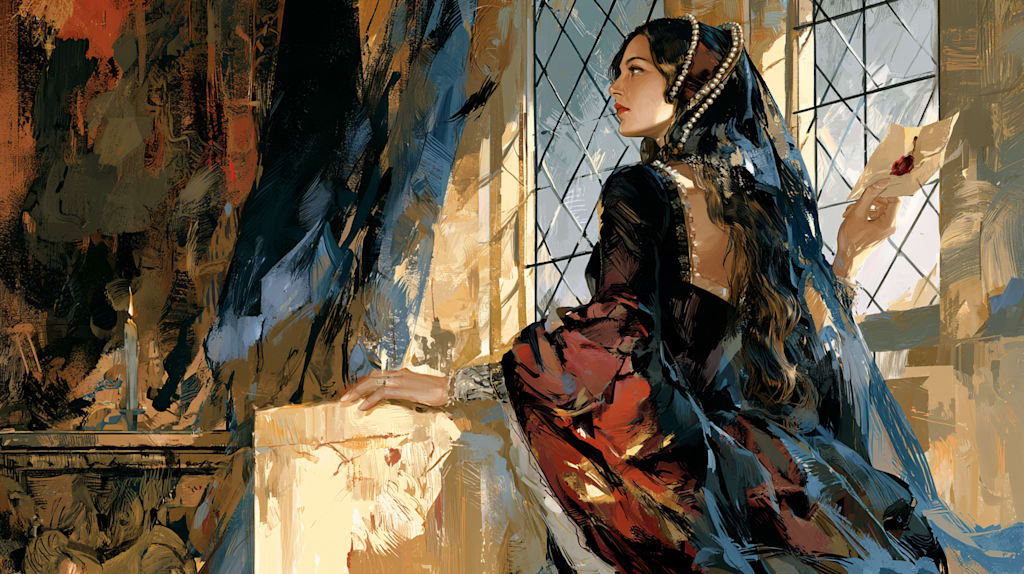
400 years ago, Jane Boleyn became the most despised female at the Tudor court without ever wearing a crown. Most people will recognize her from novels and/or TV shows where she is usually hiding behind a tapestry. The jealous sister-in-law who reported to Thomas Cromwell that her husband George had been having an affair with his sister, Queen Anne.
Most versions portray her as saying this out of spite due to her cold marriage and her inability to tolerate the bond between the two siblings. In total, two individuals lost their heads, and five men were executed along with them. The above is a nice, neat little story, often repeated.
However, once you begin to research where it originated from, it quickly unravels in your hands. From a family of scholars, Jane Parker was born in approximately 1505. Her father, Henry Parker, Lord Morley, translated Petrarch and provided the Royal Family with manuscripts as New Year's gifts.
Jane arrived at Court at a young age and married George Boleyn either in 1524 or 1525. King Henry VIII provided the newlyweds with a manor house in Norfolk as a wedding gift. As the Boleyns ascended socially, so did Jane. She served Anne as one of her ladies-in-waiting, and we have evidence indicating that Jane acted in her best interests.
For example, in 1534 she was temporarily removed from Court for assisting Anne in a plot to rid Henry VIII of one of his many mistresses. That is certainly an unusual action for someone whom you despise. When everything fell apart in the spring of 1536, Anne was arrested, then George, then four other men.
The charges included adultery, treason and, in George's case, incest with his own sister. Historians now generally agree that these charges were fabricated. So who provided testimony? This is what angers me. At the time of Anne's execution, numerous writers pointed fingers at other women. A courtier named John Husee believed that the information came from the Countess of Worcester. The judge John Spelman identified Lady Wingfield. A French poet named Lancelot de Carles told a tale of a woman who, upon receiving a scolding from her brother concerning her own loose conduct, retorted that the queen behaved much worse. That woman was Lady Worcester. The Imperial Ambassador Eustace Chapuys, who was enjoying the demise of the Boleyns and wished to identify a treacherous wife, did not identify Jane as the informant against George and Anne.
The accusation against Jane does not appear until several decades later, written by authors who did not reside during the events. John Foxe inserted a footnote into the 1576 edition of his Book of Martyrs stating that it was "reported of some" that Lady Rochford produced a fraudulent letter. This sentence implies a great deal. Noticeably absent from Foxe's original 1563 edition.
George Wyatt, born in 1553, wrote a biography of Anne in which he alleged that Jane was the accuser of her own husband, yet he subsequently contradicted himself by stating that George was executed based on a technicality of statute law. By the eighteenth century, authors were readily labeling Jane as scandalous and infamous without verifying any claims. There is some evidence which may connect to Jane. George was accused of repeating a comment regarding King Henry VIII's lack of sexual energy. Allegedly, Anne had revealed this fact to Jane. Regardless of whether Jane was the originator, discussions between sisters-in-law concerning King Henry VIII's sexual performance are vastly different from concocting an accusation of incest. In a court where Thomas Cromwell's agents were interrogating each woman in Anne's household, it is plausible to envision a fearful young widow-in-waiting inadvertently revealing more than intended and having it distorted.
Additionally, while George was imprisoned in the Tower of London, Jane forwarded him a message inquired about his well-being and pledged to intercede with King Henry VIII on his behalf. These actions are difficult to reconcile with a woman desiring her husband's demise. Jane escaped the year 1536 without coming to any harm, and has subsequently been viewed negatively as a result of her survival. Jane then continued to serve Jane Seymour and attended her funeral as one of the primary mourners.
Subsequently, Jane served Anne of Cleves, followed by Katherine Howard, a young queen wedded to an aging, ulcerated monarch. It is at this juncture that Jane made a grave error. She facilitated Katherine Howard's clandestine meetings with Thomas Culpeper, a young man from King Henry VIII's Privy Chamber.
No one understands why Jane assisted Katherine Howard in this endeavor. Perhaps she was commanded to do so. Perhaps Jane believed she was protecting her. When news of the affair became public in November 1541, Jane was apprehended and incarcerated in the Tower of London.
While imprisoned, Jane suffered a breakdown. Accounts from the period describe her losing her mental faculties entirely. Under prevailing laws, a mentally incapacitated individual could not be executed; consequently Parliament amended existing legislation. A new law permitted traitors who had lost their mental faculties to be put to death regardless.
On February 13, 1542 Jane was executed on Tower Green; the same morning as Katherine Howard, on the scaffold where Anne had died six years earlier. You may recall Jane Boleyn's alleged final words wherein she confessed that she had lied about George and Anne and deserved to perish for doing so. They provide an ideal conclusion for the malicious wife story.
However, they represent a fabrication. Historians attribute those words to Gregorio Leti, a seventeenth-century author who invented some of his sources. We possess only one authentic eyewitness account written by Ottwell Johnson, a London merchant, two days after Jane's execution. He writes that both women accepted their fate as Christians, confessed that they were sinners and prayed for King Henry VIII. He makes no reference whatsoever to Anne or George.
She was interred within the chapel of St Peter ad Vincula located several yards from the husband whom she presumably delivered to his demise. In part, this story exists due to convenience in creating a narrative arc. Anne Boleyn's downfall requires a villain other than King Henry VIII, and a spiteful wife is far simpler to write than a governmental structure capable of transforming any woman's innocuous comment into a death warrant. In part it exists because Jane did indeed contribute to Katherine Howard's downfall, and once you have committed one such act, people will accept anything you say as fact. Julia Fox spent years studying Jane's life and concluded that Jane has become a scapegoat. Not all historians agree with Foxe's assessment; therefore, the most honest truth is that we do not know what Jane stated in May 1536 nor to whom. The case against her was constructed many years after her demise by individuals who never met her and repeated until it appeared as factual.
About the Creator
Daisy Fernsby
I’ve spent years writing about the natural world, and I still get a thrill from a fact that changes how someone sees an animal. History pulls at me just as hard, especially the Tudor and medieval world with all its scandal and consequence.
Enjoyed the story? Support the Creator.
Subscribe for free to receive all their stories in your feed. You could also become a paid subscriber, letting them know you appreciate their work.
Comments
There are no comments for this story
Be the first to respond and start the conversation.