
The Solitude of Robert Frost
A Life built by Loss, Silence, and the Search for Home

Most people remember Robert Frost as the elderly poet with white hair who spoke in a steady voice about the American countryside. He seemed comfortable before an audience, and his poems carried the ease of someone who understood the rhythm of country life. That image became part of his legacy. Another Robert Frost lived beneath it, a man who spent much of his years carrying sorrow that never wandered far from his thoughts.
He entered the world on March 26, 1874, in San Francisco, California. His father, William Prescott Frost Jr., worked as a journalist with strong political convictions, while his mother, Isabelle Moodie Frost, loved literature and encouraged her son to read from an early age. Childhood changed forever when tuberculosis claimed his father's life. Robert was only eleven years old.
His mother gathered the family and traveled across the country to Lawrence, Massachusetts, where Robert's grandparents welcomed them into their home. The move left a lasting impression. New England became the landscape that settled deep within him, later finding its way into many of the poems that readers would come to treasure.
School introduced him to Elinor White, a thoughtful young woman who shared his love of books. Their friendship slowly became something deeper, and they married in 1895, believing determination and hard work could build a meaningful life together.
Before recognition ever arrived, Frost struggled through one occupation after another. He taught school, edited newspapers, repaired shoes, and worked a small New Hampshire farm. The work demanded long days, though the income rarely matched the effort. Evenings often ended with tired hands, unpaid bills, and another poem waiting to be written.
Frost graduated from Lawrence High School in 1892, earning the honor of class poet while sharing the title of co-valedictorian with his future wife, Elinor White. Two years later, a small breakthrough arrived. The New York Independent accepted his poem, "My Butterfly," making him a published poet for the first time. A check for $15.00 accompanied the acceptance, an amount worth roughly $700 to $750 today. The payment meant far more than money. It offered proof that someone beyond his own family believed his words deserved a place in print.
Even after that first success, publishers showed little interest in his work. One rejection followed another. Frost continued writing, convinced the poems deserved a reader somewhere beyond the next envelope.
By the time he reached thirty-eight, disappointment had grown heavy enough that he made a remarkable decision. He sold the farm, gathered Elinor and their children, and sailed for England, hoping another country might offer opportunities America had overlooked.
England changed everything.
His first collection, A Boy's Will, appeared in print soon after his arrival. North of Boston followed, earning praise from respected poets including Ezra Pound. During those years he formed a close friendship with Edward Thomas. Their long conversations while walking through the English countryside shaped both men as writers. Many literary scholars believe those walks inspired "The Road Not Taken," one of the best-known poems in American literature.
When Frost returned home in 1915, he arrived as an accomplished poet rather than an unknown farmer carrying unpublished manuscripts. Colleges invited him to teach. Audiences filled lecture halls wherever he spoke. His books sold well, and recognition continued to grow until he earned four Pulitzer Prizes for Poetry, a record that placed him among the greatest poets in American history.
Financial hardship slowly disappeared. Royalties from his books, university appointments, public readings, and speaking engagements provided a comfortable living after decades of uncertainty. The young husband who once worried over every dollar eventually became one of America's most respected literary voices.
Recognition never protected him from heartbreak.
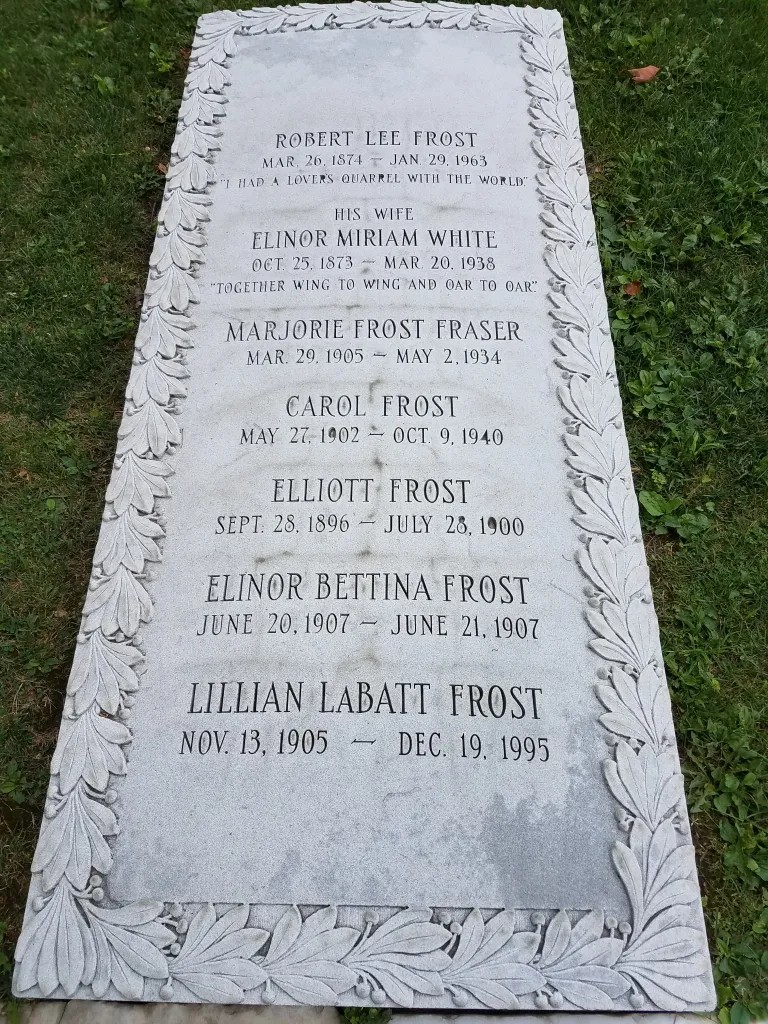
His son Elliott died from cholera at the age of four. His daughter Elinor lived only a few days. His daughter Marjorie died following childbirth. His son Carol died by suicide in 1940. Another daughter, Irma, struggled with severe mental illness throughout much of her adult life. Then came the loss that reached deepest into his heart. Elinor, his wife of more than forty years, died in 1938. Every passing left another space that could never again be filled.
During the closing years of his life, Robert Frost stood among the nation's most admired writers. In January 1961, President John F. Kennedy invited the eighty-six-year-old poet to participate in the presidential inauguration. The moment became one of the most memorable literary appearances in presidential history.
Robert Frost died in Boston on January 29, 1963, at the age of eighty-eight from complications following prostate surgery.
He rests beside Elinor in Old Bennington Cemetery in Bennington, Vermont. Visitors continue leaving pencils, handwritten notes, and small stones near his grave, quiet expressions of gratitude from readers whose lives found comfort in his words.
Readers often remember Robert Frost as the poet who wrote about nature. Looking across his life reveals something richer. His poems grew from years of perseverance, family devotion, quiet endurance, and grief that never fully released its hold. Solitude remained a faithful companion from childhood until his final days, shaping the voice that continues to echo through American literature more than a century after he first placed pen to paper.
-*-*-*-
Robert Frost intended to read a new poem titled "Dedication" at President John F. Kennedy's inauguration on January 20, 1961.
The bright sunlight reflecting off the snow made it impossible for the 86-year-old Frost to read the typed pages, even after Vice President Lyndon B. Johnson tried to shield them from the glare. Rather than struggle through it, Frost recited "The Gift Outright" entirely from memory.
The Gift Outright
By Robert Frost
The land was ours before we were the land’s.
She was our land more than a hundred years
Before we were her people. She was ours
In Massachusetts, in Virginia,
But we were England’s, still colonials,
Possessing what we still were unpossessed by,
Possessed by what we now no more possessed.
Something we were withholding made us weak
Until we found out that it was ourselves
We were withholding from our land of living,
And forthwith found salvation in surrender.
Such as we were we gave ourselves outright
(The deed of gift was many deeds of war)
To the land vaguely realizing westward,
But still unstoried, artless, unenhanced,
Such as she was, such as she would become.
About the Creator
Tim Carmichael
Let your becoming be louder than your fear, and your smallest steps become the road you once thought impossible to walk. An Appalachian poet and cookbook author my book Beautiful and Brutal Things is on Amazon, Link 👇
Enjoyed the story? Support the Creator.
Subscribe for free to receive all their stories in your feed. You could also become a paid subscriber, letting them know you appreciate their work.
Comments
There are no comments for this story
Be the first to respond and start the conversation.