
The Skull of a Great Composer: How Haydn Spent Almost 150 Years Buried Without His Head
How Joseph Haydn’s skull was stolen in the name of science, hidden for decades, and returned to his tomb only after 145 years.
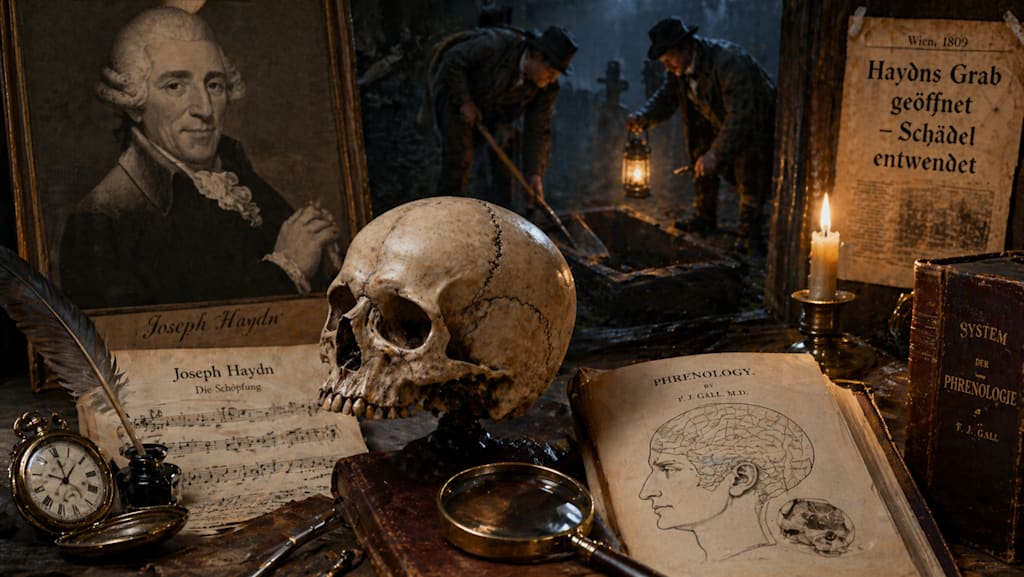
A great composer dies and is buried in Vienna with little ceremony: war is raging, and the city is occupied by French troops. A few days later, the grave is opened, the body is decapitated, and the skull is taken away. And this is done not for ransom, not out of revenge, and not out of hatred. Joseph Haydn’s head was stolen because of a fashionable obsession of the time — phrenology. That is how Haydn’s posthumous fate turned into a story of theft, substitution, searches, collectors, and a very late reunion of body and head.
How Haydn died
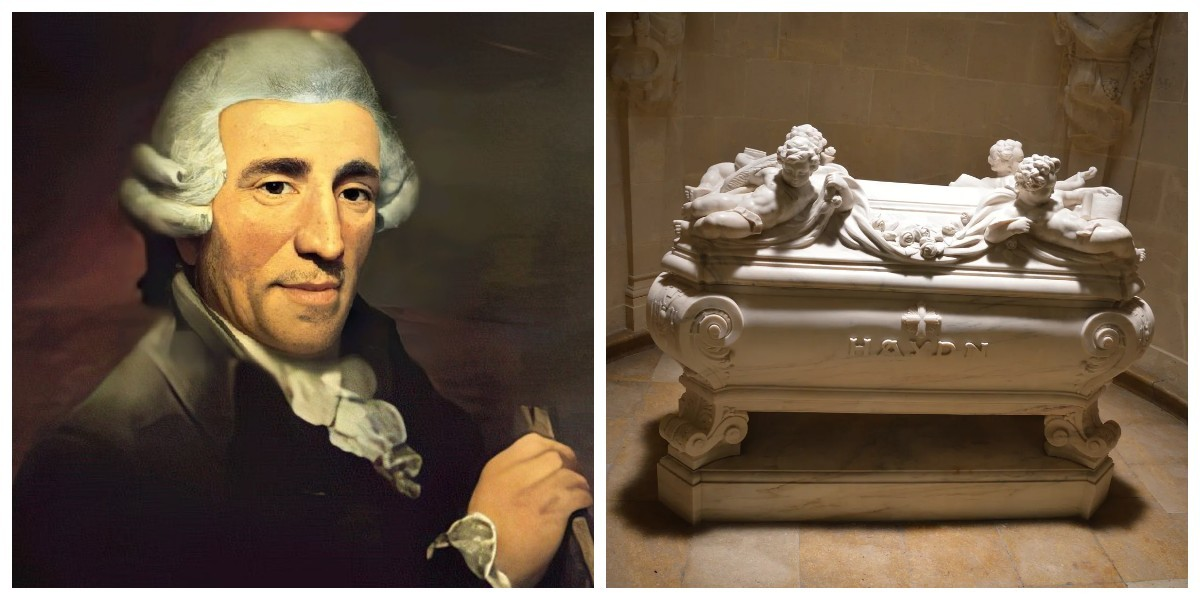
Joseph Haydn died on May 31, 1809, in Vienna. He was 77 years old. The circumstances were grim. Austria was at war with Napoleon, and French troops had occupied Vienna. Because of that, the composer’s first burial was more modest than one might expect for a man of his stature. Haydn was buried at the Hundsturm cemetery in Vienna. But soon after the funeral, the grave was opened. The head was separated from the body and taken away.
Why anyone wanted the skull of a composer

The reason was phrenology. In the early nineteenth century, many educated people took it seriously. Phrenologists believed that a person’s abilities could be “read” from the shape of the skull. Today it is considered a pseudoscience. But at the time, phrenology seemed to many almost like advanced knowledge. Haydn’s skull was especially interesting to such people. If a man was a great composer, then his skull, they thought, should show a special area responsible for musical talent. This was sometimes called the “bump of music.” So Haydn’s head was not stolen as an ordinary relic. It was stolen as “material” for the study of genius. That is the most unpleasant part of the story: respect for talent easily turned into disrespect for the dead man himself.
Who stood behind the theft
Two names are usually mentioned. The first is Joseph Carl Rosenbaum, a former secretary to the Esterházy family. This family had been Haydn’s main patron: the composer served the Esterházy princes for many years. The second is Johann Nepomuk Peter, an official connected with the prison administration. He too was interested in phrenology. According to the best-known version, the gravedigger was bribed. The grave was opened, the head was separated from the body, and it was handed over to those who wanted to examine the skull.
Why the disappearance was noticed only 11 years later
The strangest thing is that the theft remained hidden for a long time. In 1820, Prince Nikolaus II Esterházy decided to move Haydn’s remains to Eisenstadt, where the Esterházy family residence was located. The composer was to be buried more honorably there. When the grave was opened, it turned out that the body was lying without a head. Until then, no one had checked the remains. So for almost 11 years Haydn had officially rested in his grave, even though in reality his body had already been lying without its skull. At that point, a private theft became a scandal. It was impossible to ceremonially rebury a great composer and pretend that the missing head was a minor detail.
Why the skull was not returned at once
It proved difficult to recover the real skull. The people connected with the theft did not want to give it back. Deceptions and substitutions began. In the end, Prince Esterházy was handed a different skull and told it was the real one. There is a famous detail in the story: during the searches, the real skull was supposedly hidden in a mattress, and the search failed to find it. The story sounds almost like a farce, but its meaning is clear even without that detail: those who had the skull already considered it a valuable object and had no intention of simply returning it. So Haydn acquired a strange posthumous “double life.” The body was meant to lie in a crypt, while the real head continued to pass from hand to hand.
Where the skull went afterward
After the deaths of the first owners, the skull continued to pass through different hands for a long time. Eventually it ended up in Vienna, in the Society of Friends of Music — the Gesellschaft der Musikfreunde. There it was kept as an unusual historical relic. According to a number of accounts, by 1895 the skull was already in the possession of that musical institution.
When the skull was returned
The full reunion happened only in 1954. By then, 145 years had passed since the composer’s death. The skull was ceremonially transferred to Eisenstadt and placed with the rest of the remains in the Bergkirche — the church associated with the Esterházy family and with Haydn’s memory. But even here the story ended strangely. The substitute skull that had earlier been placed with the remains was not removed. So Haydn’s tomb came to contain two skulls: the real one and a foreign one that had mistakenly, or perhaps knowingly, been presented as his. This is almost a perfect ending for such a story. Even when justice seemed to have been restored, normal order could not be fully put back.
Everything about this story is strange. First, the motive. The head was stolen not for money, but out of a desire to find a physical explanation for genius. Second, the era. Phrenology at the time seemed like serious science, even though today it looks like a mistake and an act of arrogant fantasy. Third, the behavior of the people involved. They admired Haydn — and yet allowed themselves to cut open his grave and take his head. Fourth, the ending. The skull lived separately from the body for almost a century and a half, and after it was returned, another skull, not his, remained beside it. This is not just a dark anecdote from the history of music. It is an example of how reverence for genius can turn into a desire to possess the remains of the genius himself.
About the Creator
Enjoyed the story? Support the Creator.
Subscribe for free to receive all their stories in your feed.
Comments
There are no comments for this story
Be the first to respond and start the conversation.