
The Samurai Minimalist: Edo’s Philosophy of Less
Beyond Zen closets and cleared desks: The deadly stakes of voluntary frugality in the shadow of the Tokugawa Shogunate.

1. The Weaponization of Silence
When the Western world thinks of the samurai, they imagine flashing steel, blood-red armor, and the thunder of cavalry charging under battle banners (image_22.png). We envision the ultimate warrior—a machine of violence designed for the chaotic Sengoku period. But after the year 1603, when the Tokugawa shogunate established a fragile, enduring peace across Japan, the samurai faced a radical transformation.
They had to put down the sword and pick up the pen. They became bureaucrats, administrators, and scholars. Yet, they did not lose their warrior edge. Instead, they redirected their deadly battlefield discipline inward, creating a lifestyle of profound, calculated scarcity. This was the birth of the samurai minimalist—a philosophy that proves that long before modern design embraced "less is more," the samurai had already weaponized silence.
2. "Seihin" and the Three Pillars of Zen
Unlike the rising merchant class of the Edo period, who amassed fortunes and built gaudy displays of wealth, the samurai were often legally and financially restricted to modest stipends. To survive this "honest poverty" without losing their dignity, they adopted the spiritual concept of Seihin—a vow of voluntary frugality.
To a samurai, surrounded by luxury meant softening the spirit. Contentment with the bare minimum was a sign of ultimate psychological control. This lifestyle was supported by three Zen concepts that still dictate Japanese design today:
Wabi: Finding a deep, spiritual beauty in the rustic, the unadorned, and the natural state of things.
Sabi: Embracing the patina of time, the rust on an old iron kettle, and the grace of impermanence.
Shibui: A sophisticated restraint where the most profound aesthetic impact is achieved through the quietest possible effort.
3. The Architecture of Emptiness: The Concept of "Ma"
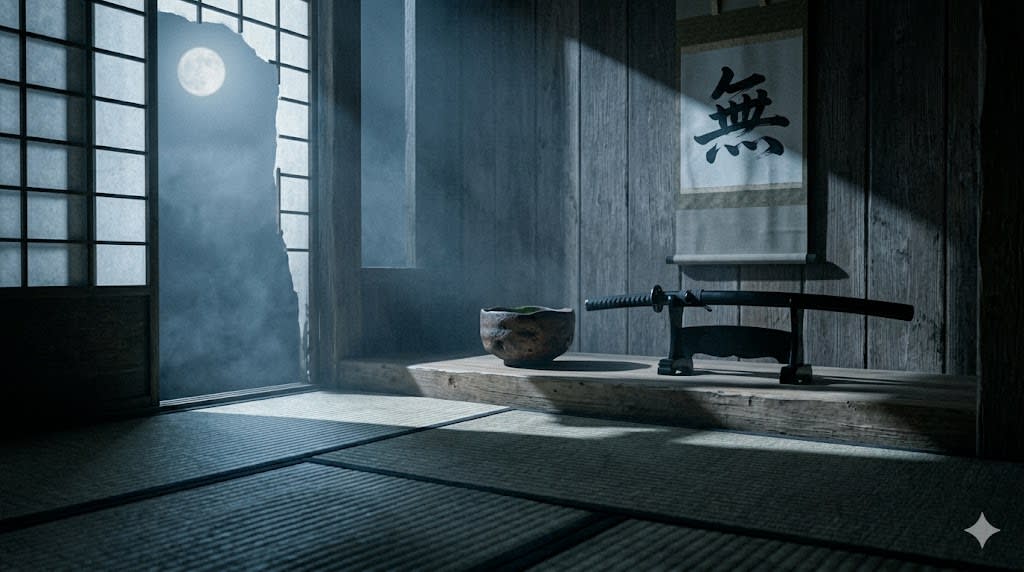
Step into a traditional samurai residence, and your first instinct might be to look for the furniture. There is none. The floor is an unbroken expanse of woven tatami mats; the walls are sliding screens of cedar and paper (Shoji). This was not a lack of design; it was the execution of Ma—the concept of negative space or "active emptiness."
In a samurai home, a room was not static. A room filled with furniture was a room trapped in one dimension. By keeping the space empty, it could transform instantly: a training hall at dawn, an office at noon, a dining room at dusk, and a bedroom at night.
Furthermore, this physical minimalism served a tactical purpose. A cluttered room offered hiding places for assassins; an empty room offered total clarity of vision. In the corner of this emptiness sat the Tokonoma—a small, recessed alcove containing a single hanging scroll and a single seasonal flower. By removing the noise of the world, the samurai forced their mind to focus on a singular, profound truth.
4. The Dual Path: The Blade and the Teacup
The essence of the samurai's minimalism can be found in their two most prized possessions, representing the dual path of Bunbu Ryodo (The Pen and the Sword).
The first is the Katana. Stripped of the gaudy gold ornamentation favored by foreign militaries, the master-crafted Japanese blade was a masterpiece of pure utility. Every curve, every fold of steel, and every polished edge was there for one reason: to cut efficiently. It was a lethal tool maintained with religious precision.
The second object is the Chawan—a rustic, often asymmetric clay tea bowl used in the tea ceremony (Chado). It is the perfect counterweight to the sword. The tea ceremony was a ritualistic stripping away of social status and ego. To enter the tea room, even the highest-ranking warlord had to crawl through a tiny, low door, leaving his swords outside. Inside, there was only the hot water, the green powder, and the shared appreciation of a flawed piece of pottery. By minimizing the physical environment, the samurai maximized the present moment.
5. Conclusion: Musashi’s Modern Echo
In his legendary text, The Book of Five Rings, the undefeated swordsman Miyamoto Musashi (image_18.png) wrote a line that serves as the ultimate manifesto for minimalists across centuries:
"Do nothing which is of no use."
The samurai didn't practice minimalism to clear their heads for a better workday or to curate an attractive feed; they practiced it to survive. They understood that attachment to material things creates vulnerability, fear, and hesitation on the threshold of life and death.
When we look at the clean lines of modern Japanese architecture, the clutter-free philosophy of modern lifestyle gurus, or the sleek design of contemporary technology, we are not looking at a new trend. We are looking at the centuries-old soul of the samurai. In a world increasingly choked by digital noise and material excess, the Obsidian Sentinels of Edo leave us with a timeless lesson: power does not belong to those who consume the most, but to those who require the least to conquer themselves.
About the Creator
Takashi Nagaya
I want everyone to know about Japanese culture, history, food, anime, manga, etc.
Enjoyed the story? Support the Creator.
Subscribe for free to receive all their stories in your feed.
Comments
There are no comments for this story
Be the first to respond and start the conversation.