
The "Puffin Devil" of Camborne
I think I know why it never really became a success and I'll bet the horses left a few droppings as well
On Christmas Eve of 1801 the streets of Camborne in Cornwall, like any other in the country, prepared for the upcoming festivities.
What made the town unique in Cornwall, in Britain and around the world was what happened between Tehidy Street and Union Street where it joins Trellowarren Street. The seasonally rhythmic sounds of the town suffered a massive tsunami disturbance. Nothing like the civil disturbance, or not so civil as it turned out, as miners took to the streets around what is now the John Francis Bassett Hotel, in 1873.
Whatever it was It made the ground vibrate to make locals think a mine shaft had collapsed and the air to be rent with new and unfamiliar noises that had never been heard in the town before.
Richard Trevithick (1771 - 1833), a local mining engineer had designed and built the world's first steam driven, independently powered, passenger carrying contraption that could travel under its own steam (no apologies for not warehousing this one) along a public highway.
This momentous event preceded Robert Stephenson's "Rocket" steam engine and train by twenty four years and it never quite seems to attract the same level of celebratory attention. I can only assume it is because steam driven road transport never acquired the same kudos and momentum as rail transport did. Or, as road transport powered by the internal combustion engine a century later.
There is a video online of a replica of Trevithick's original contraption. Having watched it, it is not surprising that it acquired the nickname of the "Puffin' Devil".
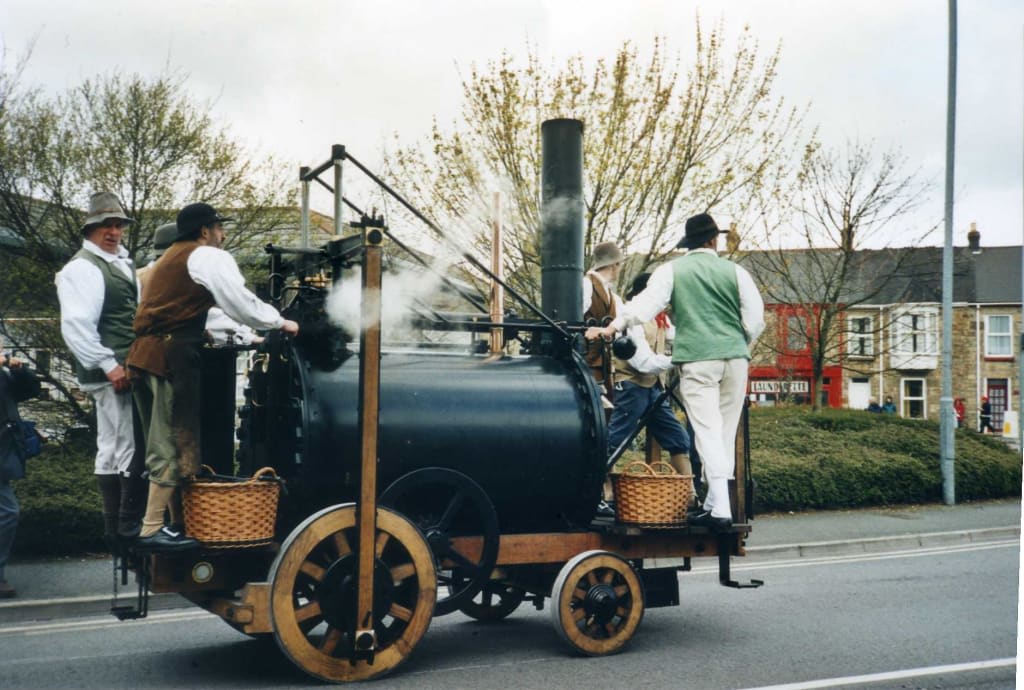
Trevithick designed his vehicle with a single cylinder engine to drive the wheels on the road. The connection between the piston and the wheels on the road were connecting rods. By designing the engine to work under high pressure Trevithick was able to build a more compact and powerful engine than used in similar static power units. And for further efficiency exhaust was sent up a chimney which was connected to the onboard furnace so it would draw air through the fire to increase the intensity of the heat it generated.
During a recent visit to Camborne (October 2025) I walked most of the route that the "Puffin' Devil would have followed during its first road test. From Tehidy Road, near where the Holman Park estate wall is, up a slight incline during which the road becomes Union Street and then on to where it joins Trellowarren Street which is the main street of the town. That short walk involved a climb over the distance in excess of ten metres.
Yours truly will confess to an underlying lack of fitness and stamina but not a lack of honesty in that I did feel the effects of that incline by the time I reached Trellowarren Street. So, the "Puffin Devil" must have put in some effort, made some loud huffs and puffs as it worked its way up what is today signposted as "Camborne Hill".
The statistics for the "Puffin' Devil " which were generously supplied by the Trevithick Society in Camborne along with the header picture are that its weight was four and a half tons. It was twelve feet long, six feet wide and with the belching chimney in place, when fired up, nearly eleven feet tall.
There is a folksong about the inaugural passage of the "Puffin' Devil".
Going up Camborne Hill, coming down
Going up Camborne Hill, coming down
The horses stood still
The wheels went round
Going up Camborne Hill, coming down
The “Going up coming down” lyric is not a record of the “Puffin Devil” making a return debut trip back to where it started. It refers to the fact that it went up the incline backwards which may seem strange but there is a logic to this. The engine was faced in this way to allow water in its reservoir to slosh forward over the boiler unit to prevent it from overheating and if nothing was done to correct this there would eventually be a explosion.
As it was there very nearly such an explosion as when the “Puffin Devil” had completed its successful run the crew parked it up outside of a pub and partook of a roast lunch which no doubt involved the consumption of some ale. What they didn’t do before eating and drinking was to stop the fire. If they had not done so when they did the engine may well have blown itself to smithereens and been consigned to the archives of road transport as an engineering failure.
On Boxing Day, the “Puffin Devil” was taken out for a spin to the home of a local aristocrat. As it was going along the road, such as it was, it hit a pothole and a rut causing it to veer off of the road into a ditch, where it caught fire and destroyed itself.
The narrow escape on Christmas Eve and the engine’s total demise on Boxing Day could well be why its place in transport history was so overshadowed by Stevenson’s Rocket.
I have complete faith in the integrity of the first two lines of lyrics of this song. As for the reference to "The horses stood still" I do have very serious doubts.
From personal experience when I have been on a horse when something such as an unusual looking and sounding vehicle comes up behind us or towards us I have never known a horse “stand still”. They have tensed up as they brace themselves to take flight from fear, pawed the ground and gone into rocking horse mode on the spot. In a dressage arena this last movement would be called a “piaffe” but on the road it is a precursor to a one eighty degree turn followed by a nought to forty miles an hour in less than a second.
There is also no reference in the entire folksong about what the street cleaner had to clear up either.
About the Creator
Alan Russell
When you read my words they may not be perfect but I hope they:
1. Engage you
2. Entertain you
3. At least make you smile (Omar's Diaries) or
4. Think about this crazy world we live in and
5. Never accept anything at face value
Enjoyed the story? Support the Creator.
Subscribe for free to receive all their stories in your feed.
Comments
There are no comments for this story
Be the first to respond and start the conversation.