
The Professor Who Changed the World with a Messy Desk: How a Stray Mold Defeated Deadly Bacteria
To truly understand the magnitude of what happened in a dusty London laboratory in the early autumn of 1928, one must first imagine a world completely stripped of modern medicine. Before the dawn of antibiotics, the human race was entirely at the mercy of microscopic killers.
A simple scratch from a rose thorn in a garden, a minor cut while shaving, or a basic dental infection was routinely a literal death sentence. Hospitals were filled with patients dying of blood poisoning, and doctors could do nothing but watch, offer comfort, and wait for the end. Entire families were wiped out by diseases that we treat today with a simple, inexpensive prescription from a local pharmacy. The battlefield was even worse; during the First World War, far more soldiers died from secondary wound infections and sepsis than from the actual bullets and shrapnel. Human civilization was desperately fighting a losing war against bacteria.
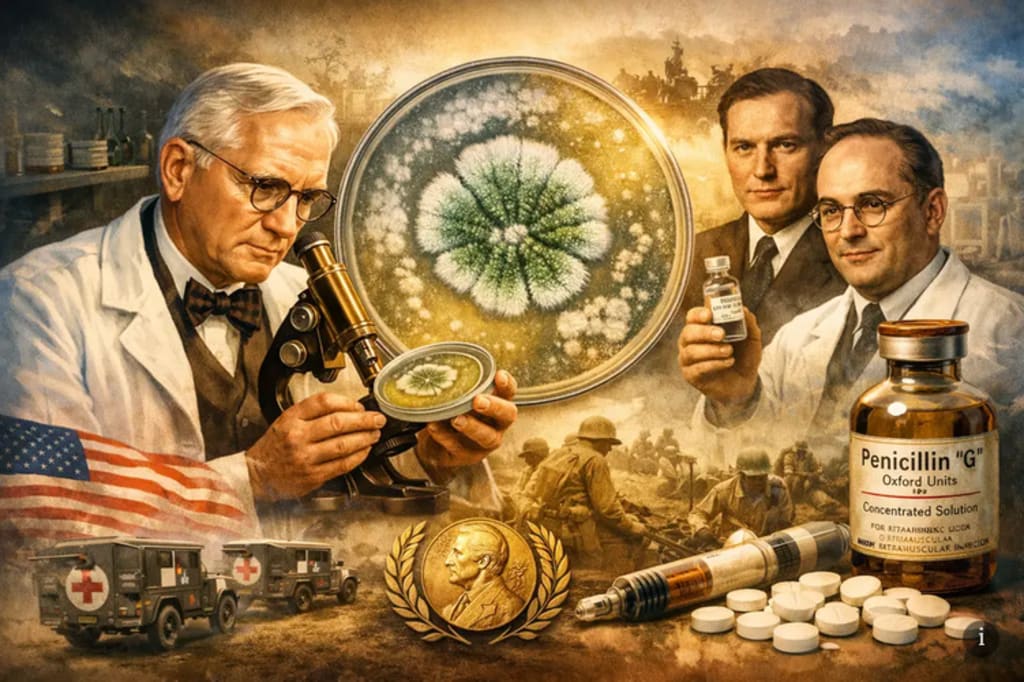
Enter Alexander Fleming. In September 1928, this brilliant Scottish biologist and physician walked back into his laboratory at St. Mary's Hospital in London. He had just spent several wonderful weeks away on vacation with his family, completely disconnected from his research. Fleming was undoubtedly a respected expert in his field, but he also possessed a persistent, well-known reputation among his colleagues for being incredibly untidy. He simply hated cleaning up his workspace. Before locking up his laboratory door for the summer holidays, he had neglected to wash his equipment, leaving dozens of glass Petri dishes scattered carelessly across his bench. In those specific dishes, he had been cultivating colonies of staphylococci bacteria—dangerous, aggressive pathogens responsible for severe skin infections, pneumonia, and deadly blood poisoning.
As he began his routine inspection of the old, cluttered dishes upon his return, he intended to discard them in a vat of disinfectant. However, fate intervened. He noticed a bizarre anomaly in one of the plates that had been exposed to the air. A common household mold spores had somehow drifted through an open window or up from the stairwell, landed on the agar, and established a small, fuzzy colony. But what truly frozen Fleming in his tracks was not the presence of the mold itself, but the strange behavior of the bacteria around it. The aggressive staphylococci colonies that should have covered the entire dish were completely gone in a perfect circle immediately surrounding the mold. They hadn't just stopped growing; they had been entirely dissolved and destroyed, while the bacteria further away on the edge of the plate were thriving normally.
The mysterious mold, which he later identified as Penicillium notatum, was producing a powerful chemical defense mechanism—a substance capable of easily dissolving the tough cell walls of the bacteria and preventing them from multiplying. Recognizing the immense potential of this accidental phenomenon, Fleming named the active substance penicillin.
Although Fleming published his historic findings in a scientific journal in 1929, the medical world largely ignored him. He faced a massive wall of limitations. He lacked the funding, the advanced laboratory equipment, and the deep chemical expertise required to isolate the pure penicillin from the crude mold juice, or to manufacture it in any meaningful quantity. For nearly a decade, the greatest medical discovery in human history sat on a shelf, forgotten by the mainstream scientific community.
The true turning point arrived with the terrifying outbreak of the Second World War. A team of brilliant, dedicated scientists at Oxford University, led by the Australian pharmacologist Howard Florey and the German-born biochemist Ernst Chain, rediscovered Fleming's 1929 paper. With casualties mounting on the front lines, they realized that penicillin was the ultimate wartime necessity. Working under constant threat of German bombings, the Oxford team turned their laboratory into a miniature factory. They used whatever equipment they could find, including bedpans, milk churns, and old crates, to grow the temperamental mold.
They successfully overcame the massive technological hurdles of purification, but they needed industrial power to scale production. Florey traveled to the United States, convincing American chemical enterprises and government authorities to invest in a massive, top-secret project. Engineers developed a revolutionary method for mass deep-tank fermentation, allowing the mold to grow in giant, circulating vats. By 1944, mass-produced penicillin was being rushed to military doctors on the beaches of Normandy, saving countless thousands of wounded soldiers from amputations and certain death from sepsis.
In 1945, Alexander Fleming, Howard Florey, and Ernst Chain were jointly awarded the Nobel Prize in Physiology or Medicine. The discovery of antibiotics completely revolutionized modern healthcare, fundamentally doubled the average human life expectancy, and opened a triumphant new chapter in medicine. And to think, this monumental global revolution, which saved millions of human lives, started simply because a messy professor refused to clean his laboratory desk before going on vacation.
Sources:
Nobel Prize – Official biographies of Alexander Fleming, Howard Florey, and Ernst Chain for the 1945 Nobel Prize in Physiology or Medicine
Imperial College London – St Mary's Hospital archives and the history behind the discovery of Penicillium notatum
About the Creator
Enjoyed the story? Support the Creator.
Subscribe for free to receive all their stories in your feed.
Comments
There are no comments for this story
Be the first to respond and start the conversation.