
The Last Letter of Akanni
A boy searched for a voice that never returned
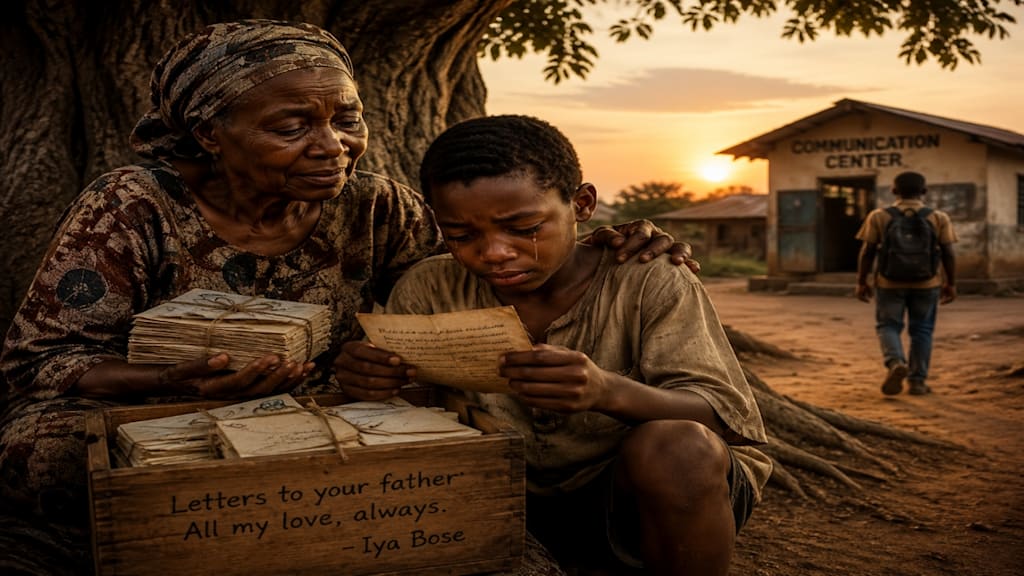
In the he quiet village of Ìlọrin-Ekùn, where red dust clung to every footstep and the sun always seemed tired before sunset, there was a time when life still had a heartbeat. Not the kind measured by clocks or screens… but the kind felt in voices, footsteps, and shared silence. That was where Akanni lived. He was thirteen, thin like a dry branch, with eyes that always looked like they were waiting for something far away. He lived with his grandmother, Iya Bose, a woman whose face carried wrinkles like written history. She had seen wars of hunger, seasons of plenty, and the slow disappearance of things that once made life whole. But what she had not seen… was the return of Akanni’s parents. They left when he was too young to remember their faces. Only stories remained. “They will come back,” Iya Bose always said, adjusting her faded wrapper as she stirred palm oil soup. “Your father is working in the city. Your mother is taking care of him.” Akanni never argued. He only nodded. But deep inside, something in him stopped believing long ago. Every evening, he would sit under the iroko tree outside their small mud house. That tree had become his companion, its branches stretching like tired arms over his head. It never answered him, but it never left either. That was enough. Until the day everything began to change. A rumor came to the village—carried by traders and strangers—that a communication center had been built in the next town. They said you could now speak to anyone in the city without traveling. Just speak into a device, and your voice would fly like a bird. The village changed overnight. Hope returned like rain after drought. That night, Iya Bose did something unusual. She opened an old wooden box hidden under her bed. Inside were wrinkled cloth, old beads… and money carefully wrapped in paper. She counted it slowly. Then she placed it in Akanni’s hand. “Go,” she said softly. “Find your father.” Akanni froze. “Grandmother… what if—” “Go,” she repeated, her voice firmer now, but her eyes trembling. So he went. The journey to the town felt longer than anything he had ever known. Dust swallowed his feet. The sun pressed hard on his shoulders. But something inside him kept walking—hope, or maybe fear disguised as hope. When he arrived, the communication center looked like another world. Bright walls. Strange machines. People sitting in front of glowing screens, speaking and crying and laughing at invisible voices. Akanni hesitated. Then he stepped forward. A man behind the counter asked for the number. Akanni repeated it exactly as his grandmother had taught him—like a sacred chant. The machine rang. Once. Twice. Then— A voice answered. “Hello?” Akanni’s heart stopped. “Hello… please,” he whispered, voice shaking. “Are you my father?” Silence. Then the voice said gently, “I think you have the wrong number.” The line disconnected. Just like that. No warning. No explanation. Only silence. Akanni stood still for a long time, as if the world had forgotten to continue moving around him. That night, he returned home without speaking a word. Iya Bose was waiting under the iroko tree. She looked at his face and already understood. “He didn’t come?” she asked quietly. Akanni shook his head. For the first time, Iya Bose did not try to explain anything. She only sat beside him and said nothing. Later that night, Akanni discovered something he had never seen before. A wooden box. Inside it were letters. Dozens of them. All written in Iya Bose’s handwriting. He picked one up carefully. “We are still waiting. Akanni asks about you every day. The house still remembers your footsteps.” His hands shook. “Grandmother…” he whispered. “Why didn’t you stop writing?” She smiled faintly, eyes wet but steady. “Because sometimes,” she said, “love must continue… even when it is not answered.” Days passed. Then weeks. Iya Bose grew weaker. Her voice became softer, like wind passing through dry leaves. One evening, she called Akanni under the iroko tree. “I don’t think I will see another season,” she said calmly. Akanni shook his head quickly. “No. You will.” But she only smiled. “I want you to keep writing the letters,” she said. “Even if no one replies.” That night, she passed away. Under the same tree where stories were told and hope once lived. No noise. No drama. Only silence… and wind moving through leaves. Years later, Akanni became a writer of letters. People came to him from distant places—those who had lost parents, lovers, children, voices. He wrote for them. Not because the people would return. But because the waiting deserved words. And every time he wrote, he remembered the lesson the iroko tree never spoke, but always showed: Some voices never come back. But love… if written… never disappears.
About the Creator
Enjoyed the story? Support the Creator.
Subscribe for free to receive all their stories in your feed.
Comments
There are no comments for this story
Be the first to respond and start the conversation.