
The King of All Survival Stories - Man Who Walked 27 Years
Survival o Walked 27 Years

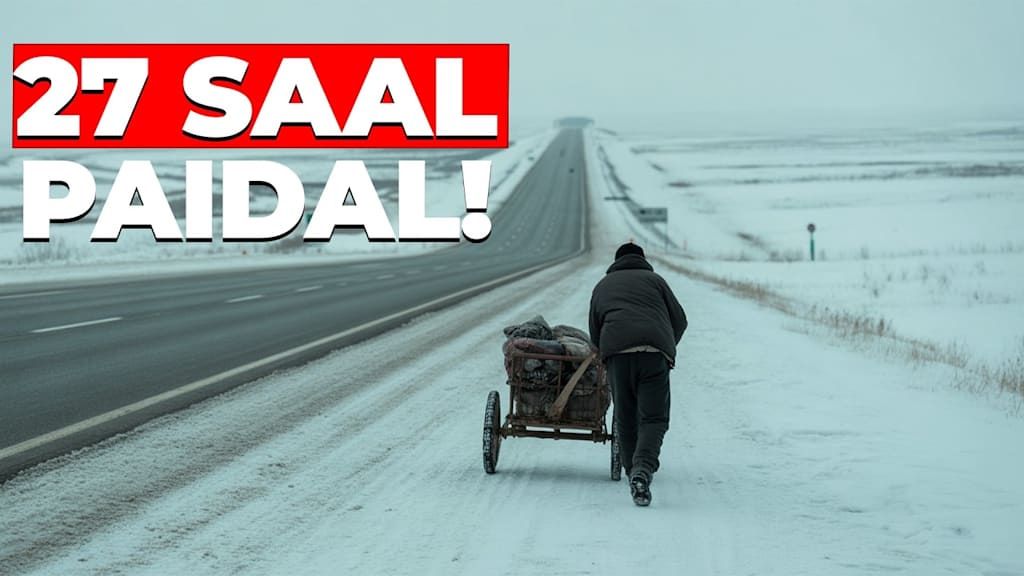
Did you know that Dave Kunst was the first person to walk around the world? However, during his journey, Dave used airplanes to cross the oceans. In total, he walked around 27,000 km, even if it was done in separate parts. But today, we are not talking about Dave. We are talking about a man who may have gone even further than him.
This man is determined to cross the longest continuous route in the world — entirely on foot. Yes, where our imagination ends, Karl Bushby’s determination begins. Not 5,000 km, not 10,000 km, not even 25,000 km — he has already walked an astonishing 47,000 km using nothing but his own feet. And surprisingly, his journey is still not over.
25 countries, 6 deserts, 7 mountain ranges, and 27 years — all for one goal: to walk around the world without any support.
Welcome once again
Karl Bushby, a former British paratrooper from England, decided to attempt one of the most dangerous walking expeditions ever. On November 1, 1998, with only $500 in his pocket, he began his journey from the southern tip of Chile, in the city of Punta Arenas. He called this mission the “Goliath Expedition.”
His plan was to cross the entire American continent, enter Russia, continue through Asia, and finally return to his hometown in England. The total distance would be around 58,000 km.
Karl estimated that if he walked 19 km a day, he could complete the journey in about 8 years. But he had no idea the difficulties ahead would turn those 8 years into more than 27 years — and the journey still would not be finished.
Karl Bushby created two strict rules for his expedition:
No transportation of any kind would be used. No trains, cars, airplanes, or motorized vehicles. Every step had to be taken on foot.
If the journey was interrupted for any reason, he had to resume exactly from the same spot where he took his last step.
These rules sound simple, but Karl paid for them with years of loneliness, visa troubles, and constant danger.
Karl’s journey began across the rocky landscapes of South America. Harsh weather, wild terrain, and endless challenges stood in his way. To avoid the dangerous Amazon jungle, he mostly stayed along the Pacific coast and near the Andes mountains.
Before entering Central America, the biggest challenge was the terrain and weather. In Patagonia, he faced freezing winds. Crossing the Andes mountain range itself was an almost impossible task. In northern Chile, he crossed the Atacama Desert, one of the driest places on Earth. Water shortages and extreme heat became major problems.
Karl carried a small two-wheeled push cart to transport food, clothes, and supplies. He later said that while crossing the Atacama Desert, he only stopped whenever he found water.
Crossing South America was a huge milestone, but the real challenge was the Darién Gap — a 320 km stretch between Colombia and Panama. This region is filled with dense jungle, dangerous insects, poisonous snakes, and guerrilla groups.
While crossing into Panama, Karl was arrested by Panamanian police and spent 18 days in jail. After being released, he restarted his journey from the exact point where he had stopped.
Crossing Central America brought more visa complications because of the many borders. By 2002, Karl had crossed Central America and entered the United States.
In the U.S., he walked long highways, faced heavy traffic, and crossed the blazing Sonoran Desert, where the heat was even worse than Chile’s Atacama Desert.
By 2005, he reached Canada and Alaska. There, the environment completely changed. He faced freezing temperatures, snowstorms, and difficult terrain. In remote Alaskan regions without roads, he often used dog-sled trails because the compressed snow made walking easier. However, Karl refused to use dog assistance because it would violate his “no support” rule.
After Alaska came the most dangerous part of the entire expedition: crossing the Bering Strait from Alaska into Siberia, Russia.
The Bering Strait is a frozen sea connecting the U.S. and Russia. The ice there constantly moves because of ocean currents. Karl often had to swim through freezing Arctic water to move between floating ice sheets, risking hypothermia at every moment.
Karl crossed this section with French adventurer Dimitri Kieffer. They traveled 240 km through Arctic storms, surviving for 14 days with almost no sleep.
But when they finally reached Russia, Karl faced another disaster. Russian authorities arrested him. Although he had a valid visa, they argued that the Bering Strait was not an official port of entry. He was deported back to the UK.
At that point, the expedition could have ended. But Karl had become internationally famous. Britain’s Deputy Prime Minister John Prescott and Russian billionaire Roman Abramovich intervened to help him gain permission to continue.
Even then, Russia only granted him 90-day visas. Every 90 days, he had to leave the country and later return to the exact GPS point where he had stopped walking. Sometimes the delays lasted months.
In 2008, Karl ran out of funding and had to stop in Mexico for nearly two years. In 2011, after receiving funding again, he returned to Siberia and continued through the frozen tundra.
In 2013, he received another huge shock: Russia banned him for five years.
Instead of giving up, Karl protested in an unusual way. He walked 4,800 km from Los Angeles to Washington, D.C. and protested outside the Russian Embassy. After the media covered his story, Russian authorities lifted the ban in 2014.
Karl returned to the exact GPS point in Siberia and continued walking.
From Russia, he entered Mongolia and crossed the 1,130 km Gobi Desert. Then he passed through China, Kazakhstan, Uzbekistan, and Turkmenistan. But Iran’s visa restrictions blocked his route again, especially during the pandemic.
In 2022, Karl came up with a life-threatening alternative plan. Since he could not enter Iran, he decided to swim across the Caspian Sea to Azerbaijan.
He used a small kayak only to carry his supplies, not himself. Karl swam 288 km across the Caspian Sea in 31 days, swimming 6 hours daily — 3 hours in the morning and 3 in the evening. At night, he slept on the kayak. Despite strong waves and exhaustion, he succeeded.
In 2025, Karl entered Turkey from Azerbaijan. By then, he had become so famous that people in villages invited him into their homes. In an interview with BBC, Karl said he would never forget Turkish hospitality.
In Istanbul, he needed to cross the Bosphorus Strait to enter Europe. Since only vehicles are allowed on the Bosphorus Bridge, authorities gave Karl special permission to walk across it on foot.
Karl later joked that when he started the journey, Tony Blair was Prime Minister of Britain — and now several new Prime Ministers had already come and gone.
After 27 years of struggle, Karl Bushby now has only around 3,000 km left. His remaining route passes through Bulgaria, Romania, Hungary, Austria, Germany, France, and finally the UK.
However, one final obstacle still remains: the English Channel Tunnel between France and the UK. Walking through the tunnel is strictly forbidden because high-speed trains pass through it. But there is also a service tunnel used for emergencies. Karl will likely need special permission to walk through it.
It is expected that Karl Bushby will complete the final step of the Goliath Expedition in 2026, covering a total of 58,000 km — about 1.5 times the circumference of Earth.
Karl’s expedition proves that humans create their own limits, but in reality, there may be no limits at all. One of Karl’s famous quotes is:
“Life doesn’t stop. It only changes direction.”
And even today, Karl Bushby is still walking.
About the Creator
Imran Ali Shah
🌍 Vical Midea | Imran
🎥 Turning ideas into viral content
✨ Watch • Share • Enjoy
Enjoyed the story? Support the Creator.
Subscribe for free to receive all their stories in your feed.
Comments
There are no comments for this story
Be the first to respond and start the conversation.