
The Impossible Construction of World's Longest Undersea Tunnel
Impossible Construction

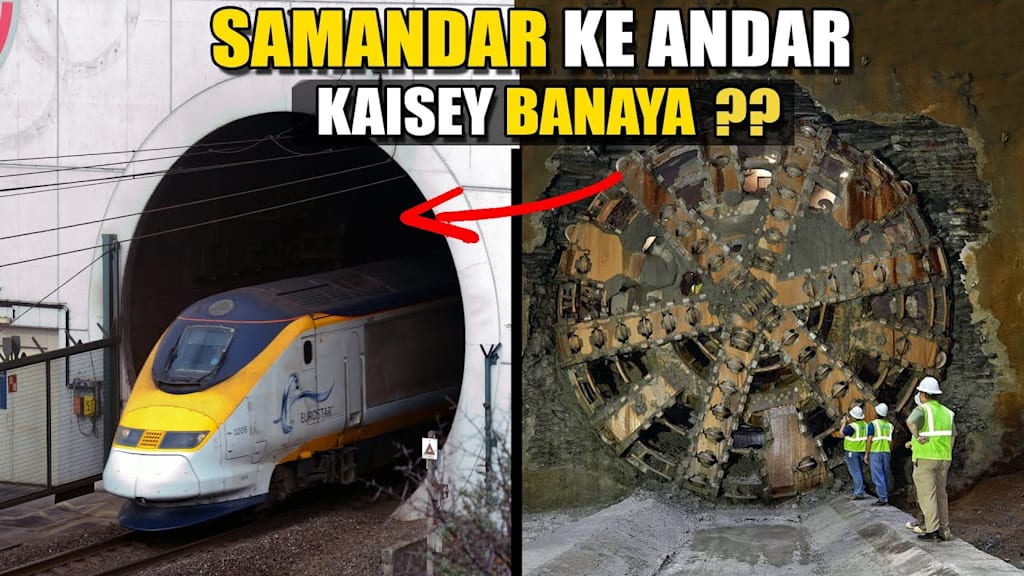
The tunnel you are seeing is not an ordinary tunnel. It is one of the greatest engineering wonders ever built — the Channel Tunnel, also known as the Euro Tunnel. Stretching nearly 50 kilometers beneath the sea, this mega project connects England and France through the English Channel. Engineers often call it the “Seventh Wonder of the World” because of the extreme challenges faced during its construction.
The idea of connecting England and Europe is very old. Around 13,000 years ago, at the end of the Ice Age, rising sea levels separated Britain from mainland Europe. Since then, many rulers and engineers dreamed of creating a direct land connection between the two regions. However, the dangerous waters of the English Channel and the lack of advanced technology made such a project impossible.
For centuries, England’s separation from Europe also served as a natural defense. Even powerful leaders like Napoleon and Adolf Hitler failed to conquer Britain, partly because crossing the English Channel was extremely difficult. During World War II, Hitler even considered building an underwater tunnel from France to England, but the idea never moved beyond planning.
By the 1980s, technology had advanced enough to make the impossible seem achievable. In 1986, after years of discussions and political debates, Britain and France officially agreed to build an undersea tunnel connecting the two countries. Many people in England opposed the idea because they believed Britain’s island status was part of its identity and security. Despite the criticism, construction finally began.
The plan was enormous. Engineers decided to build three tunnels beneath the sea — two railway tunnels and one smaller service tunnel for emergencies. The route would connect Folkestone in England with Calais in France. The total tunnel length would be around 56 kilometers, with 38 kilometers running directly under the sea.
The biggest challenge was building the Tunnel Boring Machines, or TBMs. Machines large enough for such a project did not exist at the time, so completely new ones had to be designed. The American company Robbins built gigantic TBMs that were nearly 800 feet long, weighed about 1,500 tons, and had powerful tungsten-carbide cutting blades at the front.
The machines slowly drilled through rock beneath the seabed while conveyor systems removed thousands of tons of debris every hour. The English side had stable chalk rock that helped prevent water leaks, but the French side contained dangerous cracks beneath the seabed. Engineers had to create special waterproof TBMs capable of surviving immense underwater pressure.
Transporting these giant machines underground was another huge challenge. Each TBM had to be taken apart into pieces, lowered deep underground, and then reassembled below the surface. This process alone took months and cost millions of dollars.
As the machines moved forward, workers installed massive reinforced concrete rings inside the tunnel walls. Around 750,000 concrete slabs were used to strengthen the tunnel and prevent seawater from entering. The pressure above the tunnel was enormous, and even a small mistake could have flooded the entire project within seconds.
To ensure both sides met perfectly under the sea, engineers used advanced laser guidance systems connected to computers. After three years of continuous drilling, the English and French tunnel teams finally approached each other. When only 100 meters remained, a steel rod was pushed through to check the alignment. Amazingly, the difference between both tunnels was only about 10 inches.
One final problem remained. Since the completed tunnel had become narrower after the concrete lining was installed, one of the giant TBMs could no longer fit back out. Engineers decided to bury the English TBM underground forever, while the French machine was dismantled and removed.
In 1990, workers from both countries finally broke through the last wall separating them and celebrated by exchanging flags underground. For the first time in thousands of years, Britain and mainland Europe were connected by land once again.
The Channel Tunnel officially opened on May 6, 1994. Today, thousands of passengers, cars, buses, and trucks travel through it every day, making it one of the greatest engineering achievements in modern history.
About the Creator
Imran Ali Shah
🌍 Vical Midea | Imran
🎥 Turning ideas into viral content
✨ Watch • Share • Enjoy
Enjoyed the story? Support the Creator.
Subscribe for free to receive all their stories in your feed.
Comments
There are no comments for this story
Be the first to respond and start the conversation.