

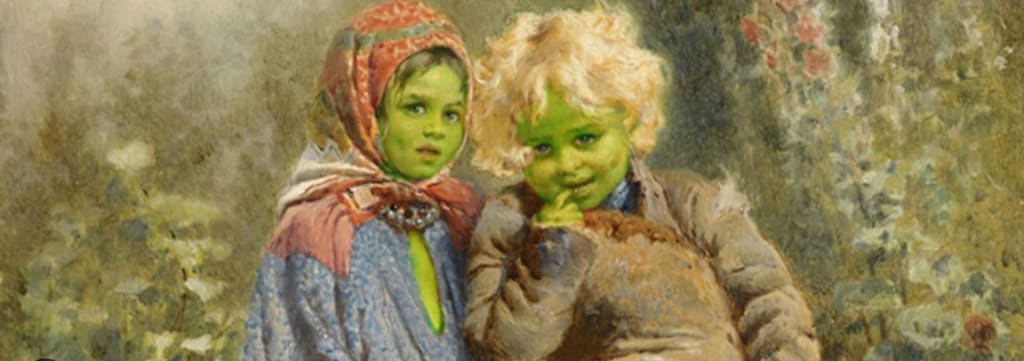
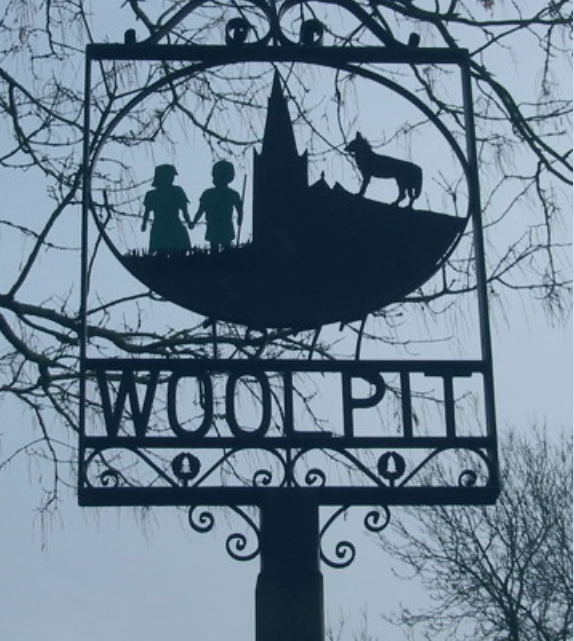
The Green Children of Woolpit are a famous 12th-century English legend featuring a brother and sister with bright green skin who appeared in the village of Woolpit in Suffolk, England. Speaking an unknown language and eating only raw broad beans, their story remains an enduring and bizarre medieval mystery.The LegendDuring the reign of King Stephen (1135–1154), farm workers in Woolpit discovered two small children emerging from the "wolf pits" (ancient trenches used to trap wolves). The siblings wore clothes made of unfamiliar materials, spoke a language nobody could understand, and refused all offered food until they found some raw broad beans.They were taken into the home of a local landowner, Sir Richard de Calne, where they were eventually baptized.
Over time, their skin lost its green tint and they began to eat a normal diet.The Boy and the GirlShortly after their baptism, the boy, who was sickly, fell ill and died. The girl, however, adapted well to her new life, learned to speak English, and went on to work for Richard de Calne's household for many years.
When asked about her origins, she shared an extraordinary story:
Their Homeland: She claimed they came from a place called "Saint Martin's Land," a perpetual twilight realm where the sun never fully rose and all the inhabitants had green skin.
How They Arrived: She explained that they had been herding their father's cattle when they followed the animals into a cavern. Drawn in by the sound of loud church bells, they wandered through the dark tunnels for a long time before emerging from the cave mouth into the glaring sunlight of Woolpit.
The only near-contemporary accounts are contained in William of Newburgh's Historia rerum Anglicarum and Ralph of Coggeshall's Chronicum Anglicanum, written in about 1189 and 1220, respectively. Between then and their rediscovery in the mid-19th century, the green children seem to surface only in a passing mention in William Camden's Britannia in 1586, and in two works from the early 17th century, Robert Burton's The Anatomy of Melancholy and Bishop Francis Godwin's fantastical The Man in the Moone. Two approaches have dominated explanations of the story of the green children: that it is a folktale describing an imaginary encounter with the inhabitants of another world, perhaps subterranean or extraterrestrial, or that it presents a real event in a garbled manner. The story was praised as an ideal fantasy by the English anarchist poet and critic Herbert Read in his English Prose Style, first published in 1928, and provided the inspiration for his only novel, The Green Child, published in 1935.
Historical Theories.
While early chroniclers treated the story as factual history, historians and researchers have proposed numerous theories to explain the strange event:
The Flemish Immigrant Theory:
The most accepted modern theory suggests the children were the orphaned children of Flemish immigrants. Many Flemish settlers lived in the region but were persecuted and killed during the turbulent politics of King Stephen's reign. If they were lost and terrified, their native language would sound like gibberish to the English villagers.
“Green Sickness" (Chlorosis): The green tint to their skin could be explained by malnourishment or severe anemia (known historically as chlorosis), which was believed to sometimes give a greenish pallor to the skin.
Folklore and Faerie Lore: Given the bizarre nature of the story, some historians believe the original event was simply embellished by medieval chroniclers who added English fairy myths—such as subterranean worlds and twilight realms—to the narrative. Myths and folklore come from somewhere, real life events, and get passed down over the generations orally, finally by written narratives.
I don’t know what to believe. You decide.
About the Creator
Guy lynn
I’m interested in history, space travel and the possibilities, Americana,( where I live now), Africa (Southern Africa, where I was born and raised), and I write about things that interest me ( bead history) and I hope will interest you.
Enjoyed the story? Support the Creator.
Subscribe for free to receive all their stories in your feed.
Comments
There are no comments for this story
Be the first to respond and start the conversation.