
The first film from the deep water shows a giant squid that looks like a glass sculpture.
The footage was captured by SuBastian, a remotely operated vehicle deployed during an expedition by the institute’s research vessel, Falkor (too), in March. While the colossal squid is thought to grow up to 23 feet (7 meters) long and weigh as much as 1,110 pounds (500 kilograms) — which makes it the heaviest invertebrate on the planet — this juvenile squid measures nearly 1 foot (30 centimeters) long.

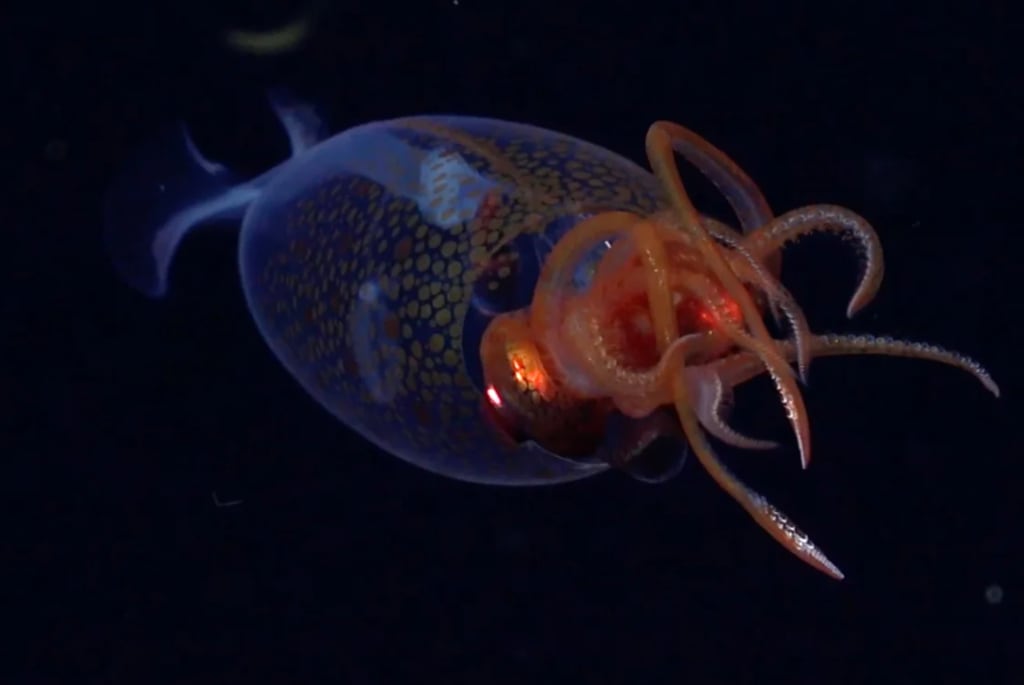
According to the Schmidt Ocean Institute, 100 years after the elusive giant squid was first discovered and given its name, scientists have finally taken video of the sea animal in its native habitat.
A young squid known as Mesonychoteuthis hamiltoni is seen swimming at a depth of 1,968 feet (600 meters) in a video shot close to the South Sandwich Islands in the South Atlantic Ocean.
SuBastian, a remotely operated vehicle that was sent out on an excursion by the institute's research vessel, Falkor (too), in March, took the video. This young squid is over one foot (30 centimeters) long, while the giant squid is believed to reach a maximum length of 23 feet (7 meters) and a maximum weight of 1,110 pounds (500 kilograms), making it the heaviest creature on Earth.
Some of the squid's "baby traits," like the stalked eyes that protrude from the side of its head, have vanished. According to Dr. Aaron Evans, an independent researcher and specialist in the family of glass squids known as Cranchiidae, to which the enormous squid belongs, the eyes are actually a part of the head, and the head and body are more proportionate to each other. Evans and Dr. Kat Bolstad, an associate professor at Auckland University of Technology in New Zealand, independently confirmed the species without being involved in the expedition.
"We might consider this to be a teenage squid," Evans stated at a press briefing on Tuesday. It is not quite an adult. It has not yet reached full maturity. It has a lot of growing still to do. However, it is also not a baby. Therefore, it is a very fascinating example for us to study. It is incredibly interesting for us to witness this kind of midway size between a hatchling and an adult because it allows us to piece together some of the elements that have been missing from the life history of this enigmatic animal.
The glacial glass squid, which has never been seen alive in its habitat, was also filmed in January by a team on a previous Falkor (too) voyage to the Southern Ocean near Antarctica.
According to a statement from the Schmidt Ocean Institute's executive director, Dr. Jyotika Virmani, "the first discovery of two separate squids on back-to-back missions is amazing and indicates how little we have seen of the magnificent residents of the Southern Ocean."
Scientists were able to identify the identification of both squid species thanks to high-resolution video footage, which is providing a unique perspective on the delicate ocean life and how animals live in its depths.
The colossal squid's existence and habits are little understood. According to Bolstad, the majority of what scientists know about the species has come from dead or dying specimens that have been discovered inside the stomachs of seabirds and whales, or as predators of toothfish that are gathered and fished for human use.
However, the new video also brings new information that was gathered during the flagship voyage, which was a joint effort by GoSouth, the Schmidt Ocean Institute, and the Nippon Foundation-Nekton Ocean Census to find marine creatures that had not yet been discovered. GoSouth is a collaborative effort between the British Antarctic Survey, the University of Plymouth in the United Kingdom, and the GEOMAR Helmholtz Centre for Ocean Research in Germany.
Bolstad and Evans went over the video closely in an attempt to find any distinguishing characteristics of the enormous squid. Squid have two larger tentacles and eight shorter arms. The enormous squid can be identified by the hooks that are located in the center of its eight arms. Evans claimed that when he saw the hooks on the just captured juvenile squid, he started to hyperventilate with joy.
Since the early 2000s, I have been studying deep-sea squids, including the enormous, and I can honestly say that this is one of the most fascinating discoveries we have made in my work on deep-sea cephalopods," Bolstad stated at the press conference. The animal's seeming fragility is one of my favorite aspects of this video. It appears to be a sculpture made of glass. It serves as a wonderful reminder of how much we still need to learn from nature when we observe these animals prospering and in such a delicate state and consider the distance humans must go to reach that habitat.
Bolstad also observed that the squid's mantle had big chromatophores, or color-changing cells, that were rusty red brown.
About the Creator
MD NAFIUL ISLAM
Love is Bad
Enjoyed the story? Support the Creator.
Subscribe for free to receive all their stories in your feed.
Comments
There are no comments for this story
Be the first to respond and start the conversation.