
The Fall of Anne Boleyn
How a queen went from coronation to execution in three years

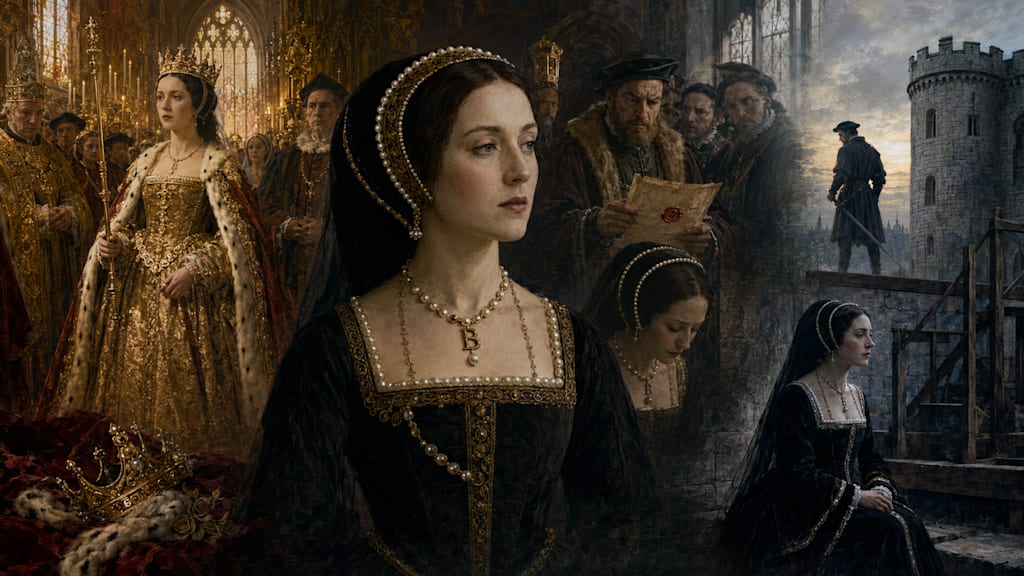
The fall of Anne Boleyn: how a queen went from coronation to execution in three years
What actually happened between the crown and the scaffold, and why none of it was sudden
Three years. That's the entire span between the day Anne Boleyn was crowned Queen of England and the day a swordsman brought over from Calais took her head off in front of a crowd inside the Tower of London. Most retellings treat her fall like a scandal that came out of nowhere, some unpredictable royal tantrum. It wasn't. Every piece of it had been building since before she ever wore the crown.
A marriage no one was supposed to talk about yet
Anne and Henry married in secret in January 1533. At that point, Henry's marriage to his first wife, Catherine of Aragon, hadn't even been formally annulled. Rome certainly hadn't agreed to anything. The whole arrangement depended on Thomas Cranmer, the newly appointed Archbishop of Canterbury, ruling that the Catherine marriage had never been valid in the first place.
He did, that May, and England's break from Rome became permanent policy rather than a threat Henry used to get his way. Anne wasn't just a new wife. She was the reason a country changed its religion.
A coronation meant to settle an argument
Anne was crowned on June 1, 1533, at Westminster Abbey, already visibly pregnant. The ceremony was designed to look inevitable, a done deal the country should simply accept. London didn't fully cooperate. Crowds turned out, but plenty of onlookers stayed quiet or openly loyal to Catherine, who many still considered the rightful queen.
The pregnancy mattered more than the crown itself. The entire justification for upending a marriage, a religion, and a decade of diplomacy rested on Anne delivering a son. Everyone in that abbey knew it, including her.
The daughter who wasn't supposed to happen
She gave birth that September to a healthy girl. Physicians and astrologers had assured Henry a son was coming. Elizabeth arrived instead, and the disappointment was real, though not yet fatal to the marriage. Henry still needed an heir badly enough to keep trying.
What it did was start a clock. Anne's position had never rested on affection alone. It rested on a promise she hadn't kept yet, and everyone around her, Cromwell included, understood exactly how conditional her security was.
A body that kept failing under the weight of it
The pregnancies after Elizabeth didn't go well. There was at least one miscarriage in 1534. Then came January 1536, the month that changed everything: Anne lost a male fetus, on the very day Catherine of Aragon was buried.
Historians treat this as the real turning point, not the executions that followed months later. Losing a son on the day his first wife went into the ground read to Henry as something closer to a verdict than bad luck. He started pulling away almost immediately.
Someone new was already waiting
By early 1536, Henry had turned his attention to Jane Seymour, a lady in waiting known for being everything Anne wasn't: quiet, deferential, careful never to argue with him in public. Anne had never been quiet. She'd built her position partly by challenging Henry, which had worked when he wanted a partner and stopped working the moment he wanted an exit.
Cromwell had his own reasons to want her gone. He and Anne had clashed hard over how to spend the wealth seized from the monasteries during the Reformation, and a queen who fought him on policy was a liability he no longer needed.
A case built to be won, not to be true
What happened next moved fast. In April and May of 1536, Cromwell assembled accusations of adultery against Anne involving several men at court, along with a charge of incest against her own brother, George Boleyn, and a charge that she had conspired to bring about the king's death.
Most historians today view the evidence as thin at best, built from courtly flirtation and gossip stretched into treason. It didn't need to hold up. It needed to end in a conviction, and everyone involved in building it knew exactly what outcome was expected.
Anne was arrested on May 2, 1536, and taken to the Tower of London, the same fortress where she'd stayed the night before her coronation not three years earlier.
A trial that decided the outcome before it started
She was tried on May 15, in front of a jury of peers presided over by her own uncle, the Duke of Norfolk. The verdict was guilty on every charge. The men accused alongside her, including her brother, had already been convicted days before.
There was no real path to acquittal built into a trial like this one. The king wanted a resolution, and the court delivered exactly that.
The last request she was granted
Anne was executed on May 19, 1536, inside the Tower walls rather than in public, one small mercy among very few. Henry arranged for an expert swordsman from Calais rather than the usual axe, a request that was itself considered an act of relative kindness given the era.
Witness accounts describe her final words as measured and careful, praising the king rather than condemning him, almost certainly a calculated choice meant to protect her daughter and remaining family from further retaliation. She was buried without ceremony in the Chapel of St Peter ad Vincula, inside the Tower, in a grave that went unmarked for centuries.
Three years earlier, trumpets had played for her coronation in that same fortress. There's no record of anyone playing anything the day she died.
About the Creator
Diane Foster
I’m a professional writer, proofreader, and all-round online entrepreneur, UK. I’m married to a rock star who had his long-awaited liver transplant in August 2025.
When not working, you’ll find me with a glass of wine, immersed in poetry.
Enjoyed the story? Support the Creator.
Subscribe for free to receive all their stories in your feed. You could also become a paid subscriber, letting them know you appreciate their work.
Comments
There are no comments for this story
Be the first to respond and start the conversation.