
The Darkest Night in White House History
How Fire, War, and Fear Forever Changed the American Presidency

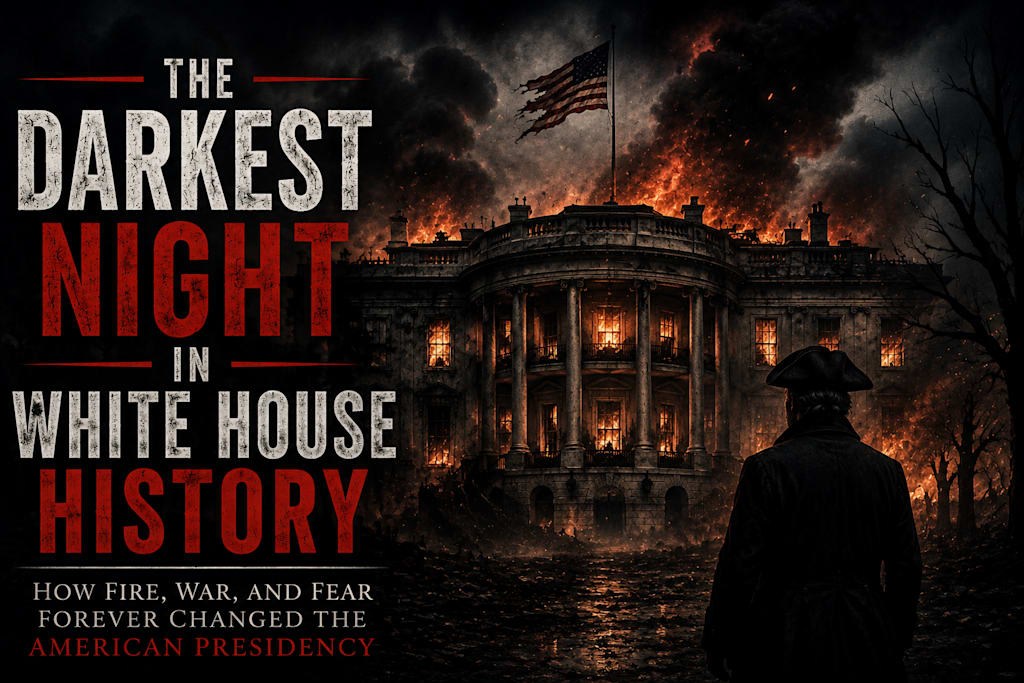
On a hot August evening in 1814, Washington emptied out in a hurry. Families threw whatever they could grab into wagons and pulled out of the city. Soldiers moved the opposite direction, toward an enemy most of them doubted they could stop. By the time smoke started showing up on the horizon, it was obvious the young United States was about to have one of the worst nights in its short history.
Inside the White House, nobody was calm either. President James Madison had already ridden off to join his military commanders, betting that American troops could still hold the British back. His wife Dolley stayed behind, checking the road for news of her husband while trying to figure out what, if anything, could still be saved.
Nobody watching that evening thought the White House itself might end up in flames before sunrise. But it did.
This isn't folklore or an exaggerated campfire story — it actually happened, and it changed the way the United States thought about protecting its capital and its leaders from then on.
How It Got to This Point
The trouble had been building for two years. The War of 1812 grew out of trade disputes, naval incidents, and general bad blood between Britain and its former colony. America was still new enough that plenty of people, at home and abroad, weren't convinced it would hold together against a European power.
Britain's goal in marching on Washington wasn't really strategic in the traditional sense — it was about morale. Take the capital, and you send a message that no American city is safe, not even the seat of government.
American officials didn't see it coming, or didn't want to. Most assumed the British would go after bigger prizes like Baltimore or New York instead. Washington in 1814 was still half-built, muddy, and thinly defended, and some in government figured that made it an unlikely target rather than an easy one. That turned out to be a serious miscalculation.
On August 24, British troops routed American forces at the Battle of Bladensburg, just outside the city. What was supposed to be a defense collapsed into a chaotic retreat — many of the American soldiers were green, and once the line broke, the road into Washington was basically open. Madison had ridden out to watch part of the battle himself, and when it became clear the day was lost, he had to leave before the British reached the city. Few American presidents, before or since, have had to flee an approaching army.
Dolley Madison's Night
Back at the White House, Dolley Madison wasn't ready to just walk away. She stayed as long as she reasonably could, trying to save what couldn't be replaced. The most famous item was the full-length Gilbert Stuart portrait of George Washington. The popular version of the story has her personally cutting it from its frame, but the historical record is a bit more modest: she gave the order, and a small group of aides did the actual work of getting it off the wall and out the door before the British arrived.
Before she finally left, Dolley Madison made sure several things were carried out of the building:
The full-length Gilbert Stuart portrait of George Washington
Important state papers and government documents
Silver and other valuables from the residence
She left the White House just a couple of hours ahead of British troops. When those troops arrived, they found the building empty. According to several accounts, officers sat down and ate a dinner that had been laid out for Madison before getting to the actual business of burning the place. They stacked furniture, set fires room by room, and by nightfall the White House was lighting up the sky like a beacon.
The fire tore through the building furniture, official records, the interior work that had taken years to finish. The Capitol and the Treasury building were hit hard too. For a lot of Americans who heard the news days or weeks later, it felt less like a military setback and more like the country itself was on fire.
Rebuilding From the Ashes
What's striking is what happened next. Instead of giving up on the capital, people got more stubborn about keeping it. The outer walls of the White House had survived, scorched but standing, and officials decided almost immediately to rebuild on the same spot rather than start over somewhere else. That choice mattered — it was as much a political statement as a construction decision.
The attack forced a hard look at how the country defended itself. In the years that followed, several lasting changes came out of that failure:
Stronger fortifications built around the capital
Better coordination between military and civilian leadership
Improved early-warning and communication systems
A shift away from assuming Washington was safe by default
There's one strange footnote to the story: shortly after the fires were lit, a violent storm rolled through Washington, and some witnesses described what sounded like a tornado. The wind and rain knocked down chimneys and tore off roofs, but it also helped put out a number of the fires before they could spread further. Whether that storm was luck, coincidence, or something people just needed to believe meant something, it kept the damage from being even worse.
Millions of tourists walk past the White House every year without knowing how close it came to never being rebuilt at all. Its bright white paint — which, contrary to popular belief, predates the fire and wasn't applied to cover burn marks —gives no hint of the night the building nearly disappeared for good.
It's a good reminder that even a country that survives and thrives can have genuinely terrible nights. What tends to matter more than the disaster itself is what a country does in the weeks and years after.
Picking Up the Pieces
As the ash settled over the following days, the mood in Washington started to shift. The city had taken a real beating, but it hadn't folded. Officials trickled back in, determined to show the government could keep functioning even with its main building in ruins.
For Madison personally, the fallout was rough. He'd watched American defenses collapse in real time, and plenty of citizens were quick to blame his administration for letting the British walk into the capital at all. Leadership rarely gets remembered for the easy calls — it's the decisions made in the middle of a mess that stick.
With the White House unlivable, Madison ran the government out of temporary quarters for a while. It wasn't glamorous, but it worked, and that mattered: it told both Americans and foreign observers that the country had been hurt but not knocked out.
Rebuilding wasn't quick. Craftsmen spent years repairing scorched stone, rebuilding interiors, and reinforcing the structure. Every wall that got cleaned and every room that got restored was, in a small way, part of restoring confidence in a country that had just watched its capital burn.
The Myth of the White Paint
There's a persistent myth that the White House got its name and color from workers painting over fire damage. Historians mostly reject that version — the building had already been coated in a lime-based whitewash before 1814, meant to protect the sandstone from weather, not fire. Still, after that August night, people looked at the building differently. It stopped being just the president's house and became something closer to a symbol of the country holding itself together.
Lessons in Leadership
Militarily, the attack was a wake-up call. Leaders stopped assuming the capital was safe by default and started actually planning for its defense — better fortifications, better communication, better coordination. Over time, that grew into one of the most elaborate security operations in the world.
Looking back, it's tempting to ask how an invading army managed to just walk into the nation's capital. The honest answer is overconfidence: officials assumed the British would go elsewhere, didn't prepare seriously for the alternative, and paid for it. That kind of mistake shows up again and again in history — not because people are careless, but because certainty is dangerous.
There's a broader point buried in this story, too. Buildings can be rebuilt. Furniture can be replaced. What's harder to restore is public confidence — and the people living through that period seemed to understand that saving the country's morale mattered just as much as saving its bricks.
Dolley Madison's decision to save the Washington portrait stuck in the public memory for exactly that reason. It wasn't just a painting she protected — it was a piece of the country's founding story, salvaged in the middle of a crisis by people thinking clearly under pressure.
The war ended a few months later, but August 24, 1814 was never really forgotten. Tourists still walk past the White House daily, most with no idea they're standing in front of a building that was once a blackened shell. History tends to get remembered for its victories and speeches, but some of its clearest lessons come from its failures. This one showed that even a powerful government can be caught flat-footed — and that resilience isn't about avoiding disaster, it's about what happens afterward.
That's really why the story still holds up more than two centuries later. It's not just a war story. It's about leadership under real pressure, ordinary people making good calls when it counted, and a capital that refused to let one bad night define it.
The White House standing today isn't just a landmark — it's a record of that recovery, wall by wall. Somewhere under the paint is the memory of a night the presidency itself was forced out of its own house, and the country kept going anyway.
About the Creator
Enjoyed the story? Support the Creator.
Subscribe for free to receive all their stories in your feed.
Comments
There are no comments for this story
Be the first to respond and start the conversation.