
The Coffee Stain, the Damp Carton, and the Handwritten “Enough”: The Untold Story of Who Really Won India’s Retail Wars
From a warehouse flood photo nobody replied to, to the $16 billion bet that rewired a market—the moments that decided billions were never in the boardroom.
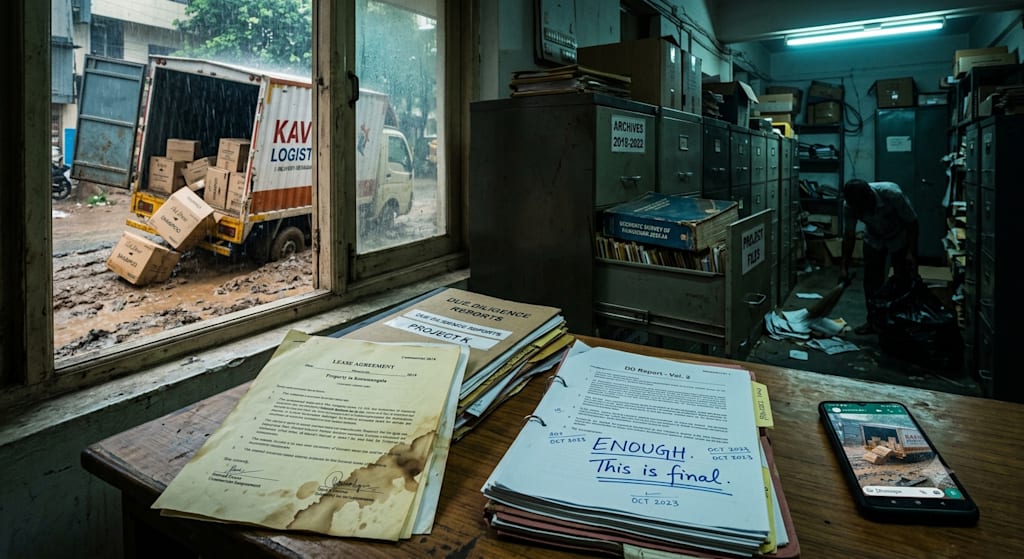
Bengaluru, WeWork, Q3 2014 – SoftBank's investment team signed a three‑year lease. The floor plan labeled the space "Southeast Asia Expansion Hub," but on signing day, no one paid attention to the ageing plumbing or electrical conduits. The broker had called an hour earlier: "There's a Japanese fund asking about the same floor." SoftBank wired the advance payment that afternoon.
The partner who signed was Nikesh Arora. His later departure from SoftBank is another story, but that day he glanced at the lease line that said "rent payable in INR," crossed it out, and wrote by hand: "USD‑locked." The administrative assistant slipped the page into the file folder. On the bottom right corner of the paper, a coffee stain remained—left by the previous tenant, an enterprise‑software startup that had moved out three months earlier after failing to close its next round.
Six weeks after signing, SoftBank closed its first Indian investment: an online pharmacy delivery startup called MediBid. The due‑diligence report said on page three: "Indian pharma‑e‑commerce regulatory framework is not yet defined," and on page five: "warehouse compliance rates are below Southeast Asian averages." Arora made no marginal notes on either line. He asked only one question, pointing to the financial model: "You project GMV at $300 million for 2020. What's the basis for that number?" The team answered: "We assume online pharmacy penetration in India goes from 0.3% to 1.2%." He listened and said: "Make it 1.5%." Then he forwarded the report to legal. Legal replied by email with three words: "Compliance risk." Arora did not answer that email. But three days later, at a board meeting, he said: "If compliance could be solved upfront, it wouldn't be early‑stage investing." That sentence was later written into SoftBank India's internal memo as "Decision Rule No. 1."
Walmart in India, meanwhile, moved at a different tempo.
Walmart's India financials for the full year 2014 showed a net loss of $87 million. The company did not close a single operational logistics node. For the warehouse site on the outskirts of Bengaluru, signed in 2016, the site‑survey report contained one line: "Water table is high; monsoon season may affect heavy‑vehicle access." The head of Walmart India, Krish Iyer, circled that line on the last page of the survey and wrote one word beside it: "Alternative route." But the alternative‑route plan was never drafted. In the 2017 monsoon, a heavy truck did get stuck. The driver posted a photo in a WhatsApp group: wheels sunk to the hubs, trailer tilted, boxes of shampoo sliding off the pallets and sitting in standing water. Krish Iyer saw the photo. He did not reply to the group. His executive assistant later recalled that he sat in his cubicle that afternoon, looked at the photo for about four minutes, then turned his phone face down on the desk and continued signing that day's purchase orders.
Walmart's GST issue ran finer. Before the unified GST was introduced in 2017, tax rates were not uniform across states. Walmart's finance team built a comparison table: one carton of 24 shampoo bottles, moved from a warehouse in Haryana to a distribution centre in Karnataka, passing through Rajasthan and Gujarat—each state levied its own transit tax. The total difference was enough to pay for another full shipment over the same distance. The finance director projected that table on the screen at a quarterly review and said: "This route is eating one percentage point off our gross margin." The room went quiet. Krish Iyer said: "Then we re‑route the distribution path. Work out a plan that bypasses Rajasthan." After the meeting, the logistics lead stood in the hallway and said to a colleague: "Bypass Rajasthan? That means going down the south‑coast route—an extra four hundred kilometres." But he had not said that in the meeting. In the meeting, he had said: "Understood. I'll run the numbers."
In Walmart's fourth consecutive loss year, the internal email sent on the day they signed for the second Bengaluru warehouse site was later quoted by The Economic Times. The email body had exactly three sentences: "The competitive landscape is unclear. The cost of exiting is higher than the cost of staying. Maintain current position." Attached to those three sentences was one file: a map of Amazon's warehouse footprint in India. Amazon had seven more nodes than Walmart. Krish Iyer did not comment on that number in the email. He simply sent the attachment—and that, in the culture of that office, was read as a statement.
Moving forward. In 2019, Amazon had deployed over $6.5 billion in India. Flipkart was acquired by Walmart for $16 billion for 77% equity. That year, India's total e‑commerce market was estimated at nearly $38 billion. Every number pointed the same way: keep going, do not pull back. But a Goldman Sachs research note that leaked in late 2019 had one paragraph circled in many inboxes: "Modern retail accounts for only 9% of India's total retail market; the remaining 91% is made up of kirana stores. E‑commerce penetration is not expected to exceed 7% by 2023." That paragraph circulated widely in investment banking circles. Usually, only the first half of the paragraph was shared; the second half—"though short‑term growth will still outpace other Asian emerging markets"—was rarely pasted alongside it.
2020, first‑wave lockdown. Indian e‑commerce order volumes dropped sharply for three weeks. Walmart's delivery network in the Delhi region saw volumes hit zero on certain days. A regional manager at Flipkart filed a risk alert in the internal system, marked "Red," with the rationale: "Supply chain disruption exceeding 72 hours." The Amazon India team held an emergency video meeting from the Bengaluru office. On the background video feed, someone had left their microphone unmuted, and the sound of a coffee maker ran for six minutes. The sole conclusion from that meeting was: "Do not close any warehouses. Keep warehouse staff on rotation." After the meeting, the regional director who made that decision sent a separate email to each of six team members. The text was identical: "Thanks. Keep going."
2021, subsidy war at its peak. A US‑based fund—widely believed later to be a Sequoia India‑affiliated vehicle—produced three versions of its due‑diligence report over six weeks.
The first version made no mention of India's offline‑consumer‑data accuracy issues. The second version, on page 23, contained this line: "India offline consumer data may have an error margin of over 40%, based on our sample check of 1,300 retail outlets across Delhi, Mumbai, and Bengaluru." The third version—the final signed copy—had page 23 entirely replaced. The title of the page remained the same, but the content was reduced to a general summary of "data collection methodology." The 40% error line was gone. The internal email chain for that replacement was archived: the VP in charge of due diligence wrote to the partner: "I recommend keeping that number—it came from field checks." The partner replied with one line: "Tell me, when Amazon entered China in 2013, was their data accurate?" The VP did not write back. On the day the third version was signed, the fund wired $250 million, in four tranches, the first arriving three business days later. That same day, the fund's India office ordered a case of sparkling water—the green‑bottle Italian brand—and put it in the break‑room fridge. No one remarked on it. But the fridge door was opened seventeen times that day.
That same year, a European fund was doing fieldwork in Mumbai. The fund was not top‑tier in name, but it had two decent exits in Southeast Asian consumer sectors, so it carried some credibility in India. Its research team rented a car in Mumbai, spent a month on the road, met sixty‑two retail end‑points, four distributors, and two mid‑level logistics managers. The final report contained one sentence on page 47, in the appendix, not bolded or highlighted: "India's logistics infrastructure improvement cycle may extend beyond this fund's holding period."
At the investment committee meeting, someone read that sentence aloud—not as a question, simply as a reading. The room was quiet for a few seconds. Then the partner at the long side of the table said: "If we don't invest now, who will own the top three companies in this sub‑sector three years from now?" He did not wait for an answer. He flipped back to the market‑size projection page and added: "This company is currently number four. But two of the top three have already taken US money. Number three is talking to Japanese money. If we don't enter now, that seat belongs to someone else." The committee approved the wire by majority vote. There was one dissenting vote—the same person who had read the "holding period" sentence aloud. He did not debate it in the meeting. He simply voted no, and the minutes recorded: "One dissenting vote." No reason was noted.
2023, three Southeast Asian funds simultaneously bid for the same Indian D2C brand. The brand made hair‑care oils and scalp‑treatment kits; the founders were two IIT graduates, five years into the business, with 78% of sales online. The three funds—one Singapore‑based, one Indonesian, one Malaysian—all moved into due diligence.
One of the diligence teams visited the brand's Delhi warehouse. They took photos: cartons on the lower shelves showed moisture marks. The side of one carton had a production date of September 2020, with a three‑year shelf life—six months from expiry. The edges of the packaging were slightly curled. Not severe, but someone who opened one box said: "The inner cardboard has damp spots, about fingernail‑sized, at the four corners." The investment manager posted the photos in the diligence working group chat with a note: "Inventory turnover days may be understated. This batch from 2020 hasn't cleared yet."
There were five people in the group. No one replied. Six hours later, the partner posted a screenshot—a message he and the brand's founder had exchanged the night before. The founder had written: "We are adjusting our SKU structure. Production of the old packaging has been stopped." The partner did not comment on the damp‑storage photos. The next morning, he signed the approval line for the $40 million wire.
That evening, on a call with his team, he said near the end: "The beauty brand we invested in Indonesia had the same issue during diligence—old stock sitting in the warehouse. And then? Everyone saw the returns." After the call, the investment manager deleted the damp‑storage photos from the group chat. But he did not delete the originals from his phone. Those photos remained in his camera roll and never appeared in any formal report.
Q4 2023. Of the three Southeast Asian funds, the Indonesian one won the allocation. The Singapore and Malaysian funds were out. After losing, the investment director of the Singapore fund posted on LinkedIn: "India's consumer market is exciting." The photo attached showed a road outside the Delhi warehouse, with a cow standing on the shoulder. The post received forty‑plus likes. He did not mention the due‑diligence report. He did not mention inventory turnover.
Looking back at all those Indian consumer‑sector deals, the one with the highest reported book return had the thinnest due‑diligence report among all bidders. The cover was white, without any firm logo, only a project code. The inside ran to eighteen pages—compared with the forty‑plus pages of peers, it omitted three separate chapters on "regulatory risk," "logistics bottlenecks," and "currency volatility." The signature page was page eighteen. Beside the signature, in the blank margin, there was a handwritten note—ballpoint pen, blue ink, scrawled in the speed of everyday note‑taking, not in standard caps, not in a neat hand. The note had two characters. In English, they read: "Enough."
The date under the signature was November 2022. Four months after signing, that company closed its next funding round at 1.4x the valuation. The eighteen‑page report was never opened a second time. It sat in a filing cabinet, stacked with seven other reports, weighed down by a copy of the India Economic Survey 2023, whose cover had a crease.
Early 2024. The WeWork building in Bengaluru changed operators. All files of former tenants were moved to storage in another building. On packing day, movers carried several cartons from the third floor to the ground floor. One carton split at the bottom, and papers scattered across the floor. Among them was a photocopy of the Q3 2014 lease—the coffee stain still visible on the lower right corner. The cleaner swept the copy aside with a broom, together with shredded paper, plastic wrap, and empty water bottles, into a trash bag.
That same afternoon, a new fund team was moving into the same office space. They signed a five‑year lease. They did not haggle. The broker said on the phone: "There's a Korean fund asking about the next building." They signed.
The pen was black.
About the Creator
Jin
Writer of reamstories
https://reamstories.com/jin
Enjoyed the story? Support the Creator.
Subscribe for free to receive all their stories in your feed. You could also become a paid subscriber, letting them know you appreciate their work.
Comments
There are no comments for this story
Be the first to respond and start the conversation.