
The Case India Never Solved…| Airdrop Mystery!
India Never Solved

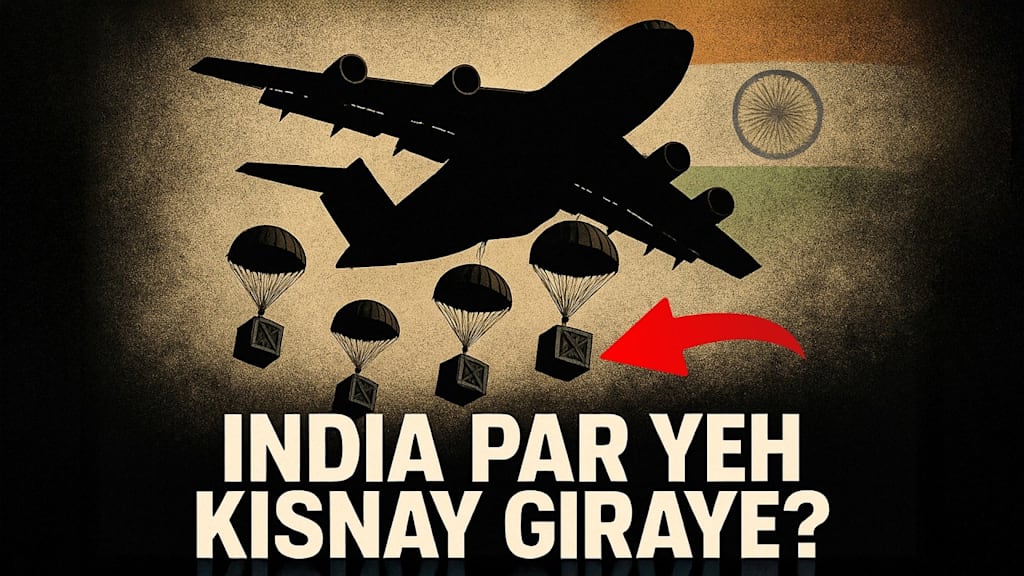
On the morning of December 18, 1995, in a village in India, people spotted something shiny lying in the fields. When they went closer, they discovered a strange rifle—something the villagers had never seen before.
As they were still trying to understand how it got there, they noticed around 35 more rifles scattered across the area. News spread quickly. The entire village gathered, and soon the police arrived at the scene.
The situation became even more serious when tank-destroying grenades were recovered from a nearby pond.
This incident took place in the Purulia district of West Bengal, where weapons falling from the sky remain a mystery to this day.
When police searched the surrounding area, they found broken olive-green boxes tied to parachutes. In total, three such boxes and parachutes were recovered. However, authorities still could not determine who had dropped them—or why.
As the situation escalated, the army was also called in. One thing was clear: if the boxes had been dropped by parachute, they must have come from an aircraft.
It was later discovered that a plane had flown very low over Purulia that night. It was suspected that this aircraft might be responsible.
But the question remained: whose plane was it, and why did it drop weapons over Purulia?
The recovered boxes contained around 300 AK-47 rifles, 25 9mm pistols, 2 sniper rifles, 2 night-vision binoculars, more than 100 grenades, and over 16,000 rounds of ammunition. The total weight exceeded 4 tons.
By now, the media had picked up the story. Everyone was asking the same question: who dropped 4 tons of weapons—and why?
Investigators checked flight logs from the previous day. They found that a Latvian Antonov An-26 aircraft had taken off from Karachi, passed through Varanasi, and flown over the exact area in Purulia where the weapons were found. It then exited Indian airspace via Kolkata and landed in Phuket, Thailand.
But was this the same plane that dropped the weapons?
There was no solid proof at the time. However, suspicion grew when authorities noticed a discrepancy: when the plane requested permission to enter Indian airspace, the pilot had declared Cambodia as the destination—but the aircraft actually landed in Thailand.
A few days later, on December 2, 1995, the same aircraft requested permission to re-enter Indian airspace. This time, it claimed its destination was Latvia, with a planned refueling stop in Karachi.
This time, Indian authorities were prepared.
As soon as the plane entered Indian airspace, two Indian Air Force MiG-21 fighter jets intercepted it and ordered it to land at Mumbai airport.
From here, a new chapter of the story begins.
After landing in Mumbai, the plane remained unattended for 45 minutes—no security forces approached it during that time. There were eight people onboard.
One of them was Kim Davy, a Danish national who had worked on community development projects around the world—including agricultural projects in Purulia, the very district where the weapons were dropped.
Another was Peter Bleach, a UK citizen and former member of the Special Air Service (SAS), who later became a weapons dealer. Years later, it was revealed that he was actually an undercover agent for British intelligence (MI6).
A third person was Deepak Manikant, an Indian-Singaporean linked to an organization called Ananda Marga, whose headquarters was located near the drop site.
The remaining five were Latvian crew members.
During those 45 minutes at Mumbai airport, Kim Davy took some documents and escaped. He disappeared for years.
Shortly after his escape, security forces surrounded the plane and arrested the remaining seven people.
A search of the aircraft revealed photographs of the Ananda Marga headquarters and partially burned documents related to the weapons.
It became clear that the weapons had been dropped from this aircraft. But the biggest question remained: why?
During the investigation, Peter Bleach stated that he had arranged the weapons on Davy’s request. He claimed he was told the weapons were meant for the Bangladeshi military.
However, he became suspicious and informed British intelligence. He said he was told to continue with the operation.
This raised another question: if the weapons were truly meant for Bangladesh, why were they dropped in Purulia, India?
According to a BBC investigation, the weapons were intended for the Ananda Marga organization.
Kim Davy, who had escaped, later gave an interview claiming he worked with Ananda Marga members, who were allegedly facing oppression in West Bengal. He said he arranged the weapons for their self-defense.
However, controversy erupted when Davy claimed that members of the Indian government, including figures from the Congress party, the Prime Minister, and intelligence agency RAW, had helped him.
He even alleged that they assisted in his escape from Mumbai airport.
Indian authorities rejected these claims, calling them fabricated.
At the time of the incident, West Bengal was governed by the Communist Party of India (CPI). Ananda Marga was growing in influence, which was seen as a threat.
Davy claimed that Ananda Marga followers were being attacked, and the government was ignoring it. He said this was the reason he wanted to arm them.
He also alleged that the central government wanted to create unrest in West Bengal to dismiss the state government.
However, no solid evidence has ever proven these claims.
Meanwhile, the arrested individuals were sentenced to life imprisonment. But over time, they were released one by one.
The five Latvian crew members were granted Russian citizenship and released in 2000 following a request by Vladimir Putin.
Peter Bleach was also released in 2004, reportedly under pressure from the UK government.
Later, a former intelligence officer revealed that Bleach had indeed worked for MI6.
Denmark refused to extradite Kim Davy to India, citing concerns about possible torture.
Documents later found suggested links to Bangladeshi military officials, but Bangladesh denied any involvement.
To this day, the Purulia arms drop remains unsolved.
Who planned the operation? Who funded it? Why were the weapons dropped? And how did Kim Davy escape so easily?
Even after nearly 30 years, these questions remain unanswered—making this one of the most mysterious incidents in modern history.
About the Creator
Imran Ali Shah
🌍 Vical Midea | Imran
🎥 Turning ideas into viral content
✨ Watch • Share • Enjoy
Enjoyed the story? Support the Creator.
Subscribe for free to receive all their stories in your feed.
Comments
There are no comments for this story
Be the first to respond and start the conversation.