
The Black Knight mystery in orbit around the Earth
Following the evidence from Tesla to the Space Shuttle

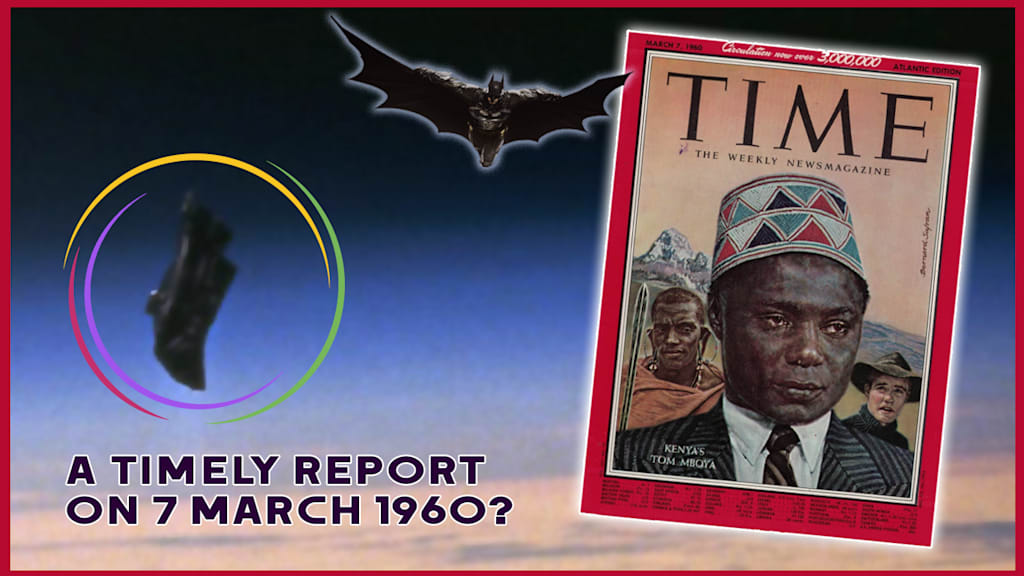
In its edition on 7 March 1960 Time magazine reported that the “mysterious ‘dark’ satellite wheeling overhead on a regular orbit” that had made headlines three weeks earlier, causing “nervous speculation that it might be a surveillance satellite launched by the Russians”, was in fact “a space derelict, the remains of an Air Force Discoverer satellite that had gone astray”.
“The dark satellite was the first object to demonstrate the effectiveness of the US’s new watch on space,” Time reported. “And the three-week time lag in identification was proof that the system still lacks full coordination and that some bugs still have to be ironed out.” Oh, what a relief, panic over!
Nice save that by the United States defence department... lucky they could bring everyone up to speed just three weeks after the story had broken and the American public had been worried sick they were being watched by the Russians who’d successfully launched Sputnik 1, the first man-made object to orbit the Earth, on 4 October 1957.
And by March 1960 when the Time report went out there’d already been a whopping 16 successful launches by the US or USSR, 19 failures (satellites not even reaching orbit) and seven deemed to be partial successes... so a possibility of there being a huge amount of derelict junk floating around – um, well, not really – that the defence department needed to be brought up to speed on.
Four of those partial successes were apparently US Discoverer satellites that had reached polar orbit before failing shortly afterwards, so one of them showing up in 1960 in a regular orbit – even in a derelict state – would really have been a turn up for the books, wouldn’t it?
But, evidence of the Black Knight satellite, as it’s now known, floating over the poles was not a particularly new phenomenon in 1960... in fact one could argue it was first reported back in 1899 by Serbian-American inventor and science visionary Nikola Tesla.
Sitting alone in his Colorado Springs laboratory trying to figure out atmospheric electricity and wireless technology, Tesla picked up what he believed to be unusual rhythmic signals from space. At first he speculated the “counting code” transmissions had originated from a planet communicating with Earth – perhaps Mars or Venus – but later came to believe the radio waves emanated from a satellite orbiting the planet, although he later returned to the opinion the signals probably came from an intelligent alien civilisation on Mars.
After all, couldn’t be a satellite orbiting Earth could it? The USSR didn’t launch one until 1957! But Tesla’s observations were the first of many to surface before Sputnik 1 went into orbit.
Perhaps one of the most intriguing of these claims arrived in popular culture after Norwegian engineer Jorgen Hals reported receiving strange “long-delayed radio echoes” in the 1920s. Although it wasn’t until five decades later that Scottish author and space enthusiast Duncan Lunan suggested they could be messages from an alien probe, although he makes it very clear on his website (www.duncanlunan.com) that any correlation with the Black Knight satellite was not of his doing.
In an Orkney News report from May 2022 Lunan explained what his report – “Space Probe From Epsilon Bootis?” – published by the British Interplanetary Society in Spaceflight in April 1973 had hypothesised about Hals’ “long-delayed radio echoes”... concluding that there was a strong possibility our planet had been visited by a probe 13,000 years ago... just not one that was still orbiting the planet from pole to pole today. But, read the article for yourself, it’s all far too technical for my humble brain to properly digest.
So the likelihood of there being a probe orbiting the planet on a polar trajectory for 13,000 years is probably not very strong, however a Black Knight satellite in orbit since the beginning of the 20th century is undoubtedly far from being beyond the realms of possibility.
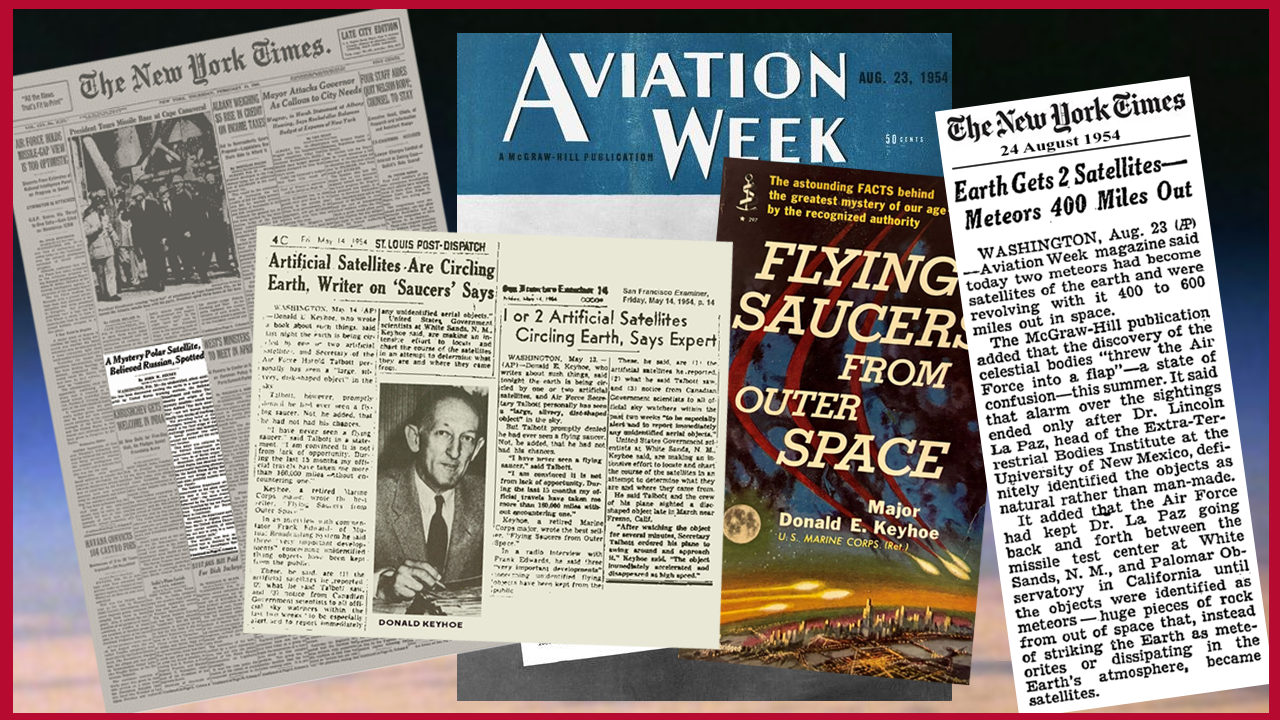
And it’s a story that’s been knocking around since the 1950s when the St Louis Post-Dispatch and the San Francisco Examiner carried articles on 14 May 1954 about artificial satellites circling Earth.
Both the St Louis Post-Dispatch and the San Francisco Examiner quoted Donald Keyhoe, a former Marine Corps naval aviator and UFO researcher, claiming the US Air Force had detected two satellites in Earth’s orbit, despite no such satellites having been launched by any nation at that time.
And, despite Pentagon attempts to play down the story, it resurfaced on 23 August in the technology magazine Aviation Week And Space Technology, followed up a day later on page 23 of the 24 August edition of The New York Times.
Then in February 1960 the object was allegedly spotted in polar orbit again. Dubbed the “dark satellite”, its existence was reported in The New York Times, on 11 February, allegedly being tracked for three weeks before abruptly disappearing, although amateur radio operators once again reported long-delayed radio echoes during the same period.
“The identity and origin of the mystery satellite which has been dubbed ‘the dark satellite’ are not known despite nearly two weeks of tracking,” the newspaper said. “The prevailing belief at the Pentagon, however, is that the object is the final stage of the multistage rocket that launched a Soviet payload into orbit around the Moon and the Earth last October.”
The New York Times report went on to say the silent satellite was “in a near polar orbit”... “the same course followed by the Discoverer satellite launched by the Air Force from Vandenberg Air Force Base in California”.
“However, the department said, ‘This object is slightly smaller than the United States Discoverer carrier rockets, of which six are now in orbit in a somewhat similar path’,” the article continues, adding: “The satellite was first detected late in January by the Navy Space Surveillance System, known as SPASUR. The discovery set off considerable speculation and discussion within the Pentagon about its origin and purpose.
“It was the first time an unidentified man-made object had been definitely detected in space. More importantly, there was no assurance that the silent object was not a Soviet reconnaissance satellite surveying the United States like the long-predicted ‘big brother in the sky’.
“Identification of the satellite has proved difficult because, unlike all other satellites, it never transmitted radio signals. Nor was there any indication from the United States intelligence network of any launching attempt in the Soviet Union that would explain the presence of the satellite.
“Through the memory unit of the Space Surveillance System, which keeps track of the course of all satellites in orbit, it was possible to establish that the satellite was not one launched by the United States or known to have been launched by the Soviet.”
However, less than three weeks later Time magazine was able to definitively report the object was just a derelict bit of a Discoverer satellite launched from Vandenberg Air Force Base in California which the Space Surveillance System was just a bit slow in identifying.
So, problem solved? Well, not really. The four Discoverer launches from 1959 had all only been deemed partial successes and were satellites the SPASUR tracking would have been aware of, but it had already established the dark satellite had not been launched by the US or was known to have been launched by the Soviets, while its trajectory was supposedly unlike any other object orbiting Earth.
This intrigued scientists at the Grumman Aircraft Corporation (now part of Northrop Grumman) and seven months after the satellite was first detected on radar a tracking camera at Grumman’s Long Island factory captured a photograph of it in September... the NASA contractor forming a committee to study the data it had captured although nothing was ever made public.
Then in 1963 when astronaut Gordon Cooper piloted Mercury-Atlas 9, the longest and last Mercury spaceflight, on a 34-hour mission and became the first American to spend an entire day in space, and the last on an entirely solo orbital mission, he reported seeing a glowing green object in the distance moving towards his capsule, which he’d named Faith 7. The Muchea tracking station in Australia, which Cooper reported the object to, also picked up the unidentified gadget on radar travelling east to west. Oddly, when Cooper returned to Earth he was allegedly forbidden from talking about the light and it was officially reported he had suffered hallucinations from an excess of carbon dioxide in his cabin.
So, what do we have so far? Well, certainly nothing definitive, just a few tantalising tidbits to suggest there could be a strange Black Knight satellite in a polar orbit around the planet that may well have been spinning around since the beginning of the 20th century... or even for 13,000 years if you’re convinced by some of the many other online accounts. But let’s just say it’s been orbiting the planet for 126 years, give or take a bit, so surely in that time – if it did exist – a decent photograph would have been taken of it by now?
Well, funny you should say that, it just so happens that in 1998 a series of photographs taken during the STS-88 Space Shuttle mission seem to offer just that... probably being the most compelling evidence for the Black Knight’s existence you’re likely to find. The images appear to show a dark, irregularly-shaped object floating near the shuttle but, hold on, they’ve been identified by NASA as showing nothing more than a thermal blanket apparently lost during an extravehicular activity.
Well, all I can say is, take a look at them yourselves... the Black Knight satellite, definitely not put into orbit by any agency on Earth, or a thermal blanket?
About the Creator
Steve Harrison
From Covid to Gaza and Ukraine... nothing is as it seems in the world. Don't just accept the mainstream brainwashing, open your eyes to the bigger picture at the heart of these globalist agendas.
JOIN THE DOTS: https://not.wildaboutit.com
Enjoyed the story? Support the Creator.
Subscribe for free to receive all their stories in your feed.
Comments
There are no comments for this story
Be the first to respond and start the conversation.