World History
The Real Santa Claus Explained by Michael Savage, New Canaan
Every December, the image of Santa Claus appears everywhere, from store windows to holiday movies and children’s letters. He is cheerful, generous, and always ready to bring joy. However, behind the red suit and flying reindeer is a true story rooted in history and kindness. Understanding where Santa Claus really came from adds deeper meaning to Christmas. New Canaan’s blogger Michael Savage often says that knowing the origin of holiday traditions helps people appreciate the values behind them, not just the symbols.
By Mike Savage New Canaan9 months ago in History
The Letters That Survived a War
In 1942, in a small town in northern France, life felt impossibly fragile. The war had already changed everything. Streets that once carried children laughing were now filled with silence or the distant thrum of military vehicles. The air carried a tension that had no scent, a weight you could feel pressing on your chest whenever you stepped outside. Marie, a young schoolteacher, had grown up surrounded by books. History fascinated her even then, though she never imagined she would live through an era that would one day be studied as history itself. Her days were consumed with teaching, with rationing, and with the quiet fear of what tomorrow might bring. Every morning, she would walk past the same corner where the local market used to be, imagining the bustling life that had vanished almost overnight. One day, while clearing out her small attic, Marie discovered a box of letters. They were brittle, the ink faded with age, but each one bore the signature of her father, who had disappeared years earlier at the onset of the war. Reading them felt like touching history itself. These letters told stories of a man who loved deeply, who worried endlessly about his family, and who clung to the small moments of humanity that war could not take away. The letters became her secret refuge. At night, she would sit by the window, candlelight flickering across the paper, reading her father’s words over and over. He wrote about the changing seasons, about neighbors who had fled, and about the quiet hope that he would one day return home. Though he never did, his words taught Marie something profound: history is not just dates and battles; it is the human experience that survives between them. As the war progressed, the town experienced more upheaval. Soldiers came and went. Families were torn apart. But Marie held onto the letters, treating them like a lifeline. She shared some of their stories with her students, teaching them not only language and arithmetic but also the power of memory and the importance of recording life as it happens. The children listened in silence, absorbing the weight of history through her voice. Years later, long after the war ended, Marie moved to Paris. The city was rebuilding, but the scars of the past were visible in every street, every building, every story whispered among strangers. She carried the box of letters with her, a reminder that ordinary people live through extraordinary times and that their experiences form the threads of history that textbooks cannot capture. One afternoon, she donated the letters to a small museum dedicated to documenting the lives affected by the war. The curator looked at the fragile papers and said, “These are not just letters. They are a testimony to resilience.” For Marie, it was the first time she realized that the story of her father, and of her town, could teach others lessons about courage, hope, and the endurance of the human spirit. Visitors to the museum would often pause in front of the letters, tracing the faded ink with their eyes, imagining the life behind each word. They could almost hear the father’s voice, whispering across time, carrying love, fear, and hope. History, Marie realized, is not only about kings and generals, treaties and battles. It is about the people who lived, who wrote, who remembered, and who survived despite everything. The letters had survived decades of neglect, decay, and silence. They survived because someone cared enough to keep them safe. In doing so, they became a bridge between the past and the present, a reminder that history is alive in the smallest details of everyday life. Marie’s story, though small in the vast timeline of the war, reflected a universal truth: history is not only found in monuments or textbooks. It lives in letters, photographs, memories, and the ordinary moments of people who endure extraordinary circumstances. Every word on those pages was a pulse, a heartbeat echoing across time, teaching future generations what it meant to live, to love, and to hope in the midst of uncertainty. In the end, history is not simply a record of what happened. It is a story waiting to be discovered, understood, and remembered. And sometimes, it survives in a box of letters in an attic, waiting for someone to open it and let the past speak.
By Jhon smith9 months ago in History
The 5 Most Dangerous Jobs in Early America - And the People Who Did Them Anyway
There was a time in America when going to work meant making peace with the possibility that you might not come home. No safety regulations. No OSHA posters. No warning labels. No compensation forms.
By The Iron Lighthouse9 months ago in History
When the Sky Fell Back to Earth
On a bright September morning in 1986, downtown Cleveland looked like it was preparing for a celebration that would be remembered forever. Volunteers filled Public Square with nets, smiles, and helium tanks. Children laughed. Cameras rolled. The plan was simple and beautiful: release an ocean of colorful balloons into the sky, break a world record, and raise money for a good cause. What could possibly go wrong?
By Izhar Ullah9 months ago in History
When AI Listens Too Closely: The Hidden Human Cost of Digital Companionship. AI-Generated.
The Rise of AI in Everyday Life — and the Cost We Didn’t See Coming Artificial intelligence didn’t arrive with a bang. It slipped in quietly. First as a homework helper. Then a writing assistant. Then something people talked to late at night when no one else was awake. Today, AI answers questions, cracks jokes, offers advice, and sometimes pretends to listen. For most users, that’s harmless. Useful, even.
By David John9 months ago in History
Beyond the Prison Walls
The city moved as it always had. Cars filled the roads, shops opened their shutters, and people hurried through their routines. Yet beneath the noise of everyday life, a quiet unease lingered. In homes, tea stalls, and university corridors, one question echoed repeatedly: Can truth really be locked behind iron bars? Behind tall prison walls, Imran Khan sat alone in a narrow cell. The room was simple—cold walls, a small window, and a bed that creaked with every movement. To the authorities, he was just another prisoner. To millions beyond those walls, he was something far more—a symbol of hope, resistance, and belief. Many believed, with unwavering certainty, that he was innocent. Imran Khan was not an ordinary man who had stumbled into prison by chance. He had lived his life in the public eye, carrying dreams of justice and reform. His rise had been filled with struggle, criticism, and sacrifice. Now, at the peak of controversy, he found himself confined to silence. Yet even in confinement, his mind remained free. Time inside prison passed differently. Minutes felt like hours, and hours stretched into eternity. The only reminder of the outside world was the thin beam of sunlight that slipped through the small window each morning. Imran Khan often watched that light carefully, as if it carried messages from the world he had left behind. He thought of the people—farmers, laborers, students—who had once stood in crowds, listening to his words with hope in their eyes. He remembered their chants, their faith, and their belief that change was possible. Those memories did not weaken him; they strengthened him. Prison had taken away his freedom, but not his purpose. Each morning, he began the day in silence. A quiet prayer, a moment of reflection, and then hours of thought. Sometimes he wrote on scraps of paper, capturing ideas, reflections, and hopes for a future he believed would come. Other times, he simply sat still, his mind traveling far beyond the prison walls—to the mountains, the villages, and the streets of his country. One of the prison guards often observed him from a distance. Unlike other inmates, Imran Khan never complained. He never begged, nor did he show anger. His calm unsettled those around him. The guard once whispered to another, “This man may be locked, but he is not defeated.” Nights were the hardest. When darkness filled the corridors and silence grew heavy, doubts crept closer. Yet even then, Imran Khan reminded himself of history. He knew that many before him had faced imprisonment despite their innocence. Time had eventually cleared their names, even if it had come too late for some. He believed justice, though delayed, could never be denied forever. Outside the prison, conversations continued. Supporters argued, critics debated, and neutral observers watched closely. The nation stood divided, but one thing was undeniable: his imprisonment had not erased his presence. In fact, it had amplified it. His name was spoken more often now, his ideas discussed more deeply. Imran Khan understood this truth well. Power does not always live in offices or titles. Sometimes, it lives in endurance. Sometimes, silence speaks louder than speeches. From behind bars, his resolve became a message of its own—a reminder that principles cannot be imprisoned. He believed his struggle was not personal. It was a test for the nation itself. Would truth survive pressure? Would justice stand firm when challenged? These questions mattered more than his own comfort or freedom. Days turned into weeks, and weeks into months. Though physically confined, his spirit grew stronger. He imagined a future where history would look back and judge fairly. A future where truth would stand clear, no longer buried under accusations or fear. In his heart, Imran Khan carried hope—not blind hope, but patient hope. He believed that walls crumble, systems change, and lies fade with time. Only truth remains. This story is not just about one man in prison. It is about every individual who stands for justice and pays a price for it. It is about the belief that innocence may be ignored for a while, but it cannot be erased. And so, behind prison walls, a silent trial continued—not just of a man, but of a nation’s conscience. For while a body can be locked away, the truth has a way of finding the light.
By Abubakar khan 9 months ago in History
What Do You Mean by “Retro Spirit”?
What Do You Mean by “Retro Spirit”? When people say they love the retro spirit, they’re not just talking about old clothes, vinyl records, or vintage furniture. They’re pointing at something deeper and harder to pin down: a mood, a feeling, a way of looking at life through a softer, warmer lens. Retro isn’t only about the past. Retro spirit is about how we use the past to make the present feel more human.
By Sayed Zewayed9 months ago in History
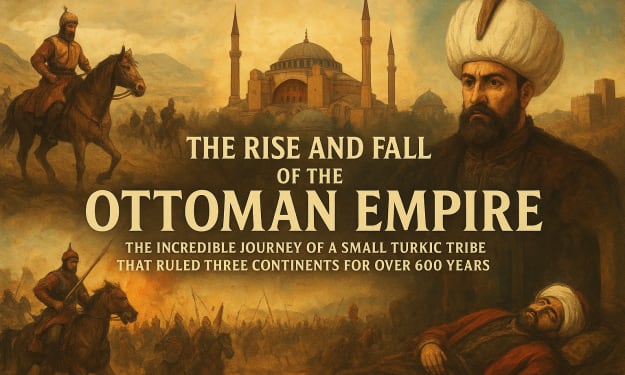
The Rise and Fall of the Ottoman Empire
History has seen many empires rise and fall, but few stories are as dramatic and powerful as that of the Ottoman Empire. What began as a small group of nomadic warriors eventually became one of the greatest empires the world has ever known. For more than six centuries, the Ottomans ruled vast lands across Europe, Asia, and Africa. Their journey is a story of ambition, faith, military genius, cultural brilliance, and, eventually, decline.
By shahid khan9 months ago in History