World History
3 Ordinary Places That Hid Something Truly Disturbing for Years. AI-Generated.
Most of us take comfort in ordinary places. Schools feel safe. Homes feel familiar. Workplaces feel predictable. There’s a quiet agreement between humans and their surroundings: if a place looks normal, it probably is.
By Enoch Sagini8 months ago in History
The Quiet Collapse of Global Arms Control
The Quiet Collapse of Global Arms Control For decades, arms control agreements helped prevent the world’s most powerful weapons from spiraling out of control. Treaties limited nuclear stockpiles, increased transparency, and built fragile trust between rival states. Today, that system is quietly unraveling—and its collapse may define the next era of global insecurity.
By Wings of Time 8 months ago in History
The Red Sea Crisis and the Fragility of Global Trade
The Red Sea Crisis and the Fragility of Global Trade The Red Sea has quietly become one of the most critical pressure points in global affairs. Once seen mainly as a commercial shipping route connecting Asia, Europe, and Africa, it is now a zone of rising military tension, disrupted trade, and geopolitical rivalry. What happens in this narrow stretch of water is no longer a regional issue—it is reshaping global economics and international security.
By Wings of Time 8 months ago in History
The Quiet Rise of Global Militarization
The Quiet Rise of Global Militarization Across the world, governments are increasing military spending, expanding defense industries, and modernizing weapons systems—often without openly acknowledging why. There are no formal declarations of war, no mass troop mobilizations, and no clear enemy named in many cases. Yet behind the scenes, a quiet shift is taking place. Global militarization is rising, not loudly, but steadily, reshaping international relations in ways that may define the coming decades.
By Wings of Time 8 months ago in History
The Fall of Tibet to a Communist State: History, Causes, and Consequences
The incorporation of Tibet into the People’s Republic of China (PRC) after 1950 was not a single event but a complex process involving military force, political negotiation, ideological conflict, and long-lasting resistance. Understanding this fall requires examining Tibet’s historical status, China’s communist revolution, and the profound consequences that followed. Tibet Before 1950: A Distinct Civilization Before the Chinese communist takeover, Tibet functioned as a de facto independent region for decades, especially after the fall of the Qing Dynasty in 1911. Although China historically claimed suzerainty over Tibet, actual control was minimal for long periods. Tibet was governed by a theocratic system led by the Dalai Lama, combining religious authority with political power. Tibetan society was deeply rooted in Buddhism, monasteries were central institutions, and cultural traditions had evolved largely isolated from the outside world. However, Tibet was not a modern nation-state in the Western sense. Its political system was traditional, its military weak, and its international recognition limited. While Tibet maintained its own administration, currency, and foreign relations to some extent, few countries formally recognized it as an independent state. This ambiguity later played a crucial role in China’s justification for intervention. Rise of Communist China and Its Ideology In 1949, the Chinese Communist Party, led by Mao Zedong, emerged victorious from the Chinese Civil War and established the People’s Republic of China. The new communist government was driven by Marxist-Leninist ideology, which emphasized territorial unity, central authority, and the elimination of feudal and religious systems viewed as oppressive. From the communist perspective, Tibet was considered an inseparable part of China that had been “liberated” from imperial control in the past. The Chinese leadership described Tibetan society as “feudal” and “backward,” arguing that communist intervention would free the Tibetan people from serfdom and religious exploitation. These ideological beliefs formed the moral and political justification for China’s actions in Tibet. The 1950 Invasion: Military Force and Political Pressure In October 1950, the People’s Liberation Army (PLA) crossed into eastern Tibet and defeated the small, poorly equipped Tibetan forces at Chamdo. This military action is often referred to by China as the “Peaceful Liberation of Tibet,” but for Tibetans, it marked the beginning of occupation. Facing overwhelming military pressure and lacking international support, Tibetan leaders were forced to negotiate. In 1951, Tibetan representatives in Beijing signed the Seventeen Point Agreement. This agreement affirmed Chinese sovereignty over Tibet while promising autonomy, protection of religious freedom, and preservation of the Dalai Lama’s authority. Importantly, the agreement was signed under duress, and the Dalai Lama later stated that it did not reflect the true will of the Tibetan people. Broken Promises and Growing Tensions Initially, China adopted a cautious approach, especially in central Tibet, allowing traditional institutions to continue. However, in eastern regions like Kham and Amdo, radical communist reforms were introduced. Land redistribution, collectivization, and attacks on monasteries sparked widespread resentment and armed resistance among Tibetans. By the mid-1950s, tensions escalated as Chinese authorities increasingly interfered in religious affairs and governance. Monasteries were closely monitored, monks were arrested, and traditional elites were sidelined. For a society where religion was central to daily life, these actions were deeply traumatic. The 1959 Uprising and Exile of the Dalai Lama The situation reached a breaking point in March 1959 when a massive uprising erupted in Lhasa. Thousands of Tibetans surrounded the Dalai Lama’s palace, fearing that the Chinese planned to abduct him. The revolt was brutally suppressed by the PLA, resulting in thousands of deaths and widespread destruction. Following the uprising, the 14th Dalai Lama fled Tibet and sought asylum in India, where he established a government-in-exile in Dharamshala. His exile symbolized the definitive collapse of Tibet’s traditional political system and marked a turning point in the Tibetan struggle. Cultural Revolution and Cultural Destruction The fall of Tibet deepened during China’s Cultural Revolution (1966–1976). Religious practice was banned, monasteries were destroyed, sacred texts were burned, and monks were forced to abandon monastic life. An estimated 6,000 monasteries were damaged or demolished. Tibetan culture, language, and identity faced systematic suppression under the banner of revolutionary ideology. This period left deep scars on Tibetan society and reinforced the perception that communist rule threatened not just political autonomy, but the very survival of Tibetan civilization. Long-Term Consequences and Global Impact
By Say the truth 8 months ago in History
The Dalai Lama: Life, Teachings, and Global Influence. AI-Generated.
Early Life and Recognition The 14th Dalai Lama was born on July 6, 1935, in a small farming village called Taktser in northeastern Tibet (present-day Qinghai Province, China). His birth name was Lhamo Dhondup. Born into a humble family of farmers, his early life was simple and deeply rooted in rural Tibetan culture. At the age of two, he was identified as the reincarnation of the 13th Dalai Lama by a search party of Tibetan monks. According to Tibetan Buddhist tradition, the Dalai Lama is believed to be the reincarnation of Avalokiteśvara, the Bodhisattva of Compassion. After rigorous tests and spiritual confirmations, the child was officially recognized and taken to Lhasa, the capital of Tibet, to begin monastic training. He was renamed Tenzin Gyatso, meaning “Ocean of Wisdom.” The Dalai Lama: Life, Teachings, and Global Influence The Dalai Lama is one of the most respected spiritual leaders in the world, known for his teachings on compassion, non-violence, peace, and universal responsibility. He is the spiritual head of Tibetan Buddhism and a global symbol of harmony and moral leadership. Over the decades, the Dalai Lama has transcended religious boundaries, inspiring millions across cultures, nations, and belief systems.
By Say the truth 8 months ago in History
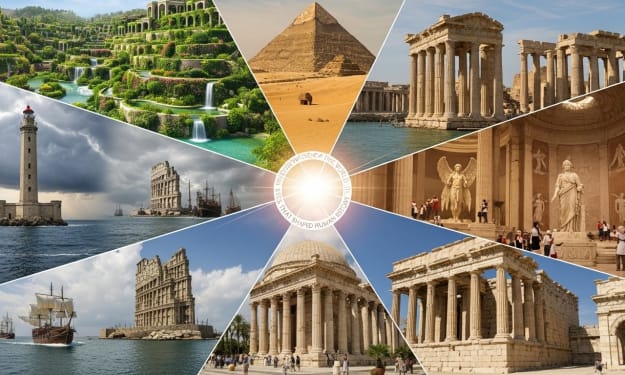
The Seven Wonders of the World: Amazing Human Creations. AI-Generated.
People have always been fascinated by things that are grand and unusual. From the very beginning of civilization, humans wanted to build structures that were not just useful, but also showed their skill, creativity, and ambition. The Seven Wonders of the World are the most famous examples of this desire. They are impressive not only because of their size or beauty, but also because of the stories they tell about our past, different cultures, and human innovation. The idea of the Seven Wonders comes from ancient travelers and historians who listed the most remarkable human creations. Even though some of these wonders no longer exist, their legacy continues to inspire people around the world. Let’s explore each one, looking at their history, significance, and why they remain unforgettable. 1. The Great Pyramid of Giza (Egypt) The Great Pyramid of Giza is the only surviving wonder of the original Seven Wonders. Built around 2560 BCE as the tomb of Pharaoh Khufu, it is an extraordinary engineering achievement. Made from more than two million limestone blocks, some weighing over 15 tons, the precision of its construction is still astonishing today. The pyramid shows the power and beliefs of ancient Egypt and continues to attract visitors from all over the world. It is a true symbol of human skill and vision. 2. The Hanging Gardens of Babylon (Iraq) The Hanging Gardens of Babylon are famous for their beauty and clever design, though historians still debate whether they really existed. Ancient stories say King Nebuchadnezzar II built these stepped gardens for his wife, Amytis, who missed the green hills of her homeland. The gardens, described as terraces full of trees, flowers, and shrubs, appeared to float above the city. Whether real or partly mythical, they show how ancient people combined nature and architecture in extraordinary ways. 3. The Statue of Zeus at Olympia (Greece) Around 435 BCE, the sculptor Phidias created the Statue of Zeus at Olympia. This huge statue of the Greek god Zeus, seated on a throne, was over 12 meters tall and made of ivory and gold-plated bronze. It represented both artistic skill and religious devotion. Even though it was destroyed long ago, records and artistic depictions keep its memory alive, showing the Greeks’ dedication to beauty, religion, and craftsmanship. 4. The Temple of Artemis at Ephesus (Turkey) The Temple of Artemis, built around 550 BCE, was dedicated to the Greek goddess of the hunt and wilderness. Known for its enormous size, detailed sculptures, and beautiful design, it was rebuilt several times after destruction, reflecting its cultural importance. People traveled from across the Mediterranean to see it, making the temple a center of religion, art, and commerce. Today, its ruins still tell the story of a civilization that valued beauty and spiritual devotion. 5. The Mausoleum at Halicarnassus (Turkey) Built between 353 and 350 BCE, the Mausoleum at Halicarnassus was the tomb of Mausolus and his wife Artemisia. Combining Greek, Egyptian, and Lycian styles, it stood around 45 meters tall and was decorated with intricate sculptures. Its design influenced monumental tombs for centuries. Even after earthquakes destroyed it, the Mausoleum remains a symbol of human creativity and architectural achievement. 6. The Colossus of Rhodes (Greece) The Colossus of Rhodes, built between 292 and 280 BCE, was a massive bronze statue of the sun god Helios, celebrating Rhodes’ victory over an invading army. Over 30 meters tall, it was one of the tallest statues of the ancient world. Although it only stood for 54 years before an earthquake toppled it, the Colossus became a symbol of triumph, resilience, and artistic achievement, inspiring large statues throughout history. 7. The Lighthouse of Alexandria (Egypt) The Lighthouse of Alexandria, or Pharos, was built around 280 BCE on the small island of Pharos. Standing over 100 meters tall, it served as both a landmark and a guide for sailors entering Alexandria’s busy harbor. Its elegant design combined functionality and beauty. Though earthquakes destroyed it long ago, it remains a symbol of human ingenuity and innovation in maritime engineering. The Legacy of the Seven Wonders The Seven Wonders are more than just buildings; they are symbols of human creativity, ambition, and achievement. Each wonder tells a story about the people who built it, the culture it came from, and the new ideas of its time. Even though some no longer exist, their stories continue to live through historical records, art, and the fascination of people worldwide. These wonders still inspire architects, artists, engineers, and travelers today. From the pyramids of Egypt to the Hanging Gardens of Babylon, they remind us that imagination and effort can create something that lasts for thousands of years. They are examples of determination, vision, and the pursuit of excellence. Conclusion The Seven Wonders of the World are timeless creations that celebrate human creativity and determination. They are more than stones, metals, or ruins—they represent entire civilizations and the marks they left on history. Even after centuries, their stories continue to inspire people to dream, create, and achieve greatness. These wonders remind us that with vision, passion, and effort, humans can build creations that
By Antonuos Zarey8 months ago in History
Why August Wilson’s Joe Turner’s Come and Gone Feels Urgent on Today’s Broadway Stage by NWO Sparrow
Why August Wilson’s vision of identity and movement resonates in today’s political climate by NWO Sparrow Joe Turner’s Come and Gone returns with urgency, reflection, and cultural weight
By NWO SPARROW8 months ago in History
Chinese Water Torture. Content Warning.
Since the dawn of history, human beings have inflicted unimaginable suffering upon one another. Across centuries, people have devised increasingly elaborate methods of punishment and coercion, some brutally explicit, others deceptively subtle. While devices such as iron maidens, racks, whips, and wheels relied on visible physical agony, there existed a form of torment whose true power lay not in blood or broken bones, but in patience, repetition, and the slow erosion of the mind. This method came to be known as Chinese water torture.
By Pure child8 months ago in History