World History
UAE astronaut on longest-ever Arab space mission: "A big responsibilIty"
The songs of the late Egyptian superstar Umm Kulthum have been played countless times in cabs and coffee shops around the Arab world because they are profound and soul-stirring. They have now made their way to the antiseptic white corridors of the International Space Station, owing to the musical preferences of a trailblazing Emirati astronaut. Sultan al-Neyadi, who will make history this weekend by completing the longest Arab space mission ever, told the Guardian from space that he believed it was important to convey a piece of Arab culture to space during the journey. Neyadi, who was floating in microgravity, stated in a recorded video message that "everyone is watching us; everybody is excited about space." Many of my coworkers have said how great it is to hear a foreign language on the station, I overheard. The majority of the few hundred people who have crossed the border of space have been Americans, and NASA-trained astronauts or Russian cosmonauts have dominated celestial flight for decades. Only six Arabs have been to space so far; they are now referred to as "aquanauts" after the Arabic word for star, "najm". Neyadi has used his six-month stay on the International Space Station (ISS), which orbits the Earth at a speed of around 17,500 mph (28,000 km/h) and an altitude of about 250 miles (400 km), to conduct crucial scientific experiments as well as to introduce the Arab world to the marvels of space. The 42-year-old flight engineer has frequently uploaded videos in Arabic to social media about life on board the space station, detailing his peculiar daily routine, which includes eating vacuum-packed food and exercising in a "weightless" environment with a machine that generates its resistance. When asked whether he felt pressure as one of a small group of aquanauts to encourage interest in space exploration and science among people in the Middle East and North Africa, Neyadi responded to the Guardian that there is a sizable audience in the Arab world that is "thirsty to learn more about space." We must impart information and present these results to them clearly and engagingly, he added. "In particular, the youth... I would like to be a resource for them—a source of knowledge and motivation. Therefore, it's a huge duty. Neyadi has also given the world's space enthusiasts a new point of view by snapping pictures of famous places and Middle Eastern cities that honor a region that is sometimes unfairly characterized in the West.
By Cyril Lord3 years ago in History
The First Americans
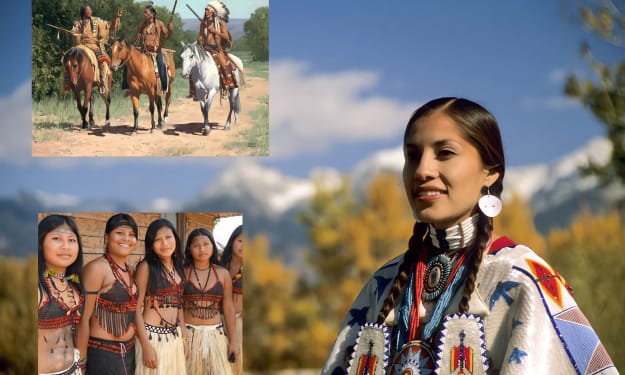
Since the inception of our species' exploration of the world, it has encountered significant challenges, and human adaptation has been a necessary requirement for our survival and proliferation on this planet. The continents of Africa, Asia, Europe, and Oceania bear the marks of human occupation since the beginning of human history. However, the American continent presents some uncertainties. The question of who the First Americans were, when they arrived on the continent, and how the colonization of the continent occurred persists due to its geographic location, far from other continents. The most widely accepted hypothesis is that at the end of the Pleistocene period, a thin strip of land called Beringia connected North America with Asia, as the sea level was approximately 120m below the current level. However, with the changes in climatic conditions that occurred at the end of the Last Glacial Maximum period, which began around 25,000 years ago, the sea level began to rise gradually, and the then layer of land, Beringia, was submerged, leaving only small islands projected further to the east. This caused the populations known as paleo-indigenous to be forced to leave the region, following the herds of animals they hunted or looking for other sources of food and heat, and they were forced to go towards what we now know as Alaska and Canada, down through the Yukon Valley, and also following ice-free corridors between the Laurentide Ice Sheets, which was a great sheet of ice that covered North America until the current Great Lakes region. An alternative migration by coastal navigation is also suggested, where some groups would follow the mainland coast, heading south. In the following millennia, the descendants of these Asians moved south in search of favorable conditions and ended up populating the entire American continent, being known as the first Americans. This is currently the most accepted hypothesis, but there are others that are also considered, such as the idea that the continent was colonized from peoples coming from the Pacific Ocean, from Australian, Malay, and Polynesian aboriginal peoples who would have migrated by accident and colonized the west coast of South America. Many support this idea, with recently discovered ancestral DNA data indicating that there is a higher proportion of Australo-Melanesian ancestry in South American Native Americans, a signature absent in indigenous populations from North and Central America. The Americas were shaped by these migratory phenomena, associated with climatic factors, to lay the foundations of various cultures and peoples that marked the continent. The evidence of the presence of ancient hunting groups in Central America has been found at the El Bosque site, near Pueblo Nuevo, in the Estelí district of northwestern Nicaragua. The stratigraphic features of the site indicate the presence of a lower layer with numerous bones of large mammals identified as belonging to the species of Megalonychids, a type of giant sloth called Ere-motherium, of species of Odocoileus, an extinct type of deer, and also bones of chelonians and small mammals, and the artifacts associated with this fauna were manufactured, being chipped in a very rudimentary way. In South America, peoples originating from the first wave created great cultures and societies as complex as those found in Asia, Africa, and Europe. Some native South American populations, such as the Suruí, Caritiana, Xavante, Guarani-Caioá, and Chutuná, share 3% of their DNA with peoples from Australia and Oceania, suggesting that these individuals descend from one of the first waves to cross Beringia about 15,000 years ago. This ancestral group is known among scientists as the Y population, initial of Ypykuéra, Tupi word for ancestor. However, there is no evidence that the peoples of Oceania crossed the Pacific and arrived directly in South America. What most likely happened, according to the most recent data, is that the migration of these individuals took place to Asia and then to Africa. Beringia, and in this migratory process, they started living in the Americas. Despite the existence of geological, archaeological, and genetic evidence, we still do not have an irrefutable certainty of who the First American was, and we hope that with more research, we can unravel this mystery.
By A História3 years ago in History
Lost in the Ice: The Mystery of the Franklin Expedition
In 1845, two British ships, HMS Erebus and HMS Terror, embarked on an ambitious journey into the icy Arctic waters. Their mission was to find a route connecting the Atlantic and Pacific oceans through the frozen bays of Canada, a pathway known as the Northwest Passage. This endeavor had both economic and scientific objectives. Britain aimed to enhance its economy through improved trade routes to China, trading silk, spices, and more. Additionally, the expedition sought to study the Earth's north magnetic pole for scientific advancement and better maritime navigation in the Arctic.
By Joshua Fiu3 years ago in History
World's Most Mysterious Places
Step into the mystical world of the Czech Republic, where ancient pagan and mystical traditions still hold sway. Among the many enigmatic sites that dot this land, the Hill of Crosses stands out as a place of great spiritual power. Nestled in the northern reaches of Lithuania, this pilgrimage site has been drawing visitors for centuries. Legend has it that the hill was originally built to honor fallen warriors, but over time, it became a sacred site associated with miracles and healing. Today, the hill is adorned with thousands of crosses of all shapes and sizes, some dating back centuries. Many visitors claim to have experienced miraculous healings and other paranormal phenomena while visiting this hallowed ground.
By miss hyena3 years ago in History
The Commonwealth in Transition: From Empire to a Global Partnership
On November 30th, 2021, a significant chapter in history was written as Barbados officially declared itself a parliamentary republic. The lowering of the queen's flag marked the end of a more than 350-year-old colonial relationship with the British monarchy. However, amidst this monumental shift, the Commonwealth of Nations, a vestige of the British Empire, continued to play a pivotal role. This article aims to explore the evolution of the British Empire, the birth of the Commonwealth, and the complex relationship between the monarch and the nations that make up this diverse organization.
By Vivian Yao3 years ago in History