World History
The Remarkable Life of Sir Adrian Carton de Wiart
The Remarkable Life of Sir Adrian Carton de Wiart In 2006, the Mexican beer brand Dos Equis launched an ad campaign featuring Jonathan Goldsmith as the "Most Interesting Man in the World." The campaign was wildly successful, transforming Dos Equis into one of the most popular imported beers in the US. Goldsmith claimed he based his character on his friend Fernando Lamas, a famous actor and director who lived an adventurous life. However, the real-life subject of today's story makes even Lamas seem dull in comparison. This is the story of Sir Adrian Carton de Wiart, a man whose life was so extraordinary that it reads like a Hollywood script. Born on May 5, 1880, in Brussels, Belgium, Adrian Carton de Wiart came from a family of Belgian aristocrats. There were even rumors that he might have been the illegitimate son of King Leopold II of Belgium. Adrian’s family moved frequently, eventually settling in Egypt. At 11, Adrian was sent to boarding school in England, where he excelled in sports but showed little interest in academics. Despite his academic struggles, his connections helped him get into Oxford to study law. However, his heart wasn’t in it, and he spent most of his time playing sports and drinking. In 1899, the outbreak of the Second Boer War provided Adrian with an escape from his studies. He dropped out of Oxford and enlisted in the British Army under a false identity, eager to experience the romanticized version of military life. His first taste of combat was brief and painful; he was shot in the groin and stomach, which led to his return to England. Despite his injuries, Adrian realized he loved the thrill of warfare. Adrian's father eventually allowed him to pursue a military career, and he went on to fight in various conflicts. His early years in the military included a stint in India, where he indulged in sports and hunting. In 1907, he became a British citizen and, the following year, married Countess Frederica Fugger, a member of a prominent German banking family. In 1914, when World War I broke out, Adrian was eager to join the action. Initially, he was sent to fight in British Somaliland, where he was shot twice in the face during a raid. Remarkably, he survived but lost his left eye. He returned to England and, within weeks, managed to convince the military board to send him to the Western Front in France. During World War I, Adrian participated in several major battles, including the Somme and Passchendaele. He was shot multiple times, resulting in numerous hospital stays and even the amputation of his left hand. Despite his injuries, Adrian’s bravery and resilience made him a legendary figure among his peers. His love for war was evident in his famous quote, “Frankly, I enjoyed the war.” After the war, Adrian led the British military mission to Poland, helping the newly formed Second Polish Republic. During this period, he survived a plane crash, was imprisoned by Lithuanians, and even got involved in a duel. His time in Poland also saw him working closely with notable figures, including the future Pope Pius XI and the Finnish President Carl Gustaf Emil Mannerheim. In 1923, Adrian retired from the military and chose to settle in Poland. He was offered a house on an island estate by Prince Karol Radziwiłł, a former aide. For the next 15 years, Adrian lived as a Polish nobleman, enjoying hunting, fishing, and social events. Adrian Carton de Wiart's life was a series of incredible adventures and near-death experiences. He was shot multiple times, survived plane crashes, and endured numerous injuries, yet his spirit remained unbroken. His story is a testament to his extraordinary resilience and passion for life. Truly, he was one of the most interesting men to ever walk the earth.
By Rabiul Molla2 years ago in History
CIRCLES. Content Warning. AI-Generated.
Of all the rabbit holes I get stuck in on the internet I don’t know any quite as powerful as Google Earth. Seeing beautiful patterns from above... Dropping down into street view... And seeing the planet in ways I would never get to see in person. So when I came across this post on Reddit, I was fascinated. It described “undocumented markings” in Algeria, in the middle of the Sahara near a location called “Tebalbalet tomb.” Visible on Google Earth. There were 22 of them, each with 12 “surrounding things”, 42 meters in diameter 420 meters apart, at longitude 4'20 East. It almost sounded like a joke. But then I copied the coordinates and I looked. There they were: identical circles in an almost perfect line. 160 kilometers from any signs of life in the world’s largest desert... in the middle of the biggest country in Africa. This is a story about the limits of what you can find out on the internet. About all the different ways of looking at the same thing. And about going all the way there. Over the course of the last 20 weeks, we filmed every step of the process as we tried to figure out one thing... What could these circles be? So this whole story starts back in September 2021 when I first saw the Reddit post. I wanted to figure out what these “markings” were and make a video out of the entire reporting process. No matter how long it took. Because the answer had to be out there. And, step one, I knew I was going to have to send some emails. For weeks, I reached out to everyone I could think of: Algerian experts, officials, tour groups... even the closest hotel, in a city called Aïn Salah. I read up on the town the circles were located closest to: Foggaret Ezzaouia. I asked the commenters on the Reddit post... and we even tracked down a Twitter account we thought was the same Will K who posted this question to several subreddits before deleting his Reddit account. I tried English and French... organizations, academics, locals... And then... I waited. But there was one easy thing to clear up first. Were these circles real? Or were they just some kind of satellite imaging glitch? So I asked a teammate who works with maps a lot: Sam, he produces our series Atlas. And he pointed me to the company that takes a lot of the satellite pictures for Google Earth: Maxar Technologies. I feel very confident that those are indeed on the ground because we see them in multiple images over multiple years. So, I know it wasn't an artifact of the processing that Google might have done with our imagery. And then a colleague of mine who has spent a decent amount of time studying this area said, “You know, this is a very rich area for oil and gas.” “This looks very similar to what we see when they're doing oil exploration.” Oil radically changed the course of Algeria’s history. "Oil from the wastelands of the desert..." "And it's believed that the Sahara is immensely rich in it." When oil and gas were discovered there in 1956, companies flocked to the region against the backdrop of a brutal decolonization war with France. Today, Algeria is one of the world’s top exporters of natural gas. What Steve is talking about here is seismic surveys where geophysicists analyze the Earth’s surface by sending shock waves into the ground. Depending on how those seismic waves bounce back researchers can tell what resources can be extracted from underground. Steve thought that, maybe, seismic pulses from a specialized vehicle could produce something like this. So, we had a hypothesis. But I wanted a second opinion. So I asked Bob Hardage at the University of Texas one of the world’s leading experts on seismic imaging. He responded by email: ”I can assure you with 100-percent confidence that the features in this imagery are not seismic arrays used in oil and gas exploration.” First, the shapes themselves weren’t right. “...there will be hundreds of thousands of receivers positioned as either a single straight line or as hundreds of parallel straight lines.” I looked up pictures from NASA of seismic surveying and you can see what he means. Second: the fact that we could even see them meant they probably weren’t a seismic survey. “... the objective is to leave the landscape like you found it." "If a seismic crew created something like these features a return visit would be made to restore the landscape.” “I have no idea what the circles in the satellite image are." "Whatever they are, the people who created them wanted those features to be permanent.” “Closeout: I don’t think we need to chat.” Thanks Bob. So I kept Googling. I found geotagged pictures from the nearest municipality, Foggaret Ezzaouia on a site called mapio.net. These old stone wells sorta looked like they could be arranged in a circle. But reverse image searches were a dead end. I didn’t know what to do next. So we looped in Vox video’s senior researcher, Melissa, to help me out. So, I was trying to find what this thing was. I don't know if you remember from his original post he calls it the Tebalbalet tomb. Do you remember that? So I found this article. This is from like 1985 — I mean, not 1985: 1885. The “Well of Tebalbalet” is at the latitude 27°20 and longitude 4°38. And that's approximately where what we're looking at is. And it says there are two circular tumuli. I had to Google that, I don't know that word. -Tumuli. What's a tumulus. Tumulus. It's an ancient burial mound. Which seems... that sounds about right. “... encompassed by two concentric mounds in the form of rings, all of great regularity." "The two rings are respectively 30 and 21 meters in diameter, from crest to crest.” So a document from 1885 said that, around this same area, there were 1) a bunch of wells, and 2) tombs with “rings of great regularity.” Now, the sketches weren’t an exact match. But they got us thinking: what if these things were actually really old? So I sent the pictures to a Tunisian archaeologist who had done research in this area. We spoke in French because of decades of French occupation in the 19th and 20th centuries French is still used in many contexts in Tunisia and Algeria. And she had a new clue. [in French] These monuments, they are without a doubt [in French] because I know Aïn Salah very well... [in French] These monuments are related to... [in French] Water. [in French] It's a desert environment, it's the Sahara. [in French] It is practically the hottest place in the Maghreb. [in French] It’s an area which is very well known for the difficulties of this heat there, and for the water harvest. [in French] So the people, they dig. [in French] It has a name: the Foggaras. Foggara. It’s the North African name for a 2,500-year-old style of irrigation system that goes by many names, but is often called a qanat. Builders dig a well at an elevated point on a slope deep enough to tap into groundwater. They then dig parallel shafts at regular intervals. These provide air flow for diggers as they create an underground channel all the way back to the main well. With a slope of 1 or 2 degrees, the channel carries water long distances powered by gravity alone. In a part of the world with barely any rain and no running rivers this technology can provide water for crops, livestock, and people year round... making human-made oases possible. [in French] It's curious, eh? This was the most promising lead yet. It explained the desert location, the circular shape, the regularity, and spacing. Even the closest municipality’s name, Foggaret Ezzaouia, is named after foggaras. And those mapio pictures of wells started to make sense. But I wanted to run it by more people who had studied qanats. Qanats are actually more than just water infrastructures. I think they are the very raison d'etre: the basis of habitation in such harsh climates. They start from outside of the city, but then they usually end up into the city or into agricultural lands. But when it came to our circles... I have no take on it, honestly. I'm looking at it now. Right. Okay, that's interesting. There's something like 20 of them in a row. Yeah. So that's definitely a foggara. So at the end of that, there should be a town. There should be an oasis or something. But if there isn't, that means that probably the water in the qanat or foggara has dried up since a long time. You should talk to Dale Lightfoot. He is the American geographer who knows everything about qanats. These are what we're looking at. I couldn't even say with confidence whether these are related to water collection. But I can tell you they're definitely not qanats. We also found these pictures. Do you think these could be what the circles are? What you're showing me pictures of here looks a lot like animal-drawn wells. I've seen these in a lot of places. To me, this is not the same thing. I think you're back to square one. Back to square one, indeed. Don't rule out space aliens. I've heard they do crazy things, too. So they might be wells, but probably not a qanat. And maybe not even related to water at all. Could we at least rule that out? That’s when Melissa found a database of oases in the Sahara. With lists of the people who help manage their water supply. Like Mohammed Brik, a farmer in Laghouat, Algeria. I don't think it was done to fetch water. Because the point of going out to look for water is to meet the needs of the population and agriculture. If there’s nothing for 160 kilometers then that’s not a valid hypothesis. Right. Because there is no village, no... There’s no village. There’s no garden. There's no oasis. There's nothing planted. There's no population. We were three months in and it seemed like our most promising hypothesis yet was probably out. Then I got an email. Back in early October, Steve Wood promised to send me high-res images from Maxar’s archive. Finally, we had them. It was the clearest look we'd had yet. And Steve believed it showed a new detail: tire tracks. If that was right, it would mean someone had been there within the last century. I kept asking people. Historians... Algerian officials... Archaeologists... And nearby residents... But after a while, I felt stuck. Like we had exhausted what we could find out on the internet. And there was nowhere else to go from here... except to the circles themselves. The longer this project went on, the more I realized that we had a choice to make. We could keep interviewing more and more people, get more and more theories and ultimately have no way to back them up. Or... we could figure out a way to get someone there... Try to film it... and then, maybe, we could know for sure. So I asked my teammate Christina — who works with journalists all over the world if she knew anyone in Algeria. And that led us to Samir Abchiche, a video journalist in Algiers. I’m about to be a dad. So no more adventures for me after this. We hired Samir to be our on-the-ground journalist... to use his expertise in the area to help us solve this mystery. The next part took months. We knew this wasn’t going to be an ordinary video shoot. We were asking him and his team to travel incredibly far to go do something potentially dangerous. But Samir took this story into his own hands. He was obsessing over every hypothesis, establishing local contacts figuring out all the details of how to get a team of people from Algiers 15 hours away by car to Aïn Salah and then deep into the desert where no roads go. Finally, Samir figured out how to make it happen. And at 7 pm on a cool February night, he and his second cameraman Abdelate... set off. And it begins. Shit. It does not begin. We can't find a hotel. They're all closed. And we're going to try Hotel El Djanoub. We have the Royal Suite. I just woke up. It's starting to get super hot. There's no service. It's yellow everywhere. But it’s beautiful. Yeah, but it’s beautiful. Which way to Ain Salah? 300 km to Ain Salah. 150 km. All we've seen is the horizon. They'd already spent 24 hours driving to get here. Now, they had to go another 160 km from Aïn Salah into the desert. But they had to pick someone else up first. Farid Ighilahriz, an archaeologist who used to lead Algeria’s national archaeological research center and managed one of Algeria’s largest national parks. He’s here to help the team identify whatever they come across. How are we going to do this without cell service? No no, I made a map. From there, they prepared. They got groceries... Bought fuel... Interviewed local officials... Planned the GPS route... And they assembled a team. A driver, an archeologist an assistant, and a desert guide. It’s right about here that I lost communication with Samir. And I wouldn’t be able to hear from him until he was back in town... With, hopefully, a definitive answer. No sandstorms, so that's good. That was making us nervous yesterday. It's still a bit risky, because nobody passes through this way. Almost nobody. And we're just two SUVs. This one is reliable, the other one, we don't really know. What’s weird is that as the crew got closer and closer... They started finding signs pointing to every one of our theories. First, tire marks from seismic survey trucks… Then, a well system... Water is always just three meters below. And finally, ancient tombs. We just saw something from far away. Yep, it's a tomb. There’s another one. So this is a tumulus. It's one of the oldest kinds of funeral monuments. And on the morning of day two, they checked the map, and… We're going roughly in the right direction. So we're 11 km from the first ones. I think we found them... False alarm... Did you see? We are approximately 500 meters from that place. Let's go! We got really excited, but they weren't there. Apparently they're just 500 meters away. We're not far. Right there, you can't see anything. You can't see anything. Right there, yeah? 10 ... 11 ... 12 .... There we go, we have all 12. After 160 kilometers of driving off-road in the desert... they were there. The 22 circles, all in configuration. They were surprisingly faint. You might not notice them if you happened to be passing by. As Samir and the team explored the area, they found the next set. And the next ones. This one's a bit clearer. The hole comes out of the ground. And a lot of them had something in common... metal wires. They’re connected. And there ... Come see up close... ...they run underground. Can I dig a little? No, no no. Not here? No. Sorry. So maybe they dug just a little bit... It's dynamite. Okay. Under these little mounds was dynamite. But here we have something else, too. We call these "attachments." It's what you'd put around a wooden crate. That's how they must have brought in the dynamite. That inscription reads SOTEMU — that’s a French acronym for the “Tunisian company of explosives and ammunition.” But one of the wires looked different than the others. It still had a yellow plastic coating. This is where it got a little scary. Is it possible... Was this one not detonated yet? Well get out of there, don't stand there. Be careful. We gotta tell everyone to be careful. Eventually they decided that the dynamite — if there was any left was probably harmless, because it would have needed a detonator to go off. So they started to dig. It must go down at least a meter. But it was buried quite deep. So, at some point, to be safe, they stopped. And then they found a clue no one could have expected. Farid? Ah, yes. Bricato... Français... "Made in France." Old cans of sardines and tuna. Here we found a little tin can. That was used for food... ...by those who worked here... ...who carried out this exploration. Oh, there’s color. Whoa... This could be the solution. So we knew what it was: dynamite, buried underground. And when Samir and the crew finally got home... I called him to hear all the details. My English, is it work for this? Yeah, it's perfect! We think that we have--we know the solution. So it's a method of searching for petroleum. But it was an old technique. At the very beginning of this journey, that’s one of the first things that anyone ever suggested. Is that it had to do with searching for petroleum. Which is crazy that it’s finally confirmed. It's the same thing that they do today just with dynamite instead of more finely tuned technology. This is crazy, this is so much more wild than I expected. Ironically, it put us right back right where we started. Seismic surveying. The circles are the remnants of surveyors looking for resources underground. This whole time, that first guess was right. But only sort of. Because Bob Hardage at the University of Texas was right when he said in that email that this doesn’t remotely resemble seismic surveying… Because this isn’t how seismic surveying works today. It’s an older technique, from the early days of surveying that uses dynamite explosions instead of vibration machines. The explosions would provide the seismic waves that would reflect and refract off of the ground underneath and that would tell surveyors that something — potentially something valuable, like oil was underground and worth digging for. The circles looked like this because of the force of those dynamite explosions happening underground. From this moment, a new question came. Who did this and when? Knowing it was a seismic survey wasn't enough. But we had one other clue from the desert to turn to... the sardine cans. I reached out to Saupiquet which seems to be the only one of these companies that still exists but they said they couldn’t identify their age by photos. So I found someone who’s been collecting sardine cans for over 40 years: Philippe Anginot. He even made a museum out of it. And I showed him the pictures. What we have here is what's called a three-body can. So these are typical cans from the 1960s. After 1960 the “Arsène Saupiquet Cannery” became the “Saupiquet Company.” When it's still labeled "Arsène," it's from before 1960. So because this can was labeled Arsène Saupiquet, we know that it was manufactured before they changed their name in 1960. Because of its 60s-style “three-body” design, we know it’s probably from the very late 1950s. Granted, this is canned food, so it’s possible that it was purchased years before it was actually eaten. But I think we can safely guess that these cans were left behind by an oil exploration crew sometime in the late 1950s. All that was left was to figure out who those people were. Before going into the desert, Samir recorded interviews with the experts that they met along the way. And there was one interview with someone who actually would have been there in the late 1950s. The father of the desert guides, who used to work as a guide himself. Peace be upon you. Here are the photos, Belhadj. I see the small holes placed like the hands of a watch. When did the drilling of [that area] take place? In 1953, the vehicles came to Djebel Beida to go to the probe. So this place existed and a company was working there. Yes, it is true. What were they doing. I know that they were digging, that's all. What was their name? I no longer remember. But I believe CREPS. I know that, at that time, CREPS was working. CREPS — a French acronym for the Sahara Petroleum Research and Exploitation Company was a joint venture between the French government and Shell. CREPS had a permit to explore and extract oil in this entire expanse of the Sahara from 1953 to 1958. Lining up that map with Google Maps shows that the circles are inside that CREPS sector. And according to these French Senate records they started geological surveys right away. Within that time, CREPS became the first company to strike oil in the Sahara, in 1956. This spurred a rush of oil companies into the region. And the struggle over control of Saharan oil became a centerpiece of France’s brutal war against Algerian Independence. "It was the end of nearly 8 years of bloodshed." "And the African nation won its freedom after 132 years." Even when Algeria won its independence in 1962 France maintained rights to Saharan oil for years to come. These circles are the scars of colonialism. They're evidence of one country’s attempts to take the resources of another. And they’re only as isolated as they are because oil wasn’t found there. Everywhere that it was, was transformed forever. So, we figured it out. These circles in the Sahara were made by French CREPS employees looking for oil. They were made by underground dynamite explosions arranged in circles along a straight line through the desert. And based on the dates of the CREPS permit, and the types of cans they left behind we can safely say they were there around 1957 or 1958. When we figured it all out, I emailed Bob. And he said this: "You have certainly done a persistent and thorough investigation." "I am comfortable with the conclusion that your features are remnants of decades-old, first generation analog recording of seismic data." "An unbelievable preservation." "Comparing 1950s seismic equipment and today's seismic equipment is similar to comparing propeller airplanes and deep space rockets." "Essentially, there is no comparison but two different worlds." "Well done." Thanks, Bob. We only know this thanks to the help of dozens of people someone’s sixty-five-year-old trash, a lot of time on the internet and a long, brave journey into the desert. Of course, a story like this could always keep going, more and more specific. But at some point to finish a story, we have to ask ourselves if the answer we have is satisfactory. And I think this one is.
By Timothy Mwiti2 years ago in History
INDIA&PAKISTAN. Content Warning. AI-Generated.
This is the Golden Temple. People come here from all over the world to bathe in its waters, to look at the Holy Book that is inside of this middle Golden Temple and to just experience the holiness of this place. This place is the epicenter of Sikhism. It sits right here in northern India in a city called Amritsar. Close by there's another important Sikh site called It was established by the founder of Sikhism more than 500 years ago. It's the place where he spent the last years of his life and it is the second holiest place in Sikhism. For centuries, Sikhs have been able to make pilgrimage between these two sites to move freely throughout their heartland. But in 1947 a British lawyer drew a border here turning what had been British India into two new countries, India and Pakistan. I could only call it one of the most bizarre lines, which were ever drawn across a map It went right here with the Golden Temple on one side and Katarpur on the other. Thanks to this border Sikhs in India are now cut off from their holy site. So many come here to a platform that the Border Patrol set up. The platform looks across the border where with the help of telescopes, Sikhs can look at their holy place just three or four kilometers away. In addition to cutting off communities from their sacred sites, this border separated families, cut across rivers, forests, farms, railroad tracks. Today this border is heavily fortified with nearly all 3,000, plus kilometers fenced. It's lit so well that you can see it from space and barely anything or anyone crosses over it When we talk about the drawing of the line, what was the most painful was the division of families which took place and that is a very big reality. This is the story of a violent separation. One of the most traumatic events of the 20th century It's the story of how a hastily drawn line on a map separated one people into two. This is a horror story. What we saw was a town soaked with the stench of death. In the train of murder and arson, come the refugees. Their suffering is the new tragedy of India. Many will never reach their new land. These are the things that are setting the heart burning on either side of the line. The sun is setting and I'm walking along one of the oldest roads in Asia One that used to connect this region but today a border runs through it and instead of connection and trade what you see here is this: There's barbed wire, there's fences, there are officers everywhere and yet, there's also ice-cream and popcorn and paraphernalia. This feels like a sporting event. You can buy keychains of machine guns. Thousands of spectators file in, filling this stadium that looks down on the border. On the other side Pakistanis are doing the same. Then, both sides start their different show. Two hours of chanting and dancing Then the finale, a face-off between the two sides. They strut back and forth in this coordinated choreography and it all ends with the lowering of each flag and the closing of this gate. This bizarre border show plays out every evening. But this ceremony, this fence, this intense nationalism If you rewind just a little in time, none of this existed. The British controlled parts of India for nearly 200 years but by 1947, a strong movement of independence was swelling across the subcontinent while back in Britain, the country was in massive debt after fighting World War II and didn't have the resources to hold on to their colony so they started making plans to leave India. British officials thought that a proper transfer of power would probably take around five years but when the British leader in charge arrived in early 1947, he hastily decided to shrink their exit timeline and so what needed five years would now need to be done in just four months. British India was to be split into two independent nations, a mostly Muslim Pakistan and a Hindu majority, but officially secular India. To do the actual drawing of the border, the British brought in a lawyer from London. He arrived the month before the British were supposed to leave India. He hadn't been to British India before and didn't know much about the region. He had no idea about India, no idea about Indian geography, no idea about Indian politics. And yet, he was the one drawing the lines on the map that would affect millions of lives. During his visit, this British lawyer looked at maps and census data, focusing on the maps that showed religious identity of people in India. India has a wide variety of religions and based on these census maps, you can see that people of all religions lived amongst each other all over the region. So to draw the line the British lawyer looked at individual districts putting any district that had a Muslim majority population into the new country of Pakistan, while Hindu and Sikh majority districts would be kept within India. Based on this method the lawyer began to see what a border might look like. He only had five weeks to do this. He later wrote that it would have taken years to settle on a proper boundary and that's because this method of drawing the line conceals that within these districts there were sizable communities of all religions that had been living side-by-side for centuries all throughout India. August 15 1947, Independence Day for India and Pakistan The British lawyer left that day. He would never return to India again. Two days after independence the borders were made public, prompting more than 14 million people to leave their homes, their lives for what was now their side of the border. We were told that you have to cross the border to India. Hindus and Sikhs from Pakistan moved into India and many Muslims in India moved into the new Pakistan. These were people who were indeed forced to lose their entire homes, their memories, their childhood and the things they saw. It was one of the largest forced migrations of people ever and it was chaos, a chaos that led to widespread unspeakable violence cities on fire, sexual violence against women, trains, full of dead bodies. The survivors I talked to were just children when all of this happened. The division of the sub-continent became known as the partition of India. A phrase synonymous with trauma fueled by the reckless mismanagement of an imperial power. I'm in a small village right near the border on the Indian side that used to be a Muslim community before partition. And in the middle of town is this shrine where residents would conduct ornate Muslim burial practices on these graves. Look at the original maps at the British drew up when they were trying to draw this line. This town was actually in Pakistan in most of the maps. But in the end the British lawyer decided to draw the line here. The people here discovered that they were now a part of the new country of India and so many of them fled just across the border to the new state of Pakistan and they left this place empty. But just as Muslims were leaving this village for the new Pakistan, Hindus and Sikhs from Pakistan were coming across into India and some ended up here. The Hindus and Sikhs that now live in this community have taken it upon themselves to continue the Muslim traditions that this community was based off of. They continue to maintain these graves and these symbols even though they don't necessarily pertain to their own religion. This is a sign of respect, of common identity in spite of the border. But this is just one side of the story. The sub-continent echoes and shudders to the sounds of a full-scale undeclared war. Within just a few months of drawing this border, India and Pakistan were fighting an all-out war. One that centered on this region in the north, which both sides claimed as their own. The new countries would fight several more wars over the years, a border fence would eventually fortify the majority of this boundary, and both countries would acquire nuclear weapons turning up the tensions and deepening the division. But if you take away the geopolitical bluster, the nukes, the barrier, the trauma of partition, you can still see how much these two countries have in common. I'm at a school in Delhi. Students are skyping with a school in Pakistan. These kids are speaking a similar language and it takes them just minutes to dive into the common roots of their culture. This shared identity with these kids are feeling isn't uncommon in India and Pakistan. Same language, same taste, same food Hindus and Muslims and Sikhs used to live together, attend each other's social functions, marriages, everything. We have this divide now. If you stand in the wall city in Amritsar and you stand in the walled city in Lahore believe me, the smells, which is a kind of giveaway are the same. I'm visiting a group of Sikhs coming off the train. They were able to get a visa to go visit this religious site that most have to see through a telescope. So with all these cultural similarities, all these happy faces, shared interests? How do you explain this? You see, it is a politician, who poisons people's minds. The divide is created, nurtured, fostered because it suits a certain politics. Over the years, politicians on both sides have exploited tension with the other side to stoke feelings of nationalism. Back here at this viewing platform, there are construction vehicles everywhere. For years, the Sikhs have lobbied for easier access to their holy site and after years the two governments finally agreed to build a little notch into this border, a corridor that will allow Sikhs to freely access their site without a visa. These four kilometers will restore a small part of what was once the Sikh heartland. But for millions of Indians and Pakistanis who continue to live with the repercussions of the traumatic events of 1947, this fortified and volatile border remains unchanged. If anything, it's getting thicker. Seventy years later, the shadow of partition continues to divide families, halt trade, cut connection, stop cooperation, instill fear, promote hatred and the people who live in its shadow on both sides, old and young, continue to live with this division that's superimposed upon their history of deep connection.
By Timothy Mwiti2 years ago in History
The REAL story of what happened to the TITANIC. . AI-Generated.
On the night of April 14th, 1912, at 11:40 p.m., the RMS Titanic encountered a disastrous incident leading to its sinking three hours later. By 2:20 a.m. on April 15th, the grandest ship of its time had submerged beneath the cold Atlantic waters, resulting in the loss of over 1500 lives. This disaster claimed more than two-thirds of the passengers on board. While it has long been believed that an iceberg caused this catastrophe, recent scientific discoveries suggest otherwise.
By Ruby Botha2 years ago in History
SUBHASH CHANDRA BOSE
Early Life and Education: Subhas Chandra Bose, popularly known as Netaji, was born on January 23, 1897, in Cuttack, Odisha, then part of the Bengal Presidency under British India. He was the ninth child among fourteen siblings in a well-to-do Bengali family. His father, Janakinath Bose, was a prominent lawyer, and his mother, Prabhavati Devi, was a pious and devout lady.
By writersteps production2 years ago in History
Leonardo da Vinci: A Life Beyond Time
Leonardo da Vinci: The Renaissance Visionary Who Defied Time. In the annals of history, few individuals have left an indelible mark on human civilization like Leonardo da Vinci. This Italian polymath was a master of various arts and sciences, and his innovative spirit, creative genius, and boundless curiosity continue to inspire and awe people to this day. Born on April 15, 1452, in Vinci, Italy, Leonardo was the illegitimate son of a notary and a peasant woman. Despite the societal norms of his time, his father recognized and supported his artistic talent from an early age. This encouragement laid the foundation for Leonardo's remarkable journey, which would span over six decades and leave an enduring legacy. The Artistic Genius Leonardo's artistic prowess is perhaps his most celebrated attribute. His iconic works, such as the Mona Lisa and The Last Supper, are widely regarded as some of the greatest paintings in human history. The Mona Lisa's enigmatic smile and intricate details have captivated art lovers for centuries, while The Last Supper's poignant depiction of Jesus' final meal with his disciples continues to evoke emotions and spark theological debates. However, Leonardo's artistic contributions extend far beyond these two masterpieces. His pioneering work in sfumato, a painting technique that creates a soft, hazy effect by layering thin glazes of paint, revolutionized the art world. His use of chiaroscuro, a strong contrast between light and dark, added depth and dimensionality to his subjects. The Innovative Inventor Leonardo's artistic talents were matched only by his inventive genius. He was fascinated by the potential of human flight and spent years studying the anatomy of birds and designing flying machines. Although his winged contraptions never achieved sustained flight, his innovative designs and ideas paved the way for modern aeronautics. His inventive spirit didn't stop there. Leonardo designed various machines, such as armored vehicles, submarines, and catapults, which were well ahead of their time. His work in engineering and anatomy led to the development of sophisticated surgical instruments and a deeper understanding of human physiology. The Visionary Scientist Leonardo's scientific curiosity knew no bounds. He was a prolific note-taker and sketch artist, filling thousands of pages with observations, theories, and designs. His work in anatomy led to several groundbreaking discoveries, including the identification of the spiral nature of the human gut and the concept of blood circulation. His fascination with light and color led to experiments with optics and the behavior of light. He even predicted the existence of the microscope and the telescope, centuries before their invention. The Legacy of Leonardo Leonardo da Vinci's impact on human history is immeasurable. He embodied the Renaissance spirit, which sought to revive classical knowledge and push the boundaries of human potential. His work in art, science, and engineering has inspired countless generations of innovators, from Michelangelo to Steve Jobs. Today, Leonardo's legacy extends far beyond the art world. His inventive spirit and scientific curiosity have influenced fields as diverse as medicine, physics, and computer science. His work continues to inspire new generations of thinkers, creators, and innovators. In conclusion, Leonardo da Vinci was a true visionary, whose work and ideas continue to defy time and inspire humanity. His boundless curiosity, creative genius, and innovative spirit have left an indelible mark on our collective history. As we continue to navigate the complexities of our modern world, Leonardo's legacy reminds us of the power of human imagination, creativity, and innovation to shape our future.
By Jophiel williamson2 years ago in History
Treasures in Qin Shi Huang's tomb reveal surprising secrets
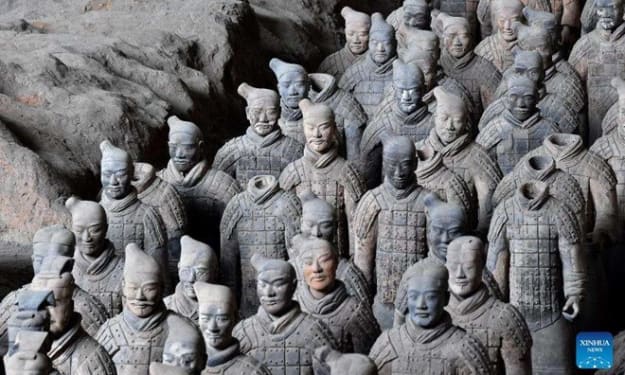
50 years ago, while digging a well on the outskirts of Xi'an, Shaanxi, China, people suddenly discovered a terracotta warrior. When the authorities continued to excavate the well, they discovered that the soldier was just one of a giant terracotta army standing guard over a large mausoleum. Turns out, they discovered the more than 2,000-year-old tomb of Emperor Qin Shi Huang - the first emperor to unify China.
By Ken Daklak2 years ago in History
Lily's Journey
Stories when Lily was a kid girl who lived in a small town They were kind and loving parents. poor but content, they had a modest home it was cozy and warm, and they had a little garden it was loaded with Lily adored flowers, so she would water them consistently She talked to them because she believed they listened when Lily's father got sick one day. he was unable to work any longer the family had no money Lily regretted not wanting her. she made the decision to visit the city where she hoped to work She desired to assist her. family she gathered her pack she embraced her parents she thanked and promised to return Soon after, Lily entered the city was enormous and noisy She was scared and felt lost. didn't know anybody she didn't have a lot money that she needed to get a job toured the city as she requested work everywhere, but nobody was interested in hiring her. She was youthful and She was a novice and felt helpless. Lily was lying on a bench one night. She was hungry and tired, but she did not spot to go she began to cry a sort The elderly woman saw her and sat next to Lily. She inquired as to why Lily was crying. her story: The elderly woman was sorry for her. she brought Lily to her back home she gave her Lily needed food and a place to sleep a lot. grateful in the morning, the elderly woman escorted Lily to a bakery The bakery needed assistance. Lily was thrilled when she got the job. acknowledged her promise to the elderly work hard Lily worked at the pastry shop consistently She cleaned and made cakes and bread. the shop where she worked and served customers extremely hard she set aside her cash she needed she wanted to send it to her family help them Lily missed her family was something she often thought about she recalled the enjoyable times they shared recalled her dad's grin she recalled her mother's reassuring hugs Her memories sustained her and gave her strength. A man showed up one day at the bakery He looked sad because he did not enough money for Lily to buy bread She gave him some bread out of compassion. free of charge, the man was extremely appreciative. He assured Lily that he would never ignore her. kindness Lily frequently assisted others. gave the the food hungry she helped the old and the debilitated She was always beaming with happiness. believed in goodness; she did. improved the world through her where Lily was walking home that evening She saw a tiny, filthy kitten. alone and terrified, Lily took it. brought it back home she gave it food and a warm She christened her bed Whiskers Whiskers. became Lily's closest friend and continuously together stubbles satisfied Lily She no longer felt so alone. Lily's life was difficult, but she was steadfast; she never gave up. put in her best effort and believed in herself She had faith in her. Lily dreamed of receiving a letter one day. was from her mom she composed that her father was deteriorating they required cash for his medication Lily was very stressed she needed more cash she needed to increase her income, Lily chose to take another work During the day, she worked at the bakery. She worked at night cleaning offices. extremely drained yet she didn't say anything negative she She wanted to assist because she was forced to. her Lily's father worked all day and night; she didn't get a lot of rest she was consistently tired however she continued to go she saved each penny she sent the cash to her loved ones She hoped it would assist her father in obtaining Lily worked hard as better months passed. She sent it to save a lot of money. her parents received the medication, her father Lily, he needed to start feeling better. was delighted, felt proud, and knew Her labor paid off. off Lily carried on with her work. to assist others, she made a lot of friends. everybody adored her they respected her toughness they admired her for thoughtfulness one day a young fellow came to the bakery when he first arrived in the city searching for work Lily saw him he looked drained and hungry she gave him some bread Through conversation, she learned his name. Was it Jack that he had sought in the city? a superior life however he was battling Lily felt frustrated about him She chose to assist him Lily spoke with her boss and inquired whether Jack could work at the bread shop her chief concurred Jack was exceptionally appreciative he expressed gratitude toward He promised to work, Lily. difficult Jack began working in the bakery. He worked well, was kind, and friendly, Lily became good friends with him. they cooperated consistently they they laughed and talked about their Lily told Jack about her family in her dreams. She mentioned her to him. struggles While he admired her resilience, Jack admired her kindness and was fortunate to have met. her one day Lily and Jack were strolling home, they saw a young girl who was crying. was lost, and she asked Lily for comfort. The girl didn't know she was there. Jack and Lily made the decision to assist she was taken to the police by them. station, where they remained with her until guardians came the young lady's folks were They expressed their gratitude to Lily and Jack. They pledged never to forget their kindness made Jack and Lily happy. knew what a good thing they had done knew they had produced a Lily's days changed into months. and Jack persevered, they were able to save their money, they helped other people, and they were They were not content that they were together. alone Moreover, one day Jack revealed to Lily that he Lily was surprised because she had no idea. what to say she loved Jack he was benevolent and caring, she stated, he made her happy. her as well, and Jack was very He gave Lily a happy hug and they decided to together together Lily and Jack kept on working hard they kept helping other people they made a winning team; they were pleased They had a bright future together. One of them was given to Lily one day. letter that she wrote was from her mother. that her father had returned to health, he was ready to work the family was improving Lily was overjoyed that she was aware of her She was aware that her efforts had paid off. a difference Lily chose to pay her a visit. family she needed to see them she needed She told Jack about her while hugging them. plan Jack made the decision to go with her. would like to meet her Jack and Lily traveled to the Villagers were overjoyed but couldn't hold on to see Lily's family when they Lily's parents were thrilled when she arrived. cheerful they embraced Lily they said thanks to Jack for dealing with her they were glad they have daughter They were appreciative of how hard she labor and Lily was very kind. pleased to be back with her family, she She had created a with Jack by her side. contrast in many lives she had found love and happiness Jack and Lily chose to remain a while in the village They wished to assist the community they opened in an effort to make a difference a small shop where they sold cakes and bread. They helped the villagers and produced numerous Lily's life had changed thanks to her friends. struggled She had faced numerous obstacles. be that as it may, she had never surrendered she had buckled down she had helped other people she had married and happiness Jack and Lily lived happy lives. life they cooperated they made a difference Others, they had a positive impact, they were valued by Everyone once knew that Lily and Jack sitting in their Nursery they were holding hands, the happy couple taken a gander at one another they realized they had been through a lot, as they were aware, made a difference that they were aware of met love and happiness Lily observed Jack, who she She wrapped him in a hug with tears in her eyes. cheerful she was thankful she realized she had a good life, she was aware that she had made a difference she was aware that she had found love and the joy Jack and Lily experienced they continued to live happily ever after. really buckle down they kept on helping other people They maintained their impact they were content, were in love, and had a happy life She had struggled, but Lily had come a long way. numerous obstacles that she had not given up on She had contributed and worked hard. others, she had found happiness and love she had made a difference The story of Lily was one of love, kindness, and strength, it was a story of hope; it was a girl's story. whose perseverance made it a tale of a girl who changed things was a story of a young lady who tracked down adoration and happiness
By Md. Mehedi Hasan2 years ago in History
LOVE. Content Warning. AI-Generated.
hello and welcome to Soothing pod sleep stories my name is ARIF and tonight i will be your guide as we travel to the autumn woods of new England and follow the story of two strangers falling in love against the backdrop of falling leaves crackling fires and cozy nights under fluffy blankets before we begin however let us take a moment to relax and find comfort in the space that we are in here and now as you close your eyes allow your body to sink into the mattress underneath you right now i invite you to simply be don't have to do anything in this moment except listen to the sound of my voice as i guide you to a place of further relaxation try and imagine yourself by the perfect bonfire what does it look like are you deep within the woods wrapped in a fluffy cashmere blanket are you sitting in a penthouse suite watching the fire crackle against the backdrop of the sparkling city lights are you sitting surrounded by autumn leaves with all your friends and family by your side listening to the chirp chirp chirp chirp of crickets nearby wherever you are i want you to try and turn your attention to the warm flames of your bonfire picture their color are they red like a juicy ripe apple in an autumn orchard or are they orange like a jack-o-lantern glowing bright in the dead of night on the steps of a farmhouse watch as they crackle crackle crackle crackle and as you breathe in imagine the flames growing growing growing growing as you exhale imagine them shrinking shrinking shrinking shrinking watch as your breath empowers and relaxes the flame just as it does the same thing in your own body you breathe in bringing warmth welcoming comfort and you exhale providing relaxation and ease now that we have taken the time to relax and find comfort in the space that we are in let us begin our story in the hills of Vermont autumn would not arrive quietly or subtly it would start with a single tree in a sea of green the locals would all drive by it and smile knowing that their favorite season was days away from sweeping across the mountainside from brightening their towns and urging the harvest of their fields what was a single tree one morning would be two trees the next and three four five six in the following days the vibrant reds browns and oranges would bloom across the landscape like a spreading fire igniting everyone with passion about the season and for sage this year was no different when she awakened on the first real autumn day there was a change in the air that was blowing in through her open window causing her orange curtains to billow the air of summer had disappeared the scent of lilacs freshly mowed lawns flourishing forests and ripe sweet strawberries had faded seemingly overnight and in its place the smells of autumn were in full swing the air had a bite to it it was invigorating even at this early morning hour sage swore she could smell the ripe apples growing on the gnarled apple trees on the far hillside she could smell the earthy aroma of leaves hitting the mossy ground she could smell the spiced cider the dry warmth of harvested wheat and hay the sweet spice of pumpkin the world smelled alive in a way it didn't during summer it was as if the atmosphere was inviting you to do as you please if you wanted to curl up with a book and drink a steaming cider you were welcome to if you wanted to venture out into the woods and explore the splendor of the falling leaves you were welcome to if you wanted to meander through corn mazes and pick apples under the sunset over the horizon that was ablaze you were welcome to and on that first fall morning sage decided that she wanted to do all three she rose from her sheets and wrapped herself in the warmest sweater she could find she slid on her boots a necessity for traversing the soft autumn ground and she began her trek outside she took an even deeper breath of that fresh air she felt as though she was in some fall storybook from her childhood there was a magic in the air that couldn't quite be found in other seasons a magic that she welcomed wholeheartedly wanting to enjoy the weather she opted to hop on her old cruiser bike and start the journey down down down down the dirt road past farm after farm all the farmers were busy in the fields harvesting their crops the air was rich with aromas of ripe fruits and vegetables and of the delicious dishes slowly being prepared with them sage waved to each farmer she passed they all smiled happy to see her sage had grown up in the small town of cranberry cove a beautiful little town nestled against the mountains and a large lake flanked by farmland on the outskirts it was a town where everyone knew everyone where there were always people ready to help you whether you requested their help or not sage felt as though she was flying through the autumn air by the time she arrived at the farm at the very end of the road she was full of a joyful energy that was contagious to everyone she passed by the farm she arrived at was a staple in the autumn months a farm with a large corn maze with acres and acres of apple trees to pick apples from and with a dense forest with a nice trail for a vibrantly colorful nature walk it was the perfect place to experience all that the season had to offer and sage decided that she'd like to start with the corn maze she grabbed a map and descended into the maze all around her corn stalks rose so high they seemingly touched the sky it felt cozy and exciting all at once a safe adventure where you could simply explore sage loved to meander through the maze without too much of a purpose for her it was about being somewhere away from it all being somewhere where she could stand still with nature and to listen to the sounds and breathe the smells of the season around her however sage wasn't quite expecting what she found around a corner in the center of the maze for quite some time she had been wandering through the rows of corn by herself only hearing the sounds of children and close friends giggling behind the stalks but as she rounded the corner she walked directly into someone standing in the middle of the aisle trying to decide which path to take she was so surprised she let go of her map and watched as it drifted down down down until it flopped into a puddle she apologized profusely to the man and when she finally looked up and caught his eye her heart leapt out of her chest the man before her smiled apologetically his eyes were a dark warm amber so deep and intricate that she felt as though she could get trapped in them his smile was equally warm and not forced in a way that so many people's smiles often are he extended his hand to her to help her get more steady on her feet the man Casper was equally enthralled by the woman before him she had an energy about her that promised that adventure and joy were always just around the corner even in the moment of surprise there was still a spark in her light green eyes which shimmered and shined like the forest floor after a gentle rainfall it's all right it's my fault after all Casper chimed I'm the one who doesn't know where I'm going only then did sage look a little more inquisitively at Casper he wasn't dressed like a local he wore a warm vibrant blue wool sweater and perfectly tailored pants his hair fell in curls around wire-rimmed glasses and slung around his neck was a camera sage invited him to join her with a smile laced on her face after all she couldn't just leave the tourists to be lost in the maze Casper chuckled at her little dig and gestured toward the maze inviting her to lead the way as they walked sage learned more about Casper he grew up in the city and had worked for several companies as a photographer however the commercial life just wasn't meant for him he sold everything he owned and hit the road to photograph the country over the course of a two-year trip a two-year trip that he was almost certain would be extended he wasn't exactly sure what he wanted for his long-term future mainly because he simply liked too many places sage found herself mesmerized by this strange wonderful man's story he had given it all up in search of something and clearly it was in search of something he wasn't even sure he would find for now he was just chasing sunsets across the country stopping wherever his heart desired in trying to sink into each and every community he passed along the way he asked sage about her life how had she ended up in this town sage's story was much different from Casper's although in some ways they were almost exactly the same sage grew up in this town she was born and raised here she played in the creeks and streams on warm summer days as a child she sledded down the icy hills and skated on the sleek ponds as a teenager she studied in the old stone library that was nestled at the foot of the mountain and she learned to drive on the ancient oak and maple lined streets that laced through neighborhoods full of Victorian houses rather than going to college she too had set out into the world without a plan she decided to travel around the country stopping wherever her heart desired embarking on whatever adventures came to her that day and when she was done she wanted to come home she missed the smell of the woods here she missed the bubbling melody of the river as it coursed through their little valley she missed the tang in the air as winter descended sweeping across the landscape and inviting everyone to enjoy cozy nights inside curled up with a blanket and a book in fact she had returned here to write a book of her own every morning she'd bike down down down down to the little library and do her writing and reading just as she had as a young child all those years ago while most people in the town would smile politely at sage's story Casper was fully engaged eyes lit up as he asked sage all about her travels and about her book where did the idea for it come from what was her inspiration the two talked for what seemed like an endless amount of time as they weaved through the rows of corn it felt as though they were in a world of their own their journey's soundtrack was the swish swish swish swish of the corn swaying in the sweet autumn breeze and the crunch crunch crunch crunch of the earth underneath their feet before long they had found their way out of the maze when they emerged from their small world into the rolling hills of the farm it looked more beautiful than ever they hovered there for a moment their conversation still flowing their bodies inching closer together as if the maze had closed in on them sage asked him what else had he planned on seeing that day he admitted that he had never experienced autumn before being from a southern city this was his first time seeing the leaves change his first time in a corn maze his first time smelling the sweet earthy aroma of ripe pumpkins growing in the lung without hesitating sage invited him to join her of course if he wanted a real local autumn experience who better to show him around than a local Casper was delighted by her offer it was more than he ever could have hoped for sage kindly took him by the hand and led him to their very first fall activity a staple that all the local kids grew up doing they were going to pick apples she led him into the far orchard which was a spectacle in itself the orchard sat on a particularly hilly part of the farm the tree stretched far to the horizon in perfectly straight lines over the natural dips and dives and curves of the landscape Casper took a deep breath of the air as he meandered through the soft dark green grass there was a freshness in the air he had never experienced before a bite to it as if the world was begging you to pay attention to the splendor it was providing all around it smelled like an apple candle warm and cozy and sweet and yet there was a natural freshness to it he could not only smell the ripe juicy apples but he could also smell the earthiness of the leaves as they wavered in the blowing breeze he could smell the spiciness of the bark the children had been lovingly climbing for generations to reach the best apple at the very top of the tree he could smell the comforting aroma of the old wood and iron boxes provided for people to pile up their harvest in he stood in the breeze for a moment simply breathing in the air that was unlike anything he had ever smelled when he opened his eyes sage was already up in the tree she sat on a branch casually one leg dangling down as she reached to gently pluck a ripe apple from a tall branch she looked as though she belonged up there she was practically glowing in the soft autumn sun her hair billowing around her in that fragrant breeze Casper watched her for a moment simply observing her do something that was such an innate part of her sage began to gently toss apples down to Casper he caught each and every one and tucked them away into the white bags they had been provided with once a bag was full sage patted the branch next to her Casper was hesitant sure he had climbed fire escapes but he'd never scaled a tree before with a shrug and a smile he hauled himself up on the branches and clumsily sat beside sage his heart pounding in the best way possible she smiled at him with a bit of pride and admiration with a chuckle he told her that was my first time climbing a tree sage smirked as she softly told him it shows the two found themselves laughing up in the branches though they weren't particularly high up it gave them a new wonderful perspective they were no longer observers of this nature and this landscape it felt as though they were part of it and you know the best part of this sage asked smiling at Casper she reached across and grabbed an apple she handed it to Casper inviting him to bite into it he'd never eaten an apple straight off the tree and certainly not while he was sitting in a tree but with a shrug he went along with it as soon as he bit in he knew that this wasn't an ordinary apple it was the sweetest apple he had ever had packed with flavor and bite and crunch it was entirely different from the apples he had had from the grocery store they sat up in that tree for quite some time their legs dangling as they finished their apples laughing and telling stories all the while every once in a while Casper would catch himself gazing at sage for a second too long it was easy to become transfixed on her the way those green eyes shone the way she spoke with her hands the way she kicked her head back when she laughed and whenever she caught him staring her cheeks would flare just a tinge more than once Casper tried to convince himself it was just the red of the apple reflecting on her cheeks finally when their apples were finished the two climbed down from the tree Casper put his hand out helping her down though it was probably him who needed more help when they were down they both had a newfound energy excitement about what the rest of the day had in store for them once more sage took him by the hand and led him through the farm they meandered through the fields that were flourishing with ripe vegetables around them large pumpkins clung to their vines their orange skin nearly as bright as the leaves that sage and Casper were walking toward Casper was in awe as they entered the walking trail in the woods at the edge of the farm all around them the forest was ablaze with the colors of fall every once in a while a cool fresh breeze would blow and autumn leaves would come drifting down down down like the most beautiful rainfall on the planet here they walked mostly in silence it seemed that the forest around was speaking for them and the creatures within it with the cold of winter on the horizon all the creatures of the forest were busy getting ready to settle down in their cozy dens for a few months time squirrels regularly scampered across the forest path in front of them chittering the entire way until they adeptly leaped up into the trees high overhead the birds were even more talkative than usual their songs rang through the forest echoing off trees as they called to one another it seemed every few hundred feet a cardinal would swoop through the trees ahead of them his bright red coat matching the vibrant leaves silhouetting him it was strange to Casper how the forest was so utterly alive and yet it felt stuck in time at the very same moment it was as if nothing outside this forest mattered the bills the obligations the struggles they all faded away and all you were left with was the beauty of nature in the world time moved slower here time moved as it was meant to move and as they rounded a corner near the bubbling river time seemed to stop because standing before them wading through the cool water was a beautiful dough its fluffy fur was flecked with white patches its plush ears and tail seemed to sway and move with the breeze they watched in awe as the dough leaned down taking a nice long drink of the moving water there was such a grace in her movements something sacred about them the energy around her was one of kindness nurturing and belonging she was the gentle mother of the forest and all things within it Casper could have stared at her for hours when she turned her gaze to them there was no fear in her eyes no surprise it was as if she had known for quite some time that they would be joining her here at some point her eyes were a mahogany brown nearly the color of the bark coating the trees around her without much fanfare and without a hurry she continued to wade through that coursing river until she reached the other side casting one final look over her shoulder perhaps a look of gratitude or a look of understanding she disappeared into the fiery-colored forest Casper and sage stood there for a long moment soaking in the experience that they had just shared after some time to breathe Casper took sage by the hand and they continued over the rickety bridge on the river thank you for showing me this sage he muttered the tone in his voice showed sage how wonderful and meaningful the experience truly had been for him so far and she couldn't help but smile because she knew what they were going to find at the end of the path to overlook as they emerged to the top of the hill Casper looked stunned the path they had been climbing wasn't particularly steep yet over time it wound up the side of the hill until you were overlooking the entire town and what they saw was a town straight out of a fairy tale it seemed every tree in the valley was a light with the colors of fall as if a paintbrush had been swept across the landscape coloring the trees vibrant reds into oranges and yellows and browns it was so warming and comforting to look out over and see Casper and sage stood there for what seemed like hours he took pictures he hadn't taken a picture of the doe earlier but he hadn't felt he needed to that moment was something sacred to be shared between him and sage not one that needed to be shared with the world in his pictures of the town he captured moss-coated cobblestone streets Victorian houses coated in a blanket of orange leaves candles and lanterns glowing in the windows of houses on tree-lined streets finally they began their journey back down down down down into the very town they had been gazing at only moments before they had experienced all the farm had to offer but sage promised there were more fall things to experience she led him down to the town center where there was a pavilion nestled against the river the pavilion was surrounded by trees with long swaths of garden and seating for people to sit back and enjoy the views of the town they sat on a wooden bench on the far side of the town center where a fire pit sat before them as the sun began to set and the colors of the sky began to match the colors of the trees around them sage and Casper got to work gathering wood for the fire it didn't take long for the wood to ignite and fire to grow and grow and grow and grow Casper watched in amazement as that single ember became the crackling bonfire in front of them the fragrant natural minty smell of the wood was both invigorating and relaxing at the same time Casper would close his eyes on occasion listening to the fire crackle crackle crackle crackle accented by the sounds of the remaining crickets chirping into the afternoon air Casper felt all his tension melt away any doubts he had about this trip any doubts he had about his future they no longer existed all that mattered right now was sitting by this bonfire surrounded by autumn leaves his fingers intertwined with sages it's true they had only met a few hours ago and yet they felt closer to each other than they had felt to anyone in quite some time as they wandered through the beautiful landscape they talked about their dreams their hopes their shortcomings they had embraced the changing landscape as they had embraced their rapidly changing relationship as the night air cooled even more sage curled up against Casper he wrapped an arm around her drawing her close to keep her warm she lay on his shoulder feeling utterly safe and content in his arms they smiled at each other on occasion but mostly they sat in a comfortable silence watching the flames dance before them soon the sky overhead was alive too millions of stars shone brightly in that pitch-black sky and even more incredible out here so far from the city they could make out the haze of the milky way Casper had never seen something so beautiful when it was time to say good night Casper rode with sage back to her home to walk her to the door they hovered in that doorway for quite some time a million unsaid things floating between them unable to say them all in the few minutes they had sage leaned forward pressing her lips against Casper it was a kiss of passion of connection in that moment they both felt whole I think I'm going to stay in this town for a little bit Casper whispered against her lips adding i at least need to see the rest of autumn don't I sage smiled as she whispered and then winter comes surely you'll want to get some photos of the snow won't you Casper replied I think I might with that Casper climbed back on sage's bike which she allowed him to borrow and he began the ride back to his hotel he felt utterly free riding that bike through the countryside gliding up and down over hills feeling as though he was suspended by the stars feeling as though he was sailing through apple orchards and forests ablaze with color it was unlike anything else on earth as he lay down in bed in the cozy inn he found himself smiling it was his first autumn and he knew it was going to be one of the best experiences of his life I hope you have enjoyed this story and it has brought you a night of peaceful relaxing sleep please join me again tomorrow for another sleep story until then sweet dreams you
By Timothy Mwiti2 years ago in History