World History
The Mysterious Pyramid of Gunung Padang: A 25,000-Year-Old Enigma
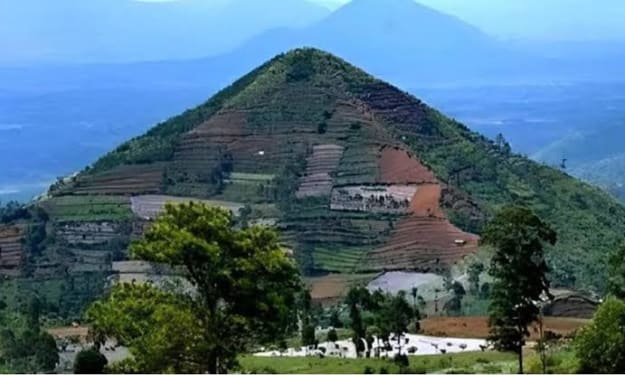
In the heart of Indonesia lies a structure that has sparked significant controversy among archaeologists and researchers. Known as Gunung Padang, this ancient site was traditionally regarded as an important megalithic monument, with its origins dating back several thousand years. However, recent research is turning that narrative on its head, with groundbreaking claims suggesting that parts of the pyramid may be as old as 25,000 BC—making it potentially the oldest pyramid in the world. The discovery, led by Dr. Danny Hilman Natawidjaja and his team from the Institute of Sciences of Indonesia (LIPI), has ignited debates that challenge the conventional understanding of human civilization and technological advancement. While ancient sites such as the Great Pyramids of Egypt and the structures at Göbekli Tepe have long been regarded as the pinnacles of early construction, Gunung Padang might predate them by tens of thousands of years. If this new research holds true, it would force historians and archaeologists to radically reconsider when and how complex societies first arose. The Structure of Gunung Padang Located on a hilltop in West Java, Gunung Padang appears at first glance to be a natural formation. The site is covered with enormous, rectangular basaltic stones, which were long believed to be part of a natural outcrop. However, detailed studies in recent years have revealed evidence of human intervention, suggesting that the stones were intentionally placed and arranged. Seismic and geophysical studies conducted at the site have unveiled a deeper complexity beneath the surface. Using methods like seismic tomography, researchers discovered that the site conceals a vast network of chambers and cavities, some measuring up to 15 meters in length with ceilings as high as 10 meters. These hidden rooms beneath the surface suggest a level of architectural sophistication previously unrecognized in the region’s ancient history. What’s more, the dating of the site has been a point of major controversy. Radiocarbon dating of layers within the pyramid structure suggests that certain portions of the site could be up to 25,000 years old, pushing its construction back to the last glacial period. This discovery, if confirmed, would make Gunung Padang not only the oldest known pyramid in the world but also one of the oldest known structures of any kind built by humans. Is the Pyramid Man-Made? One of the most contentious aspects of the Gunung Padang research revolves around whether the pyramid is entirely man-made. While some archaeologists argue that the pyramid consists primarily of naturally formed andesite lava, others assert that it was sculpted and manipulated by humans. Dr. Natawidjaja’s team contends that advanced masonry skills were used to shape and assemble the stones, hinting at technological prowess that far exceeds what we previously thought ancient humans were capable of during the last ice age. The controversy arises from the lack of conventional evidence typically used to validate man-made structures from antiquity. Traditional archaeological methods, such as the identification of tool marks or the presence of man-made mortar, have yet to yield definitive results at Gunung Padang. This has led many experts to question the validity of the claim that the pyramid is of human origin, suggesting instead that natural geological processes may have played a larger role than previously thought. However, the argument that this ancient site could have been the product of a sophisticated civilization is not without merit. If Gunung Padang was indeed built 25,000 years ago, it would challenge the prevailing view that complex construction techniques only emerged with the development of agriculture around 12,000 years ago. This would suggest that advanced societies existed far earlier than we currently believe, capable of organizing large-scale construction projects during a period when humanity was thought to be largely nomadic. The Implications for Archaeology The implications of a 25,000-year-old pyramid are profound. If the Gunung Padang structure was built during the last glacial period, it could rewrite the history of early human civilization. It raises fundamental questions about the origins of architectural knowledge and the capacity for complex societal organization. How could a civilization living in an era traditionally regarded as primitive develop the skills necessary to construct such a monument? What resources did they have at their disposal, and what motivated them to undertake such a massive project? Additionally, the discovery of underground chambers hints at the possibility of an unknown or forgotten civilization with its own religious, social, or cultural motivations. Could these chambers have been used for ceremonial purposes? Were they burial sites, storage areas, or places of ritual? The answers remain elusive, but further excavation and research could one day offer more insights into the mysterious people who built Gunung Padang. A Challenge to Mainstream Archaeology Gunung Padang stands as a fascinating case of how new discoveries can challenge the established norms of archaeology. While mainstream scholars remain skeptical of some of the more radical claims surrounding the site, the findings are impossible to ignore. Dr. Natawidjaja’s research forces us to entertain the possibility that advanced civilizations could have existed long before the dawn of agriculture and written history. Of course, more research is needed to fully understand the origins of Gunung Padang. The scientific community will need to subject the findings to rigorous peer review, and ongoing excavations will hopefully yield more conclusive evidence. For now, the site remains an intriguing mystery that invites us to look deeper into humanity’s distant past. As the debate continues, one thing is certain: Gunung Padang has become one of the most compelling archaeological puzzles of our time. Whether or not it proves to be the world’s oldest pyramid, its discovery reminds us that the history of human civilization is far from settled, and that there are still many mysteries waiting to be uncovered beneath the earth’s surface.
By Deji Akomolafe2 years ago in History
The Fascinating History of Tea
Tea, one of the world's most beloved beverages, boasts a rich and intricate history that dates back thousands of years. According to ancient legend, the story of tea begins with Shennong, the divine farmer of Chinese mythology. During his quest for edible plants, he poisoned himself on numerous occasions—reportedly 72 times—only to be revived by a mysterious leaf that accidentally drifted into his mouth. While this tale is steeped in myth, it underscores the significance tea held in ancient Chinese culture.
By DANIEL AKAM OKO2 years ago in History
Trudeau Accuses India of 'Massive Mistake' Amid Diplomatic Row
A major diplomatic conflict has emerged between Canada and India as Canadian Prime Minister Justin Trudeau publicly accused India of making a "massive mistake." This row has drawn global attention, straining relations between the two countries. The core of the issue stems from accusations, counterclaims, and concerns about sovereignty and international relations. In this article, we explore the background, key events, and potential consequences of the escalating tensions between Canada and India.
By Zinnat ara Begum2 years ago in History
How the Elephant Man Defied ALL Medical Knowledge: The Life and Legacy of Joseph Merrick
Joseph Merrick, known as the "Elephant Man," has become a symbol of the struggles faced by those with severe physical deformities. Born on August 5, 1862, in Leicester, England, Merrick's life story is a profound journey that intertwines themes of medical curiosity, societal prejudice, and the pursuit of dignity in the face of overwhelming challenges.
By Marveline Merab2 years ago in History
Were Aliens Our Gods in the Past?
Humanity has long grappled with the mysteries of its origin and the concept of divinity. For centuries, people have turned to religious beliefs to explain their existence, often rejecting alternative ideas about where humans came from or who—or what—may have shaped them. However, as scientific exploration advances and questions surrounding human uniqueness persist, the possibility that extraterrestrial beings could have influenced our development has captured the imagination of many. Could our gods from ancient times have been visitors from other planets?
By Sidhu John2 years ago in History
Why Is There a City Full of Dead Pirates on the Ocean Floor? The Wild and Wicked History of Port Royal, Jamaica
Port Royal, Jamaica: the name alone conjures up images of pirates with eye patches, rum-fueled brawls, and hidden treasures buried on sandy beaches. But as much as it might sound like the setting of a Hollywood blockbuster (thanks, Pirates of the Caribbean), the history of Port Royal is every bit as real—and twice as outrageous—as anything Captain Jack Sparrow could dream up. In its heyday, Port Royal was the epitome of pirate paradise, a bustling, wealthy city filled with swashbucklers, merchants, and, well, a whole lot of debauchery.
By Marveline Merab2 years ago in History
Discovering the Enchantment of the UAE: A Journey Through Culture, Innovation, and Nature. AI-Generated.
The United Arab Emirates (UAE) is a land where tradition meets modernity, and the desert’s golden sands intertwine with the dazzling skyline of its cities. From the bustling markets of Dubai to the serene landscapes of Abu Dhabi, the UAE offers a unique blend of experiences that captivate the hearts of travelers and locals alike.
By Muhammad hamza 2 years ago in History
The Playboy No Woman on Earth Could Resist: Porfirio Rubirosa's life story
Imagine James Bond, but with a bit more charm, several marriages to some of the wealthiest women in the world, and a passion for fast cars that would put him in pole position on any racetrack. That, in a nutshell, was Porfirio Rubirosa. The Dominican diplomat lived a life so wild and thrilling that it sometimes feels like a work of fiction—except it was all very real. Known for his remarkable charm, scandalous love life, and connections to the world’s elite, Rubirosa left an indelible mark on history. So, sit back and buckle up, as we take a joyride through the life of the man who lived every day like it was his last!
By Marveline Merab2 years ago in History
UK Inflation Plummets to 1.7% – First Time Below Bank of England’s Target in Over Three Years
The UK’s inflation rate has sharply dropped to 1.7% in September, marking the first time it has dipped below the Bank of England’s (BoE) target of 2% since April 2021. This significant drop, reported by the Office for National Statistics (ONS) on Wednesday, has far-reaching implications for the British economy and financial markets, with the possibility of further interest rate cuts in the near future.
By Global News Update2 years ago in History
The Midnight Ride of Sybil Ludington: A Forgotten Heroine of the American Revolution . AI-Generated.
In the early years of the American Revolution, heroes emerged in many forms—soldiers, generals, and even ordinary citizens. But one hero stood out, not because of her battlefield achievements or political influence, but because of her unwavering courage on a dark, rainy night. This is the remarkable story of Sybil Ludington, a 16-year-old girl who, in April 1777, rode through the perilous wilderness to rally militia forces in defense of her town and her country.
By Rousela Funfacts2 years ago in History
Why Everything We Know About the Black Death Is Wrong
The Black Death – the pandemic that decimated Europe in the mid-14th century – has always been portrayed as a catastrophic event that shaped much of human history. We’ve long been taught that it was the bubonic plague, spread by fleas on rats, that killed millions across Europe, Asia, and Africa. But what if this narrative is a little... off? Could it be that what we think we know about this deadly event might not be the full story?
By Marveline Merab2 years ago in History