World History
The Forgotten Currencies
Troughout history, money has served as a cornerstone of civilizations, facilitating trade, governance, and economic growth. However, not all currencies have stood the test of time. Some once-powerful banknotes and coins have vanished due to inflation, political turmoil, or economic mismanagement. This article explores the rise and fall of some of history’s most fascinating forgotten currencies and the lessons they offer for modern economies. 1. The German Papiermark – A Case of Hyperinflation After World War I, Germany faced severe economic turmoil due to war reparations imposed by the Treaty of Versailles. The Weimar Republic resorted to excessive money printing, leading to hyperinflation between 1921 and 1923. The German Papiermark, once a stable currency, became worthless as prices doubled every few days. By late 1923, the exchange rate had spiraled out of control—one U.S. dollar was worth 4.2 trillion Papiermarks. The crisis only ended with the introduction of the Rentenmark, stabilizing the economy. Lesson: Excessive money printing without economic backing leads to hyperinflation and the destruction of currency value. 2. The Zimbabwean Dollar – A Modern Hyperinflation Disaster In the early 2000s, Zimbabwe's economy collapsed due to political instability, land reform policies, and economic mismanagement. The Zimbabwean government began printing money to cover deficits, leading to one of the worst hyperinflation episodes in history. By 2008, inflation reached a staggering 89.7 sextillion percent. The infamous 100-trillion-dollar banknote, once a symbol of wealth, became a collector’s item as the country abandoned its currency in favor of foreign alternatives like the U.S. dollar and South African rand. Lesson: Government policies and economic mismanagement play a crucial role in determining the fate of a currency. 3. The Roman Denarius – The Decline of an Empire’s Currency During the early days of the Roman Empire, the silver denarius was a stable and widely accepted currency. However, as Rome expanded, the government needed more money to fund wars and public projects. This led to coin debasement—reducing the silver content while increasing the number of coins in circulation. By the 3rd century AD, the denarius contained so little silver that it lost its purchasing power, contributing to Rome’s economic decline and eventual collapse. Lesson: A currency must maintain its intrinsic value to remain trusted by the people. 4. The Confederate Dollar – A Currency That Died with a Nation During the American Civil War (1861-1865), the Confederate States of America issued their own currency, the Confederate dollar. However, since the South lacked gold reserves and relied heavily on war bonds, confidence in the currency quickly eroded. As the war turned in favor of the Union, the Confederate dollar’s value plummeted. By 1865, it became entirely worthless, leaving those who held it financially ruined. Lesson: A currency’s value is deeply tied to the stability and credibility of the government backing it. 5. The French Assignat – A Revolutionary Failure During the French Revolution, the revolutionary government issued assignats, paper money backed by confiscated church lands. Initially, they were meant to stabilize the economy, but excessive printing and counterfeiting led to rampant inflation. By the late 1790s, the assignat had lost almost all its value, leading to economic turmoil and social unrest. Napoleon later replaced it with the gold-based franc, restoring monetary stability. Lesson: Paper money must be carefully managed to avoid inflation and loss of public trust. 6. The Greek Drachma – Absorbed by the Euro The Greek drachma was one of the world’s oldest currencies, dating back to ancient Greece. It remained in circulation for centuries but was eventually replaced by the euro in 2002. While its transition was part of economic modernization, Greece’s later financial crisis and debt struggles raised questions about whether abandoning national currency control was the right move. Lesson: Joining a larger monetary union can offer stability but may also limit a country’s financial independence. Conclusion: What These Forgotten Currencies Teach Us The downfall of these currencies highlights crucial lessons for modern economies: Excessive money printing leads to inflation and currency devaluation. A strong and stable government is essential for maintaining trust in a currency. Debasement and mismanagement can erode even the most powerful monetary systems. Economic policies should prioritize long-term stability over short-term gains.
By Kamran Khan2 years ago in History
England’s Run the show Over America: A Bequest That Molded a Nation
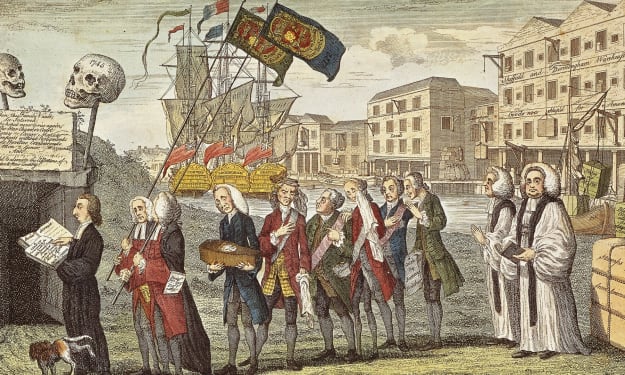
**England’s Run the show Over America: A Bequest That Molded a Nation** For over 150 a long time, Britain ruled over the American colonies, taking off an permanent stamp on the culture, administration, and character of what would afterward ended up the Joined together States of America. From the early 17th century until the late 18th century, the British Empire’s impact was profoundly inserted in the improvement of the colonies, forming their political frameworks, financial structures, and social standards. This period of colonial run the show laid the establishment for the country we know nowadays, indeed as it sowed the seeds of disobedience and independence.
By Md Arafat Hossain2 years ago in History
The History of American Colonies: Foundations of a Nation
The history of the American colonies is a fascinating tale of exploration, settlement, conflict, and the gradual formation of a distinct identity that would eventually lead to the birth of the United States of America. Spanning over 150 years, from the early 1600s to the late 1700s, the colonial period laid the groundwork for the nation’s political, social, and economic systems. This article explores the origins, development, and significance of the American colonies.
By Md Arafat Hossain2 years ago in History
As Republicans and business leaders gripe about Musk, Trump informs Cabinet members that they are in charge of hiring.
It seems like you're referencing a situation involving former President Donald Trump, his Cabinet, business leaders, and Elon Musk. However, the context or specific details of this scenario aren't entirely clear. If this is related to a recent news event or development, I recommend checking reliable news sources for the most accurate and up-to-date information.
By Md Arafat Hossain2 years ago in History
Society in the Mirror of the Media
Society in the Mirror of the Media Introduction: The Media as Society’s Reflection The media has always played a crucial role in shaping public opinion, influencing culture, and reflecting the realities of society. From newspapers to television and now social media, it acts as a mirror where we see both the strengths and flaws of our civilization. But does this mirror always show the truth, or is it sometimes distorted? This story explores how the media impacts society and the consequences of its power.
By Afia Sikder2 years ago in History
An Unfinished Love Story
An Unfinished Love Story (Some Love Stories Never End, They Just Pause Forever ) . 1. A Chance Encounter The first time Ayan saw Meera, she was standing in the middle of a crowded bookstore, completely lost in the pages of a novel. The world around her was noisy—people chatting, pages flipping, cash registers ringing—but she stood still, absorbed in her book.
By Afia Sikder2 years ago in History
The World's Most Dangerous Road: Karakoram Highway, Gilgit, Pakistan
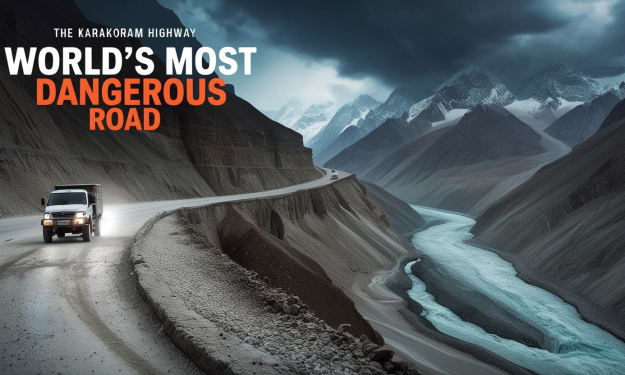
The narrow roads meander through the mountains of high containers and are unstable to stick to rough edges. One is lined with scissors, the other falls into a deep valley where a hard river crashes into the rocks. At the top of the snowy sun's sparkle, its beauty concealed the fatal risks that preceded us. This is the Karakolam Highway (KKH), one of the highest and most dangerous streets in the world, linked to Pakistan's Gilgit-Baltistan region and China's China province. This highway is not just a street, but a testament to human resilience to nature. The journey begins In the summer of 2019, Bangladesh Chau traveler Zahidul Islam ventured with three of his closest friends. They dreamed of experiencing the legendary Karakolam Highway, a street known for its breathtaking scenery and extreme danger. Their plan was to pass through the dangerous mountain paths of Gilgit-Baltistan from Pakistan's capital, Islamabad, and eventually reach the world's most paved cross-border Kungjerav Pass at an altitude of 15,397 feet. The initial stages of the trip were relatively simple. The well-planned highways from Islamabad and Abotabad allowed them to drive comfortably and enjoy the lush greenery and curved paths to Hazara. The ghosts were high, and the group often stopped to take pictures of the breathtaking scenery. However, as they went deep into the Hindu Kush Mountains, the reality of travel began to sink. The streets have become narrower, and the air thinner and the terrain are increasingly unreconcilable. Enter the danger zone On the third day, the Gilgit Group arrived in the historic city, which serves as a gateway to the most triple section of the Karakolam Highway. This is where the actual test began. Smooth streets often give rough, uneven ways lined with loose gravel and sharp curves, and can send careless drivers that have fallen thousands of feet below. The powerful Rakaposisummit (25,551 feet) was threatened in the distance, and the glacier fed the rapidly flowing Hunza River. As she climbed further, the unexpected challenge was a sudden storm. The strong winds took up dust and debris, creating visibility near zero. The rain began to fall, with the snow mixed in, making the road even more slippery. Then there was a landslide. As the rocks fell and blocked the highway, deafening rumble echoed through the mountains. The group's SUVs stopped just in time. A few seconds later, a massive boulder crashed exactly where they would have been if they had moved further. Panic in. There was no progress and was equally dangerous due to the unstable terrain. Locals and truckers experienced under these conditions advised the group to wait. Handling in the area was common and sometimes it could take hours or days for the streets to be cleared. Living on the edge As they were waiting, Zahidur and his friends saw the harsh reality of life on the Karakolam highway. They met a group of Pakistani truckers who had been stuck for more than 10 hours due to a landslide. Known for its lightly decorated trucks, these drivers regularly ignored the dangers of this route and transported goods between Pakistan and China. One of them, an elderly man named Yousuf, told the story of people who lost their lives on the streets. He pointed to the area where the bus had been torn off the edge only a few months ago and was attacked by the river. There were no survivors. Time passed and the rain stopped. Locals and stuck travelers began to remove small rocks and make the roads navigable. With the help of some truck drivers, Zahidul's group carefully steered the SUV through a narrow opening after the landslide. The street in front of me was dangerous. There was no specific section of Karakoram Highway. This means that the wrong steps can be fatal. They drove carefully and stopped a slow, steady pace. In the clouds realm Finally, the group arrived in Hunza Valley, one of the most breathtaking places in the world. Surrounded by a 7,000-meter peak, the valley houses old fortresses, pristine lakes and charming locals. As they continued, they crossed Lake Attabad, a breathtaking turquoise waters that formed in 2010 after a catastrophic landslide blocked the Hunza River. The group had to load the SUV into a small wooden boat when parts of the old Karakolam Highway were soaked under the lake. The more they climb, the thinner the air. When they approached their Khunjerab passport, Zahidul began experiencing severe illness. His breathing became a boring and boring headache. The local guide advised him to rest, drink plenty of water, take deep breaths and adapt to his height size. The final route was the toughest. The snowy streets, frozen wind and cold chewing driving made driving extremely difficult. After the group overcomes countless obstacles, she reaches the Kunge Love Pass. They stood 15,397 feet and saw the enormous arc marking the Pakistan-China border. The sense of success was overwhelming. It was a fierce, dangerous journey, but the experience was truly life-changing. Unparalleled asKarakoram Highway is more than just a street. It's a journey through adventure, challenges and history. The expressway was built by engineers from Pakistani and China between 1959 and 1979 and is a symbol of friendship between the two countries. But the costs were immeasurable - accidents, landslides and difficult circumstances left almost 900 workers dead. For Zahidul and his friends, travel wasn't just about reaching their goals. It was to experience the raw power of nature, the resilience of people, and the pure thrills of strangers. Karakoram Highway remains one of the most dangerous streets in the world, but for those who are bold enough to take the risk, it offers an unforgettable experience.
By Anwar Hossain2 years ago in History
Lost Emotions
Lost Emotions Part : 1 The first time Aisha met Rayan, she was running late for her literature class. She had stormed into the library, looking for a book her professor had assigned. In her rush, she collided with a young man who had been standing by the bookshelf, sending his books flying to the ground.
By Afia Sikder2 years ago in History
The Forgotten Empire
Throughout history, certain empires stand out, their legacies immortalized in the shared consciousness of humanity. The Egyptians, Greeks, Chinese, and Indians are among those whose contributions have withstood the test of time. However, not every significant kingdom has enjoyed such enduring recognition. The Kingdom of Mitanni, once a formidable power in the ancient world, has largely slipped into obscurity, its narrative obscured by the passage of time. This is the story of Mitanni, a realm that achieved remarkable heights, only to be lost to the annals of history.
By A História2 years ago in History