World History
Title: The Greatest Lost Treasures Yet to Be Discovere
The Greatest Lost Treasures Yet to Be Found Introduction Throughout history, countless treasures have been hidden, lost, or stolen, their whereabouts still unknown. Legends of lost gold, hidden artifacts, and vanished riches have inspired treasure hunters and historians alike. Some of these treasures could be worth billions of dollars if found. This article explores some of the greatest lost treasures that have yet to be discovered, their historical significance, and theories about their possible locations. 1. The Treasure of the Flor de la Mar Estimated Value: Over $2.6 Billion The Flor de la Mar, a Portuguese ship carrying one of the largest treasure hoards ever recorded, sank off the coast of Sumatra in 1511. This ship was loaded with gold, diamonds, and other riches from the conquest of the Malacca Sultanate. Despite numerous expeditions, the treasure has never been found. Why It’s Important: The treasure belonged to the Portuguese empire and was one of the richest hauls ever transported by sea. It could provide insights into Southeast Asian and Portuguese colonial history. Where Could It Be? Some believe the shipwreck lies in the Strait of Malacca, but shifting sands and deep waters have made recovery difficult. 2. The Lost Inca Gold (Treasure of the Llanganates) Estimated Value: Over $10 Billion When Spanish conquistador Francisco Pizarro captured the Inca Emperor Atahualpa in 1532, the Incas tried to ransom him with a vast amount of gold and silver. However, the treasure was never delivered, and legend says it was hidden in the Llanganates Mountains of Ecuador. Why It’s Important: It represents the last great wealth of the Incan Empire. If found, it could be the largest golden treasure hoard in history. Where Could It Be? Many believe the treasure is hidden deep in the Andean mountains, but the region’s harsh terrain has prevented successful searches. 3. The Amber Room Estimated Value: Over $500 Million The Amber Room was a priceless chamber decorated with amber panels, gold leaf, and precious stones. Originally built in Prussia, it was gifted to Russia and later stolen by Nazi forces during World War II. It vanished in 1945, and its fate remains one of history’s greatest mysteries. Why It’s Important: It was considered the "Eighth Wonder of the World." It symbolizes one of the greatest art thefts in history. Where Could It Be? Some theories suggest it was destroyed, while others believe it lies in an underground bunker or sunken ship. 4. The Lost Treasure of the Knights Templar Estimated Value: Over $1 Billion The Knights Templar were a powerful medieval order, amassing great wealth during the Crusades. When King Philip IV of France disbanded them in 1307, much of their treasure vanished. Some believe it was hidden in secret locations, possibly in Europe or even North America. Why It’s Important: It could contain religious relics, gold, and historical documents. Theories link it to the Holy Grail and Ark of the Covenant. Where Could It Be? Possible locations include the Rosslyn Chapel in Scotland, Oak Island in Canada, or underground vaults in France. 5. Yamashita’s Gold Estimated Value: Over $100 Billion General Tomoyuki Yamashita of Japan allegedly buried vast amounts of gold and artifacts in the Philippines during World War II. Many believe the treasure was hidden in secret tunnels and caves, but its existence remains debated. Why It’s Important: It represents one of the largest war loot collections in history. It could reshape historical narratives about wartime plunder. Where Could It Be? Numerous treasure hunters have searched for it in the Philippines, but no major discoveries have been confirmed. 6. The Treasure of Lima Estimated Value: Over $200 Million In 1820, as revolution swept through Peru, Spanish officials attempted to safeguard their riches by shipping them to Mexico. The treasure, which included gold, silver, and religious artifacts, never arrived. Why It’s Important: It represents one of the greatest colonial-era treasures. It could include irreplaceable historical artifacts. Where Could It Be? Many believe it is hidden on Cocos Island, Costa Rica, inspiring real-life treasure hunts. 7. The Romanov Jewels Estimated Value: Over $500 Million The Russian Imperial family, the Romanovs, possessed immense wealth before the Bolshevik Revolution of 1917. While some treasures were confiscated, others vanished, including rare gems, Fabergé eggs, and gold reserves.
By Say the truth 2 years ago in History
The Hidden Mysteries of Chavín de Huántar
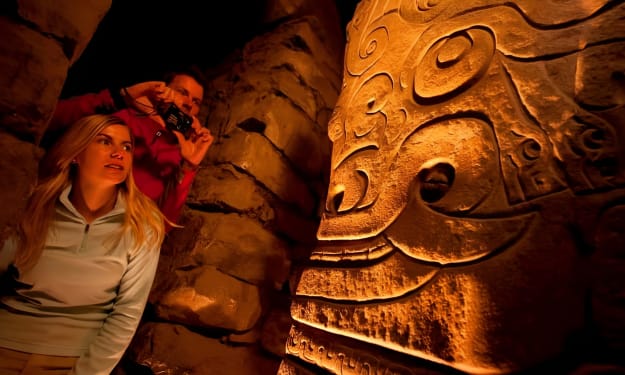
Nestled in the core of South America, where the formidable Andes mountains converge with the verdant terrains of the Peruvian coastline, unfolds the narrative of a civilization that flourished in unity with nature, deities, and the universe. This is the saga of the Chavín culture, a society that arose more than 3,000 years ago, bequeathing a rich heritage of artistry, spirituality, and enigma that continues to intrigue archaeologists and historians alike.
By A História2 years ago in History
Hank and Jackie
Hank and Jackie The year is 1947, a post war world where Americans must come of age facing the nagging responsibility of emerging as a world power. Like an adolescent struggling to break free from childish thinking, America is forced to decide whether to accept the higher principles on which it was founded or change into something else. This is a story about Jackie Robinson and Hank Greenberg, two of the greatest baseball players during the middle part of the twentieth century. They were opposing ball players on a baseball diamond but in a larger more important role they were on the same team. Are” all men created equal?” Hank and Jackie were two of the many people who helped us decide the answer to that question. Whether they wanted it or not, they became symbols for a generation and helped usher in a new dawn in American thinking.
By Larry hart2 years ago in History
Rodrigo Duterte: A Controversial Crusade and Its Unraveling
Rodrigo Roa Duterte was never a man of half-measures. He ruled Davao City with an iron fist, earning both admiration and fear. Before he became the 16th president of the Philippines, he had already built a reputation as a leader who would do whatever it took to restore order. Under his watch, Davao, once a city plagued by crime, became one of the safest in the country. His methods were brutal, but for many, they were necessary.
By Graymore Macad2 years ago in History
Kamakshi Amman Temple and the Power of Divine Feminine Worship in Hinduism
Introduction: The Divine Feminine and Her Role in Hinduism In Hinduism, the Divine Feminine is revered as a powerful, nurturing force that governs the cycles of life, creation, and cosmic order. The concept of Shakti, or divine feminine energy, is central to many forms of worship and spirituality in Hinduism. Kamakshi Amman Temple, located in the sacred city of Kanchipuram, Tamil Nadu, is one of the most revered temples dedicated to the Divine Feminine. The goddess Sri Kamakshi Ambal, who embodies the essence of Shakti, is worshiped as the protector, creator, and sustainer of the universe, representing the ultimate force of love, compassion, and spiritual power.
By Sri Kamakshi Ambal Temple2 years ago in History
The Cost of Victory: Analyzing the True Winners and Losers of Modern Warfare
Imagine two neighboring nations, X and Y, that share the same language, culture, and lifestyle. To an outsider, distinguishing between their people is nearly impossible. Yet, one day, a war erupts between them over a disputed territory. Nation X loses 3,000 soldiers and approximately $1 billion (today’s value), while Nation Y suffers the loss of 5,000 soldiers and $600 million. After weeks of intense fighting, the war ends—but the borders remain unchanged. Despite this, both nations declare victory, and the territorial dispute continues to this day.
By InkForChange2 years ago in History
10 Declassified Government Secrets You Were NEVER Supposed to See
For decades, governments around the world have kept their most controversial files hidden from the public. But as declassification efforts increase, some shocking secrets are finally seeing the light of day. From UFO sightings to secret military experiments, these newly released files are rewriting history. Here are ten of the most surprising declassified government secrets—wait until you see #7!
By Muhammad Hakimi2 years ago in History
How St. Patrick’s Day Shaped U.S. Traditions: A Concise Story. AI-Generated.
St. Patrick’s Day, observed annually on March 17, has evolved far beyond its origins as a commemoration of Ireland’s patron saint. In the United States, this cherished holiday is characterized by lively parades, crowds adorned in green, and festive gatherings that intricately weave Irish heritage into the cultural fabric of American life. As a subject of widespread fascination, it invites exploration into how this day has shaped distinctive U.S. traditions, ranging from exuberant street celebrations to educational initiatives that engage younger generations.This article invites readers to embark on a journey through the rich tapestry of St. Patrick’s Day, blending an engaging narrative with Concise analysis of the intersection between tradition and modernity. Envision a day where history, joy, and innovation converge—what traditions will you uncover, and how might they inspire your own celebrations?
By Mohamed Ennajah2 years ago in History
What We Fought For. Content Warning.
The United States of America is at a critical crossroads at this moment in history. The country is heavily divided over politics, religion and entitlement to basic human rights. Life is in turmoil around the board for many of those living in the US. On the political spectrum, there are two very different sides at odds over the morals and values of the country. However, there is a clear lack of understanding over the history of the United States of America, our formation, the government powers, and the US Constitution. When compared to other countries in around the world, the US is one of the youngest in existence, having only been formed about 250 years ago.
By Luna Verity2 years ago in History
The Tigoni Evictions
The seeds that led to the bloodshed at Lari were planted about 20 miles South East at a place called Tigoni. Tigoni is a fertile, well drained area bordered by the Tigoni and Ithanji Rivers. The beautiful countryside had favourable climate and was one of the most precious acreages of Kikuyu-land south of the Chania River. By 1906, the region was accupied by 10 kikuyu clans (mbari) who held ancestral claims to the land and had also employed tenants (muhoi, plural- ahoi).
By HINGES OF TIME2 years ago in History