World History
"Persia's Eternal Fortune: The History of Iran’s Greatest Treasures"
Crown Jewels of Persia: The Lost and Living Treasures of Iran Iran, historically referred to as Persia, represents one of the most ancient civilizations on the planet. From the formidable Achaemenid Empire of Cyrus the Great to the splendid Safavid dynasty, Persia has served as an emblem of affluence, culture, and authority. Across the centuries, Persian monarchs amassed fortunes beyond imagination: vast reserves of gold, stunning crowns, swords adorned with rubies, and seas of invaluable gemstones. Among the most renowned collections is the Iranian National Jewels, regarded as one of the most precious and illustrious treasure troves on Earth. This article examines the origins, development, loss, and endurance of Iran’s imperial wealth and assesses its present-day value. The Ancient Foundations: Achaemenid Splendor The custom of royal treasures in Iran commenced with the Achaemenid Empire (550–330 BCE), initiated by Cyrus the Great. The Achaemenid sovereigns commanded one of the extensive empires in ancient history, spanning from Egypt to India. Wealth in gold and silver flowed in from 20 distinct satrapies (provinces). Darius the Great constructed Persepolis, a ceremonial capital filled with colossal palaces, golden effigies, and walls inlaid with precious stones. Herodotus, the Greek historian, depicted the Persian monarchs as possessing immense reserves of gold and silver treasures so substantial they appeared inexhaustible. However, the first significant loss transpired with Alexander the Great’s invasion in 330 BCE, when Persepolis was set ablaze and looted. Thousands of talents of gold and silver (equating to billions today) were transported back to Macedonia. The Sassanian Revival: Imperial Wealth Reborn Following centuries of external domination, the Sassanian Empire (224–651 CE) rejuvenated Persian magnificence. Khosrow I and Khosrow II accrued riches through conquest, commerce, and tribute. Legendary artifacts like the Throne of Khosrow, encrusted with pearls, rubies, and emeralds, became emblems of Persian dominance. The Sassanian monarchs upheld clandestine treasuries brimming with coins, gems, ceremonial armor, and royal insignia. Regrettably, much of this was lost during the Islamic conquests of the 7th century, when Arab forces vanquished the Sassanians and plundered royal treasuries. The Safavid Renaissance: Birth of the Modern Iranian Crown Jewels The most illustrious period for Iran’s imperial wealth emerged with the Safavid Dynasty (1501–1736). Shah Abbas the Great (1588–1629) established Isfahan as a radiant capital. Iran dominated crucial points along the Silk Road, enriching itself through commerce. The Safavid monarchs gathered Indian diamonds, Ottoman emeralds, and Chinese jade. They commissioned artisans to craft magnificent swords, shields, and thrones. This epoch laid the groundwork for what would later evolve into the Iranian National Jewels, the most prominent collection of Persian treasures. The Afghan Invasion and Nader Shah's Conquests In the early 18th century, Iran’s fortunes took a grim turn. In 1722, Afghan forces ransacked Isfahan and plundered Safavid treasures. Subsequently, Nader Shah (r. 1736–1747) ascended to power and led ruthless campaigns across India. In 1739, Nader Shah captured Delhi and seized the Mughal treasury, which included: The Koh-i-Noor diamond (one of the largest diamonds globally). The Darya-i-Noor diamond (still in Iran today). Enormous quantities of gold, silver, and jeweled artifacts. Nader Shah's devastation is approximated to have comprised hundreds of tons of gold and gemstones contemporary value could exceed $1 trillion USD. However, following Nader Shah's assassination in 1747, a significant portion of this wealth was dispersed among warlords and competing factions. The Qajar Dynasty and Modern Preservation During the Qajar dynasty (1789–1925), Iran’s remaining treasures were reorganized. Sovereigns such as Fath-Ali Shah commissioned ornate crowns and regalia, frequently utilizing gems from previous periods. The renowned Peacock Throne, emblematic of royal authority, was produced (distinct from the Mughal throne bearing the same name). The Iranian National Jewels were relocated to more secure facilities as political instability persisted. By the dawn of the 20th century, the Pahlavi dynasty initiated efforts to catalog and safeguard the treasures. The Iranian National Jewels Today Currently, the Iranian National Jewels also referred to as the Crown Jewels of Iran are housed in the Central Bank of Iran in Tehran. The collection encompasses: The Darya-i-Noor diamond (182 carats, one of the world's largest pink diamonds). The Naderi Throne and the Sun Throne, both adorned with hundreds of gems. Crowns, swords, shields, tiaras, and royal regalia. An entire encrusted globe, where oceans are represented by emeralds and continents by rubies and sapphires. Estimated Value: While the Iranian government does not disclose a public evaluation of the collection (due to national security considerations), experts estimate the Iranian National Jewels could be valued at well over $5–10 billion USD ranking it among the most valuable collections of royal treasures globally. Nevertheless, its symbolic significance to Iranian identity and history is truly invaluable. Conclusion Iran's treasure narrative is a tale of brilliance, loss, resilience, and pride. From the gilded halls of Persepolis to the vaults of Tehran’s Central Bank, Persia’s legendary wealth has captivated the world for over 2,500 years. Even today, the Iranian Crown Jewels serve not only as a testament to past grandeur but also as a reminder of a civilization whose cultural and material contributions continue to illuminate the globe.
By Say the truth 2 years ago in History
Vancouver attack latest
On April 26, 2025, Vancouver witnessed one of its darkest days when a vehicle plowed into a crowd attending the Lapu-Lapu Day Filipino heritage festival, resulting in 11 fatalities and numerous injuries. The suspect, 30-year-old Kai-Ji Adam Lo, was apprehended at the scene and has been charged with multiple counts of second-degree murder.
By Md Faruk Ali2 years ago in History
"China's Lost Fortune: The Rise, Fall, and Legacy of the Empire’s Greatest Treasures" . AI-Generated.
The Concealed Wealth of an Ancient Power: The Tale of China's Preeminent Imperial Treasure For millennia, China emerged as one of the most affluent and formidable civilizations on the planet. Its emperors commanded extensive armies, constructed magnificent marvels, and amassed treasures that defied imagination. Among these, certain collections of gold, jade, porcelain, silk, and invaluable artifacts epitomized not merely opulence, but also imperial sovereignty itself. This article delves into the illustrious imperial treasures of China, placing particular emphasis on the wealth accumulated during the Ming and Qing Dynasties, as well as the eventual fate of these riches. Ancient China's Custom of Wealth Chinese sovereigns historically regarded wealth as an indication of divine favor. From the earliest dynasties, such as the Shang and Zhou (1600–256 BCE), emperors commissioned grandiose tombs, adorned with intricate bronze vessels, jade sculptures, and ceremonial items intended to accompany them into the afterlife. One of the earliest and most renowned treasures was the collection interred with Emperor Qin Shi Huang, China's inaugural emperor, which included the Terracotta Army thousands of life-sized warriors designed to safeguard him in the afterlife. Nevertheless, the pinnacle of Chinese imperial treasure accumulation occurred much later, during the Ming (1368–1644) and Qing (1644–1912) dynasties. The Ming Dynasty: Cornerstone of Imperial Wealth The Ming emperors established the groundwork for China's most extraordinary treasure hoards. They commissioned: Vast quantities of gold and silver through tribute missions and domestic mining operations. Porcelain masterpieces, including the celebrated blue-and-white Ming vases. Jade sculptures, regarded as the purest material symbolizing virtue and eternality. Silk and embroidery, crafted by the finest artisans in Suzhou and Hangzhou. The wealth of the Ming court gained legendary status throughout Asia and beyond. Tributary states such as Korea, Vietnam, and early European visitors, including the Portuguese, were astonished by the riches of the Forbidden City. During this period, the imperial court maintained treasure registries, meticulously documenting rare artifacts, ceremonial items, and precious metals. The Qing Dynasty: Expansion and Consolidation of Wealth Under the Qing Dynasty, the imperial treasure expanded to unprecedented proportions. Emperors Kangxi, Yongzheng, and Qianlong (17th–18th centuries) fervently collected art, calligraphy, and rare books. Military campaigns throughout Central Asia and Tibet yielded immense spoils of war. Extensive tribute missions from the Ryukyu Islands, Vietnam, and Mongol khans enriched the Qing court significantly. The Forbidden City itself evolved into not only a palace but also a vast museum housing millions of artifacts. Perhaps the most significant symbol of Qing wealth was Emperor Qianlong's private art collection, which some historians estimate to have consisted of over a million pieces, including jade seals, paintings, bronzes, and rare manuscripts. By the late 18th century, the Chinese empire may have controlled one-third to half of the world’s monetary silver, predominantly imported through trade with Spain, Mexico, and Europe. In contemporary terms, some historians estimate that the imperial hoard at its zenith would equate to over $1 trillion USD today if not more. Decline and Dispossession: The Plundering of the Imperial Treasure. The calamity of China's imperial artifacts commenced in the 19th century, a period marked by internal insurrections and external incursions. 1. The Opium Wars and the Plunder of the Old Summer Palace In 1860, amidst the Second Opium War, British and French forces invaded Yuanmingyuan, the Old Summer Palace located near Beijing. Yuanmingyuan was reputed to be even more splendid than the Forbidden City, adorned with invaluable art pieces, jewelry, and rare manuscripts. Soldiers pillaged thousands of treasures: jade sculptures, gold figures, ancient porcelain, and historical scrolls. What could not be removed was set ablaze. Numerous items seized during this event still exist in museums and private collections in Britain and France. This plundering ravaged China's imperial riches and persists as a profound injury in the cultural consciousness of the Chinese people. 2. The Decline of the Qing Dynasty (1912) As the Qing Empire disintegrated in the early 20th century: Numerous court eunuchs, soldiers, and opportunists purloined treasures from the Forbidden City. Invaluable items inundated illicit markets in Beijing, Shanghai, and Hong Kong.
By Say the truth 2 years ago in History
Trump took The US economy
A Summer Dream: Whiskers' Journey The golden light of summer filtered through the lace curtains, casting a honeyed glow across the wooden floorboards. Whiskers, a tiny kitten, slept on a small patch of sun-drenched carpet, her fluffy grey fur glistening like silver threads in the warm light. A soft smile played at the corners of her mouth, her tiny pink nose twitching from time to time, her paws gently padding at the air as she dreamt.
By Md Faruk Ali2 years ago in History
Suspect charged with murder over Vancouver Filipino festival car ramming, police say victims were aged five to 65
Tragedy at Vancouver's Lapu-Lapu Day Festival: 11 Dead, Dozens Injured in Vehicle Attack A tragic incident occurred at Vancouver's Lapu-Lapu Day Festival, a celebration of Filipino heritage, on April 26, 2025, in the evening. A black Audi Q7 SUV drove into a crowd near East 43rd Avenue and Fraser Street, resulting in the deaths of 11 individuals and injuring over 20 others. The victims' ages ranged from five to sixty-five. Reuters
By Mahmodul hassan mojahid2 years ago in History
The World’s 5 Oldest Civilizations and Why They Count Indeed moment
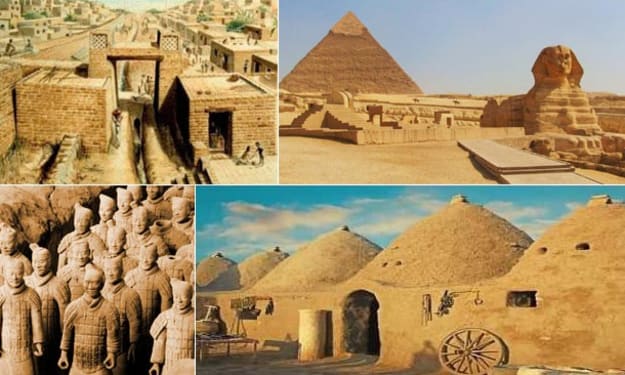
Civilizations are the backbone of mortal history, shaping societies, societies, and testaments that bolster our ultramodern world. Understanding the oldest societies gives us sapience into the complexity of our participated humanity. This composition explores the five oldest societies, outlining their characteristics and the enduring patrimonies they leave before.
By Monayem Hossain2 years ago in History
Alien Encounters: The Hidden History & Unexplained Clues of Extraterrestrials
Alien Encounters: The Untold Story and Unknown Signs of Extraterrestrial Life" Let's discuss aliens. Not the kind that comes from Hollywood and has glowing fingers and lasers that destroy the world, but the real ones that have followed us throughout history. You know, the bizarre tales that make you stop and ask, "Wait... could that actually be true?" * It turns out that strange objects in the sky have been seen by people for a lot longer than just the last century. In their temples, ancient civilizations carved images of flying machines. Medieval peasants reported seeing flaming orbs engaged in combat above their homes. Even famous artists snuck UFO-looking objects into their paintings. And right now? Well, now we’ve got military pilots, astronauts, and regular folks all saying the same thing: *Something’s up there, and we don’t know what it is. * ### The Old Things That Make You Think, "Hmm" Have you ever heard of the Sumerians? They were one of the first civilizations, and they wrote about these beings they called the "Anunnaki," which is short for "gods" who came from the sky and might have even created humans. Sound familiar? Fast forward to ancient Egypt, where hieroglyphs depict figures with enormous heads and eyes, similar to the "Greys" depicted in contemporary abduction tales. The pyramids are another attraction. How did they construct those things so precisely in line with the stars? Some believe they had assistance. The "Nazca Lines" are huge drawings in the desert that can only be seen from above in Peru. Why would ancient people create artwork that was difficult to properly view? Unless... they were never intended to be seen by humans. ### UFOs in the Middle Ages, Long Before There Were UFOs In **1561**, people in Nuremberg, Germany, woke up to what looked like a full-on **space battle** happening in the sky. Glowing spheres, crosses, and tubes were described as engaged in combat before colliding with the ground. It is even depicted in an old woodcut painting. Similar things were also observed in Switzerland, France, and even Mexico, so it wasn't just Germany. In their writings, Spanish conquistadors talked about "floating shields" that flew through the air. Even Renaissance artists like Leonardo da Vinci and Aert de Gelder depicted bizarre flying objects in religious works. Did they see something that they couldn't explain, or were they just being creative? ### Roswell, Cover-Ups, and the Pentagon in the Present Day The good stuff, the "UFO era," comes next. It really started in 1947 with Roswell, when the U.S. military said they had found a crashed flying saucer before changing their mind and calling it a weather balloon instead. Yes, guys. Since then, thousands of people, including pilots, police officers, and members of the military, have reported seeing objects in the sky that move in ways that our technology cannot. The government has conducted a few "official" investigations into UFOs, such as **Project Blue Book**, but all of them have come to the same ambiguous conclusion: *The majority of sightings are explainable, with the exception of a few that aren't. * Additionally, the Pentagon is now admitting that they are unaware of the names of some of these UAPs (Unidentified Aerial Phenomena). Fighter pilots have captured footage of objects turning at impossible speeds. If it isn't aliens, then what exactly is it? ### The Mystery of Abduction This is where things start to get really creepy. Numerous individuals assert that they have been "taken by aliens." Bright lights, missing time, and being examined by small beings with large black eyes are all common themes in each story. Some people even wake up with odd marks or implants that doctors are unable to explain. One of the first significant cases involving kidnappings was the 1961 "Betty and Barney Hill case." They recalled being examined on a ship while hypnotized. Then there's **Travis Walton**, who went missing in 1975 after his logging crew saw a UFO for five days. He told an outrageous tale when he returned about being inside a spacecraft. When so many people from different countries and backgrounds share the same story, it makes you wonder if it's sleep paralysis or hallucinations, as skeptics claim. ### So, are we by ourselves? Science is without a doubt looking. **SETI** searches the stars for signals from aliens. NASA has discovered evidence of life on Mars. We've found thousands of planets that look like Earth. It is statistically almost impossible that we are the universe's only intelligent life. However, if aliens are real, why haven't they officially introduced themselves? It's possible that they want us to figure it out first. Or maybe they've always been here, and the clues are right in front of us—buried in government files, in ancient texts, or just out of sight in the night sky. The mystery will not go away, that much is certain. The question of "*what is really out there" remains, regardless of whether you are a believer or a skeptic. * What are your thoughts? Ancient spacecraft? What are the secrets of the government? Or just a lot of things that people don't understand? In any case, the reality is probab
By Orewa Razeen2 years ago in History
At least 11 killed after car driven through Vancouver festival
Tragedy Strikes Vancouver: At Least 11 Killed After Car Plows Through Festival After a speeding vehicle plowed through a crowded street event at a summer festival in Vancouver, British Columbia, at least 11 people were killed and dozens were injured in what the authorities are calling one of the deadliest vehicular incidents in the city's history. Chaos and Carnage
By Sijan Hossain Shawon 2 years ago in History