World History
The 2002 Godhra train tragedy and the Gujarat riots.
The year 2002 is marked as a bloody and controversial chapter in India's post-independence history. On the morning of February 27 of that year, a terrible incident took place at the Godhra railway station—a fire broke out in the S-6 coach of the Sabarmati Express, killing 59 Kar Sevaks who were returning from Ayodhya. Immediately after this incident, terrible riots spread across the state of Gujarat, in which about 2,000 Muslims were killed, thousands of Muslim women were raped, mosques were destroyed, businesses were ruined, and millions of people were displaced. This riot was not just a communal outrage—behind it was a dazzling political tableau, state silence, and purposeful administrative inaction. The Godhra incident and the subsequent riots are still controversial, questionable, and symbolize the darkest chapter in politics.
By Abdul Barikabout a year ago in History
Delhi Traffic Advisory: Vehicle Restrictions and Alternate Routes Announced Amid Saket Bar Council Elections
The Delhi Traffic Police have issued a comprehensive traffic advisory in light of the ongoing Bar Council elections at the Saket Court Complex. The elections, scheduled from 8:00 AM to 8:00 PM on May 9, 2025, are expected to cause significant traffic congestion in the surrounding areas. To ensure smooth vehicular movement and minimize inconvenience to commuters, specific restrictions and alternative routes have been outlined.
By Abjol Hussain Laskarabout a year ago in History
The Byzantine Queen Who Changed Viking History Forever
Prologue: A Marriage Proposal So Wild It Actually Worked The year is 988 AD. In the golden halls of Constantinople, Emperor Basil II—the Byzantine ruler who made his enemies beg for mercy by literally blinding them—is staring at an envoy from Kievan Rus’ like he’s just been handed a ransom note written in crayon.
By The Buried Bookshelfabout a year ago in History
The Mongol Postal Service: How Genghis Khan Invented the Internet (But With Horses)
Part I: A Mongol Messenger Outruns Your Wi-Fi It’s 1220 AD, and somewhere on the vast Mongolian steppe, a lone rider is galloping at breakneck speed, his horse’s hooves kicking up dust like a toddler throwing a tantrum in a sandbox. Strapped to his back? A sack of letters and the entire future of communication.
By The Buried Bookshelfabout a year ago in History
Cosmic Catastrophe Captured: NASA Reveals Breathtaking Image of Black Hole Swallowing a Star 600 Million Light-Years Away
NASA Uncovers Black Hole That Consumed a Star 600 Million Light-Years In The Past – Breathtaking Image Revealed NASA Unveils Breathtaking Image of a Black Hole That Devoured a Star 600 Million Light-Years Distant
By Ehsan Tanvirabout a year ago in History
The Real ‘300’ Spartans Feared: Persia’s Undefeatable Immortals
Part I: The Spartans Realize They’ve Messed Up Picture this: It’s 480 BC, and King Leonidas of Sparta is standing at Thermopylae, looking all heroic with his abs glistening in the sun (because, let’s be honest, that’s the only reason Gerard Butler got cast). He’s got his 300 best bros with him, ready to hold off the Persian Empire like a bunch of over-caffeinated bouncers at history’s most exclusive nightclub.
By The Buried Bookshelfabout a year ago in History
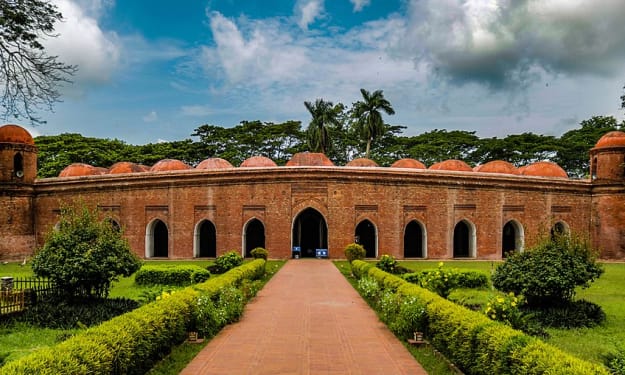
Sixty Dome Mosque
he Sixty Dome Mosque (Shat Gombuj Masjid): A Masterpiece of Medieval Islamic Architecture in Bengal Introduction The Sixty Dome Mosque, locally known as Shat Gombuj Masjid, is one of the most iconic and historically significant mosques in Bangladesh. Located in the Bagerhat district in the southern part of the country, this mosque is a UNESCO World Heritage Site and is considered the largest mosque from the Sultanate period in the Indian subcontinent. Built in the 15th century by Khan Jahan Ali, a revered Sufi saint and administrator under the Bengal Sultanate, the mosque is a magnificent blend of religious devotion and architectural brilliance.
By Dipu Sarkarabout a year ago in History
Whispers in the Trenches
France, November 1916 The earth had been torn apart by months of shellfire. Once-verdant fields were now endless miles of churned mud, the kind that swallowed boots and blurred the line between land and death. The trenches stretched for miles like festering wounds, filled with men who hadn’t seen a clean sky in weeks.
By Muhammad Zahirabout a year ago in History
“India and Pakistan: A Conflict Rooted in History”
The conflict between India and Pakistan began in 1947 when British India was divided into two countries: India and Pakistan. The division was based on religion, with India becoming a secular state with a Hindu majority, and Pakistan created as a homeland for Muslims. This division, called the Partition, caused mass displacement and violence. Around one million people died, and about 15 million were forced to leave their homes.
By Whispers of Yousafabout a year ago in History
The Phantom Fleet of the Indian Ocean: Lost Ships and Forgotten Fortunes
The Golden Phantom of the Baltic: The Abandoned Wreck of the Vasa Treasure Fleet Beneath the frigid, turbulent waters of the Baltic Sea resides a conundrum that has perplexed scholars and treasure seekers for ages: the destiny of the Vasa Treasure Fleet. Thought to be filled with gold, gems, and invaluable wartime artifacts of the Swedish Empire, the fleet's abrupt vanishing during a tempest ignited tales of a gilded phantom vessel that still roams the depths. This article delves into the origins of the Vasa Fleet, its disastrous final journey, and contemporary endeavors to reveal its elusive richesunfolding a chilling narrative of imperial aspiration, maritime catastrophe, and persistent enigma. Prompt for image generation: "A lifelike depiction of three substantial, wooden three-masted vessels from the 17th century navigating a fierce Baltic Sea storm. The central vessel is embellished with golden carvings, its sails straining against the gales, while ominous thunderclouds swirl above. A faint radiance pierces through the sky, illuminating the waves and the fleet. " Zheng He was an extraordinary admiral. Born as Ma He in Yunnan to a Muslim family, he was seized by the Ming army and subsequently castrated, becoming a eunuch attendant in the imperial palace. His intellect and fidelity garnered the confidence of the Yongle Emperor, who assigned him the command of a naval expedition unprecedented in China’s history. Zheng He’s armada consisted of enormous treasure shipsreferred to as baochuaneach potentially exceeding 120 meters in length, with multiple levels and watertight compartments. They transported commodities such as porcelain, silk, gold, and spices, as well as exotic creatures like giraffes and zebras back to China. His seven voyages extended to Southeast Asia, India, Sri Lanka, the Arabian Peninsula, and even East Africa. Each expedition solidified China’s supremacy on the seas. The final recorded voyage concluded in 1433, after which Zheng He is believed to have perishedpossibly at sea. The Eighth Voyage: Fact or Fiction? Chinese historical documentation makes no reference to an eighth voyage, yet oral traditions from the Malacca Sultanate, Java, and East Africa recount a final armada, larger than any preceding it. According to one such narrative, this ultimate fleet was laden not with tribute but with immense treasuresgold coins, imperial artifacts, jade seals, and celestial mapsmeant to be concealed in secret locations for safekeeping following the emperor's demise. One hypothesis suggests that the fleet departed clandestinely amid the political upheaval after Emperor Yongle's death, intending to conceal or protect the empire’s wealth from internal insurrection. Others assert that the voyage was commissioned by the emperor but was lost at sea, possibly due to a typhoon in the South China Sea or Indian Ocean. Clues from the Ocean Over the years, divers have unearthed ancient Chinese relics along atypical routesMing-era porcelain off the coast of Kenya, and substantial bronze coins near Sumatra and Madagascar. While some discoveries may result from normal trade, others indicate it could be evidence of a route traveled by a treasure convoy that strayed significantly off course.
By Say the truth about a year ago in History
The Golden Ghost of the Baltic: The Lost Wreck of the Vasa Treasure Fleet . AI-Generated.
The Golden Phantom of the Baltic: The Abandoned Wreck of the Vasa Treasure Fleet In the obscure depths of the Baltic Sea rests one of Northern Europe’s most enigmatic maritime legendsa narrative of royal aspiration, national pride, and a submerged fortune. The account of the Vasa treasure fleet and the immense wealth lost beneath the waves illustrates a vivid portrayal of Sweden’s imperial ambitions during the 17th century. This article explores the history of the Vasa warship, the kingdom it served, and the ongoing quest for the elusive riches once intended to finance a Swedish empire. An Ascendant Power in the North In the early 1600s, Sweden emerged as an ascendant power under King Gustavus Adolphus, who aimed to transform his nation into a European empire. Having inherited a relatively modest kingdom, Gustavus Adolphus heavily invested in military advancements and naval expansion. Central to his aspirations was the Vasaan elaborate and heavily armed warship constructed to project Swedish supremacy across the Baltic and beyond.
By Say the truth about a year ago in History