World History
Timeless Tales: America's Most Beloved Stories
The Heartbeat of American Identity Stories are the threads that weave the fabric of a nation’s identity. In the United States, literature has long served as a mirror reflecting its triumphs, struggles, and evolving values. From the roaring twenties to the dystopian future, American tales resonate because they capture the essence of human ambition, justice, and resilience. These stories—whether etched in ink or projected on screens—are not just entertainment; they are conversations with the soul of a nation. What makes a story endure? It’s the raw humanity within its pages—the flawed heroes, the moral dilemmas, and the timeless questions about who we are. This article, crafted with personal reflection and cultural insight (not a trace of AI here!), dives into the tales that have shaped America’s imagination.
By Shohel Ranaabout a year ago in History
Alexander's Indian Campaign: Triumph, Tactics, and the Edge of the World
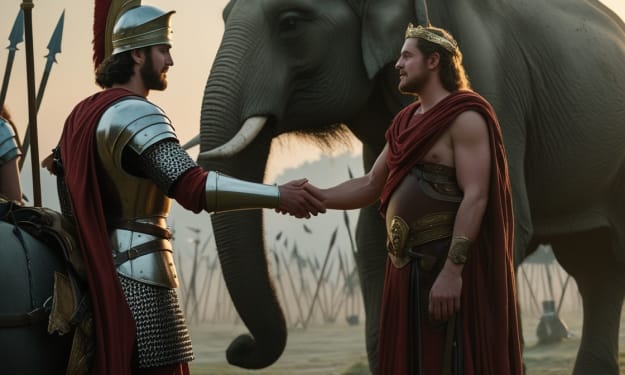
Alexander in the East: The Campaign into India and the Limits of Conquest Following the defeat of the Persian Empire, Alexander the Great advanced his forces eastward into the enigmatic regions of India. What ensued was an audacious and ruthless campaign across challenging landscapes and against unfamiliar adversaries. From the Battle of the Hydaspes to his resolution to retreat at the Hyphasis River, this article examines the strategic ingenuity, cultural interactions, and eventual obstacles that characterized Alexander’s final military frontier. Introduction: Beyond the Known World By 326 BCE, Alexander the Great had subjugated the formidable Persian Empire and emerged as the ruler of most of the known world. Yet his aspirations extended even further eastward. Motivated by the allure of glory and the tales of India’s abundance and wisdom, Alexander led his forces into the subcontinent. For his fatigued soldiers, this represented the brink of the world. For Alexander, it was the subsequent great challenge. India was not an uninhabited territoryit was the seat of ancient civilizations, proficient warriors, and formidable monarchs. The campaign tested Alexander’s military strategies, his diplomatic acumen, and even his capacity to maintain the allegiance of his battle-weary forces. Crossing the Hindu Kush To reach India, Alexander first had to traverse the unforgiving topography of present-day Afghanistan and Pakistan. The journey through the Hindu Kush mountains was arduous. The soldiers faced severe cold, perilous paths, and relentless ambushes from mountain tribes. Despite these challenges, Alexander persisted in advancing east, establishing cities and forming alliances along the route.
By Say the truth about a year ago in History
The Madman and the Moonlight: A Love That Outlived Time
There was once a boy named Qays, who loved words the way others loved gold. He wandered through the desert, his mind full of poems and his heart full of dreams. And then he saw her—Laila. She wasn’t just beautiful; she was quiet thunder, a storm in the stillness. Her eyes held stories, her silence spoke in verses.
By Naeem Mridhaabout a year ago in History
Alexander’s Conquest of Persia: Strategy, Sieges, and Supreme Victory. AI-Generated.
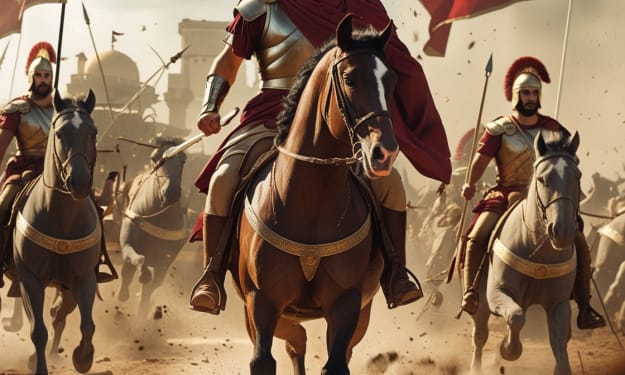
Alexander in Asia: Conquest of the Persian Empire Following the consolidation of Greece and his passage into Asia Minor, Alexander the Great commenced one of the most audacious campaigns in military historythe subjugation of the Persian Empire. Through exceptional strategy, astute diplomacy, and ceaseless ambition, he dismantled the preeminent empire of his era. This article examines how Alexander leveraged intellect and creativity to bring Persia to submission. Introduction: Into the Core of Empire In 334 BCE, a 22-year-old Alexander traversed the Hellespont with an army of 40,000 soldiers. His objective was not solely to retaliate against Greek cities previously under Persian dominion but to conquer the expansive Achaemenid Empire itself. At that juncture, Persia represented the most formidable political force on the planet, extending from contemporary Turkey to India. Alexander’s campaign against Persia would demonstrate not only the extent of his strategic brilliance but also his resolute determination to influence history. The Campaign Commences: Battle of the Granicus Alexander’s initial significant engagement in Asia occurred at the Granicus River. The Persian satraps (regional governors) had assembled a force and awaited across the river, anticipating that the young Macedonian would falter. Instead, Alexander launched a direct assault across the water, astonishing both allies and adversaries alike. Despite the inherent dangers of a frontal attack across a river, Alexander’s bold advance overwhelmed the Persian cavalry. His Companion Cavalry, fighting alongside him directly, contributed to breaking the enemy formations. This conflict opened the passage to Asia Minor and enabled Alexander to accrue a series of victories with minimal resistance. Psychological and Political Acumen Subjugating an empire as extensive as Persia necessitated more than military triumphs. Alexander recognized that public perception and diplomacy were crucial for sustained control. Following the defeat of local governors, he frequently reinstated them as satraps under his authorityprovided they pledged allegiance. This strategy preserved local governance and reduced the likelihood of uprisings.
By Say the truth about a year ago in History
The War Genius of Alexander the Great: Strategy, Speed, and Supremacy
The Military Strategy of Alexander the Great: Brilliance on the Battlefield Alexander the Great, one of history's most exceptional military intellects, established an empire that extended from Greece to India. His war strategies integrated audacious tactics, psychological operations, expert logistics, and an extraordinary capacity to adjust to shifting battlefield circumstances. This article examines the fundamental elements of Alexander's military genius that enabled him to dominate much of the known world before reaching the age of 33. Introduction: A Legacy Crafted in Combat Alexander III of Macedon, more commonly known as Alexander the Great, is remembered not only for the extensive empire he created but also for the manner in which he created itwith unparalleled strategic acumen. By the time of his demise in 323 BCE, he had never been defeated in battle, an achievement unmatched in military annals. His triumphs stemmed not merely from superior numbers or sheer force, but from profound tactical awareness, psychological manipulation, and adaptable thinking. Comprehending his war strategy elucidates why he continues to be regarded as one of the preeminent military leaders of all time. Foundation of His Strategy: The Impact of Philip II Alexander’s military instruction commenced under the vigilant supervision of his father, King Philip II of Macedon. Philip transformed the Macedonian army into a professional, highly disciplined unit and introduced the phalanx formationa tightly assembled line of spearmen wielding long sarissas (pikes), designed to be virtually impenetrable from the front. Alexander inherited this formidable army and expanded upon it. He incorporated mobility, adaptability, and a readiness to innovate. The solid groundwork laid by Philip II enabled Alexander to develop a dynamic strategy that combined strength and speed with overwhelming intelligence. Speed and Surprise: The Distinguishing Features of Alexander's Campaigns Alexander’s campaigns were marked by remarkable speed and abrupt assaults. He advocated for taking the offensive whenever feasible, seizing the initiative and keeping his adversaries off balance. His troops could march farther and more swiftly than their enemies anticipated, frequently arriving on battlefields before the opposition could adequately prepare. This was evident in the Battle of Granicus (334 BCE), his initial significant engagement against the Persian Empire. Alexander crossed the Hellespont into Asia Minor and astonished the Persian satraps by attacking across a rivera maneuver many deemed reckless. Yet the shock of his audacity secured him victory and momentum. The Hammer and Anvil Technique One of Alexander’s most renowned battlefield strategies was the hammer and anvil tactic. The Macedonian phalanx acted as the “anvil,” confronting the enemy head-on and pinning them down. Simultaneously, Alexander’s elite Companion Cavalry functioned as the “hammer,” maneuvering around the enemy’s flanks to obliterate them from the side or rear. This strategy was skillfully executed at the Battle of Gaugamela (331 BCE), where Alexander confronted the immense army of Persian King Darius III. Despite being significantly outnumbered, Alexander utilized terrain and troop positioning to neutralize Darius’ advantages. His cavalry breached the Persian lines, and his disciplined infantry maintained their ground, culminating in a decisive victory. Flexibility and Adaptation Unlike numerous commanders of his era, Alexander was not inflexible in his strategies. He swiftly adjusted to unfamiliar circumstances. During his campaign in Central Asia, he engaged guerrilla-style adversaries who did not present traditional battles. Alexander adapted by constructing fortified towns, establishing supply routes, and utilizing local guides. In India, at the Battle of the Hydaspes (326 BCE) against King Porus, Alexander confronted war elephants for the first occasion. Rather than becoming alarmed, he leveraged his maneuverability to outmaneuver the elephants and segregate them, targeting the supporting troops instead of confronting the animals directly. Utilization of Terrain and Intelligence Alexander frequently leveraged natural landscapes to his benefit. He meticulously examined terrain prior to each conflict. At Gaugamela, he intentionally selected a broad plain to neutralize Persian chariot assaults and create room for his own cavalry operations. He also excelled in gathering intelligencewhether from scouts, spies, or local populations. Prior to engagements, he discerned not only the numbers but also the morale, leadership, and cultural vulnerabilities of his adversaries. Psychological Warfare Alexander recognized the psychological factors inherent in warfare. He employed audacious tactics not solely to achieve victory but to inspire admiration and trepidation. He allowed conquered cities to hear of his compassionor his furydepending on what would yield the most beneficial results. At times, he spared cities to secure loyalty, while on other occasions, he obliterated them to establish precedents.
By Say the truth about a year ago in History
The Mystery That Time Forgot
Most people had never heard of Elderwood. It was a quiet little village surrounded by thick forest, far from the nearest city. The streets were narrow, the houses old, and the people even older. It looked peaceful on the outside — but there was one thing the villagers never talked about. 𝗛𝗼𝗹𝗹𝗼𝘄 𝗠𝗮𝗻𝗼𝗿. A hundred years ago, it was a grand house on the edge of the forest. People used to throw fancy parties there and talk about how beautiful it was. Then one day, it was just... gone. No fire. No collapse. Just gone. No rubble. No sign it ever stood there. Over time, people stopped asking questions. They said the forest took it. Or that it never existed at all. But there were still old photographs, letters, and maps showing exactly where it had been. Most people ignored it. Except for Clara Whitmore. Clara was a young historian from London. She loved forgotten places, strange stories, and solving old mysteries. When she read about Hollow Manor in a dusty book, she couldn’t stop thinking about it. A house that disappeared? That was the kind of story she had to see for herself. So, Clara packed her bags and took a train to Elderwood. When she arrived, the village looked just like she imagined: quiet, misty, and a little too still. She checked into a small inn and asked the owner, Mrs. Branley, if she knew anything about Hollow Manor. Mrs. Branley’s smile faded fast. “Don’t go looking for that place,” she said. “Some things are lost for a reason.” Clara tried asking others in the village. They all gave her the same look — half fear, half pity. One old man whispered, “People who go looking don’t always come back the same.” That night, Clara sat in her room and opened an old map. Hollow Manor was marked clearly at the northern edge of Elderwood Forest. The sun was setting, and the sky outside turned orange and purple. She grabbed her flashlight, notebook, and coat, and quietly left the inn. The forest was dark, the trees thick like walls. As she walked deeper, her compass began spinning. Her watch stopped ticking. Still, she followed the map. And then she saw it. There, in the middle of a clearing, stood "Hollow Manor" — tall, untouched, and glowing faintly in the moonlight. It looked exactly like the photos: ivy climbing the stone walls, tall windows, and a heavy wooden door slightly open. Clara stepped inside. The air smelled sweet and strange, like flowers and old books. Everything was perfect. The chairs were set, the candles unburned, and the clock on the wall ticked backward. A teacup sat on a table, steam still rising. She reached for her phone. No signal. The flashlight flickered and died. Then, the door behind her slammed shut. Clara turned to leave — but the door was gone. Just a wall now. Panicked, she ran down the hallway, looking for another exit. But the house had changed. The halls twisted. Rooms she had passed before were no longer there. Mirrors showed her reflection smiling when she wasn’t. In one room, she saw a boy, maybe ten years old, sitting in a velvet chair. His skin was pale, and his eyes were far too sad. “You came too,” he said softly. “Who are you?” Clara asked, her voice shaking. “We all came once,” he said. “We all thought we could find it. But you can’t find what doesn’t want to be found. It finds you.” Then he vanished. The lights went out. Clara ran, again and again, but the manor twisted like a maze. Time felt wrong. Sometimes it felt like morning, sometimes night. She found a mirror and gasped. Her reflection looked older — hair messy, clothes torn, eyes wide with fear. Then — 𝗦𝗶𝗹𝗲𝗻𝗰𝗲. She blinked. And she was outside. Just like that, she stood at the edge of the forest, with the sun rising through the trees. Her notebook was empty. Her phone battery full. Her watch still read midnight. She stumbled back into Elderwood, where Mrs. Branley was waiting at the inn. “You found it, didn’t you?” the old woman asked, handing Clara a cup of tea. Clara nodded slowly. Mrs. Branley just sighed. “Best to leave it now. The manor always lets you go once… if you're lucky.” Clara left the next morning. Back in London, she tried to write about what happened. But nothing made sense on paper. Still, she kept one photo she didn’t remember taking — of a boy in a velvet chair, looking straight into the lens. On the table beside him sat a teacup.
By Asad khan 313about a year ago in History
The Woman with the Gun: How a Single Photo Changed the Story of the Irish Revolution
The iconic photograph of an armed woman from the IRA, taken by photographer Colman Doyle in Belfast during the 1970s, has become one of the most recognisable symbols of the "Troubles" in Northern Ireland. Much more than just a visual record, this image encapsulates the complexities of the conflict, the involvement of women in armed struggle, and how photography can shape historical and cultural narratives. Analyzing the context, impact, and legacy of this image allows us to understand not only the role of women in the IRA but also how a single photograph can transform perceptions of gender, resistance, and politics.
By Alex Andersonabout a year ago in History
The Day Constantinople Was Officially Declared the ‘New Rome’. AI-Generated.
The year was 330 AD, and the Roman Empire stood at a critical juncture. For centuries, Rome had been the heart of imperial power, culture, and administration. Yet, under Emperor Constantine the Great, a profound transformation was underway—one that would reshape the empire and echo through history. On May 11, 330 AD, Constantine officially declared the ancient Greek city of Byzantium as Nova Roma—“New Rome.” This day marked the foundation of Constantinople, a city that would soon eclipse its predecessor and become the jewel of both the Roman and Byzantine worlds.
By Jishan Ahmedabout a year ago in History
LIFE WITHOUT FUEL
[Isaac Asimov is a noted scientist and science fiction writer. He has a remarkable gift for being able to explain complex science phenomena in ways that the ordinary person can easily understand. Asimov was recently asked to imagine and describe what would happen to everyday life in 1997 if fuel energy began running out. Asimov explains that "this is a picture of the worst, of waste continuing of oil running out, of nothing in its place, of world population continuing to rise."]
By its_ishfaq_ahmadabout a year ago in History