World History
THE SCERET OF ZIONISM IN SHORT
The Secret of Zionism" explores the origins, motivations, evolution, and consequences of the Zionist movement, delving into its political, religious, and social implications from both Jewish and global perspectives.Zionism is a nationalist movement that emerged in the late 19th century among Jews, with the primary goal of establishing a homeland for the Jewish people in Palestine. The movement was born in response to centuries of antisemitic persecution in Europe and a growing sense of Jewish national identity. Its ideological father, Theodor Herzl, published The Jewish State (1896), in which he argued that Jews could only escape antisemitism by establishing a sovereign state of their own.In the late 1800s and early 1900s, pogroms in Eastern Europe, discrimination in Western Europe, and exclusion from public life gave rise to a sense of urgency. The Zionist Congress was convened in 1897 in Basel, Switzerland, where Herzl and other leaders formally adopted the goal of establishing a "home for the Jewish people in Palestine secured under public law." During World War I, Zionist lobbying influenced the British government, resulting in the Balfour Declaration of 1917. This short letter expressed British support for the establishment of a "national home for the Jewish people" in Palestine. However, Palestine was already inhabited by an Arab majority, raising questions about the legitimacy of creating a Jewish state in a land with an existing population.Jewish immigration to Palestine increased during the British Mandate period (1920–1948), especially in response to the rise of Nazism and the Holocaust. Tensions between Jews and Arabs escalated, with outbreaks of violence becoming frequent. Zionist militias were formed to protect Jewish settlements, and Arab resistance grew against what was seen as colonial imposition.In 1948, the State of Israel was proclaimed. The United Nations had proposed a partition plan dividing Palestine into Jewish and Arab states, which was accepted by the Jews but rejected by Arab leaders. The ensuing 1948 Arab-Israeli War resulted in Israel expanding beyond the proposed borders, and over 700,000 Palestinians became refugees—a tragedy known as the Nakba ("catastrophe") in Arab history. The "secret" of Zionism, as presented in this book, refers to what critics call the duality or contradiction of a movement claiming liberation for one group while displacing another. The book likely argues that Zionism became not just a national movement but also a colonial enterprise, one that sought to claim land by replacing its indigenous population.Critics argue that early Zionist leaders were aware that establishing a Jewish majority would require either the displacement or marginalization of the Arab population in Palestine. This claim is supported by some Zionist writings from the early 20th century, which acknowledged the presence of Arabs but often viewed them as obstacles. While early Zionism was largely secular, religious Zionism has grown in prominence, especially in modern Israeli politics. Religious Zionists see the establishment of Israel as the fulfillment of biblical prophecy. This belief fuels the settlement movement in the West Bank, further complicating the Israeli-Palestinian conflict. Today, Zionism is a deeply polarizing subject. To many Jews, especially in the diaspora, Zionism simply means the right of Jews to self-determination in their ancestral homeland. To many Palestinians and critics, Zionism represents occupation, dispossession, and apartheid-like policies.The book explores how the ideals of Zionism—such as justice, security, and identity—have been compromised or contradicted by the realities of statehood, military occupation, and demographic engineering."The Secret of Zionism" does not necessarily claim a hidden conspiracy, but rather examines the unspoken contradictions and moral complexities within the Zionist project. It challenges readers to rethink the historical narratives and confront the ethical dilemmas surrounding nationalism, religion, and colonialism in one of the world's most enduring conflicts. So I recommend you to read the book
By Maynul Hassan2 years ago in History
Title: Cable Titans Unite: The $34.5 Billion Deal
That Could Reshape American Entertainment Byline: Jane Roberts, Business Correspondent Charter Communications and Cox Communications have announced a $34.5 billion merger, a significant move that is expected to reshape the US telecom industry. The deal, revealed early Friday morning, is one of the largest cable mergers in recent history and promises sweeping changes across the broadband, cable TV, and streaming industries. A Union of Giants Charter, the second-largest cable operator in the U.S., is known for its Spectrum-branded services. The third-largest is Cox, a privately held media and communications firm owned by a family. The merger will create a powerhouse with more than 50 million broadband and cable customers, rivaling Comcast in reach and market influence. "We believe this merger represents a transformative opportunity to better serve customers, accelerate innovation, and create value for stakeholders," said Charter CEO Christopher Winfrey, who will lead the combined company. Cox CEO Patrick Esser will join the board and serve as strategic advisor during the transition. What It Means for Consumers Industry experts say the merger could lead to improvements in infrastructure, including faster internet speeds and broader 5G deployment. However, critics point out that there may be fewer choices for customers and higher prices as a result of less competition. Maria Tran, a telecommunications analyst, stated, "This deal could give customers better service—but it also raises red flags about pricing power and market dominance." Regulatory Scrutiny Ahead The Federal Communications Commission (FCC) and the Department of Justice (DOJ) are likely to examine the deal closely, given recent concerns about media and telecom sector consolidation. Consumer advocacy groups are already gearing up for a fight. "This merger is bad for competition and bad for consumers," said Craig Aaron of Free Press, a nonprofit that monitors media consolidation. "We require more competition rather than less." Strategic Shifts and Streaming Stakes The merger also signals a shift in strategy as cable companies battle streaming giants like Netflix, Disney+, and Amazon Prime. By combining resources, Charter and Cox aim to launch a new joint streaming platform that leverages their massive customer base and infrastructure. "Together, we’ll be able to offer seamless access to live TV, on-demand content, and cutting-edge apps through a single platform," said Winfrey.What’s Next? Pending regulatory approval, the merger is expected to close in mid-2026. Until then, Charter and Cox will continue to operate independently. Investors responded positively to the news, with Charter’s stock climbing 7% in early trading. As the dust settles and regulators weigh in, one thing is clear: the cable wars are far from over—but the battlefield just got a lot more crowded. ---Only Jains will be united in the Charter and Coxar's 34.5 billion. This is a very big deal. They want to make the world more digital, but they will have a lot of benefits. This will keep their company swell. Start writing.This is Cabala very hard. Only Jaints will be united in the Charter and Cox's Bazar 34.5 billion. This is a very big deal. They want to make the world more digital, but they will have a lot of benefits. This will keep their company swell.Only Jaints will be united in the Charter and Cox's Bazar 34.5 billion. This is a very big deal. They want to make the world more digital, but they will have a lot of benefits. This will keep their company swell.Only Jaints will be united in the Charter and Coxar's 34.5 billion. This is a very big deal. They want to make the world more digital, but they will have a lot of benefits. This will keep their company swell. Start writing.This is Cabala very hard. Only Jaints will be united in the Charter and Cox's Bazar 34.5 billion. This is a very big deal. They want to make the world more digital, but they will have a lot of benefits. This will keep their company swell.Only Jaints will be united in the Charter and Cox's Bazar 34.5 billion. This is a very big deal. They want to make the world more digital, but they will have a lot of benefits. This will keep their company swell.
By Vocal media 2 years ago in History
The Human story
Long before cities rose or wheels turned, there was silence. The universe, vast and empty, waited. Then, with a burst of light, a star was born, and in its fiery heart, atoms danced and fused—carbon, oxygen, iron—elements that would one day breathe, build, and dream. We were not there to see it, but that was our beginning.
By Abdul Malik2 years ago in History
Precision Heat Processing: The Role of Rotary Kiln Dryers in Industry - Technomart Engineers Pvt. Ltd.
Introduction: A Rotary Kiln Dryer is a machine used in factories to dry lots of different materials by passing them over a big rotating drum that is tilted a bit on its side. The rotating shell is a bit tilted within the unit, which eases the flow of wet foods toward the dry area. Thanks to this process, the material dries quickly and water evaporates, which is why rotary kiln dryers can work well for anything from powders to granules and thicker pastes that have 3–50% moisture, bringing their moisture down to just 0.5%. The hot gases from a burner or other heat source flow either aligned or counter to the movement of the material depending on how the furnace is set up.
By Technomart Engineers Pvt. Ltd.2 years ago in History
The Hunt for Bin Laden: Secrets Behind the Abbottabad Operation
The Shadow of Osama Bin Laden Seen on Satellite and the Hunt for the Courier: The Story of the Abbottabad Operation in Netflix Series It was the beginning of 2011. Almost ten years had passed since one of the biggest attacks on American soil—9/11—but the founder and leader of the banned group Al-Qaeda, who claimed responsibility, Osama bin Laden, still remained out of America’s reach. But then the situation changed. On May 2, 2011, U.S. President Barack Obama and Secretary of State Hillary Clinton, along with other top American officials, were present in the White House Situation Room watching the U.S. operation unfold on Osama bin Laden's compound in the Pakistani city of Abbottabad. Now, the Netflix series American Manhunt: The Search for Osama Bin Laden, released on May 14, 2025, attempts to answer the questions: Why did it take the U.S. nearly a decade to capture Osama bin Laden, and what challenges did counterterrorism experts and CIA officers face in the process? The Netflix series claims that America’s Operation Neptune Spear was so secret that President Obama ordered, "No one in our own government should know about bin Laden's compound." What’s in the Netflix series American Manhunt: The Search for Osama Bin Laden? The three-part series begins with the 9/11 attacks and the American response. The second episode discusses repeated failures and frustration in attempts to capture bin Laden. The third episode focuses on Operation Neptune Spear, which eventually led to the successful capture and killing of Osama bin Laden. Former CIA officials and analysts in the series assert that the Battle of Tora Bora right after U.S. intervention in Afghanistan was a golden opportunity to capture bin Laden—but it failed. Image caption: Al-Qaeda leader Osama bin Laden was killed by U.S. Navy SEALs in the 2011 Abbottabad operation. For years afterward, Americans and officials kept wondering: Where is bin Laden? CIA analyst Cindy Storer says in the series: "There was concern that Osama bin Laden and other Al-Qaeda members could have fled Afghanistan and crossed into Pakistan or Iran—or taken a flight to hide anywhere." CIA officials say the hunt for bin Laden began in 1996, but he always managed to escape U.S. operations. Michael Morell, former CIA officer and daily intelligence briefer to the President, says that after leaving Afghanistan, Al-Qaeda didn’t go into hiding; instead, they began planning more attacks. U.S. officials feared that new attacks were being planned globally from Al-Qaeda's hideouts. The second episode describes how bin Laden’s associates were captured in Pakistan and transferred to the Guantanamo Bay detention center for interrogation. CIA officials say that detainees, including Khalid Sheikh Mohammed arrested from Rawalpindi, were subjected to physical and psychological torture during interrogation—such as being deprived of sleep for 100 hours. Still, bin Laden’s close aides refused to disclose his location. Meanwhile, every anniversary of 9/11 brought the same question from Americans: Where is bin Laden, and why hasn’t he been caught yet? The series shows how even CIA agents and contractors lost their lives in Al-Qaeda attacks. Operation Neptune Spear The series claims that U.S. intelligence officials had to change their strategy. They began analyzing bin Laden’s video messages and investigated how these videos were secretly released. U.S. authorities were searching for couriers who moved bin Laden’s videos from place to place. This led to the name "Abu Ahmed" surfacing in 2002. Former CIA officer Michael Morell claims that when Khalid Sheikh Mohammed was asked about Abu Ahmed during interrogation, he responded, "I’ve heard of Abu Ahmed, but he no longer works with Al-Qaeda." "When he returned to his cell—which we had bugged—he told other Al-Qaeda members not to say anything about the courier... He knew that the courier could lead us to Osama bin Laden." The series claims it took eight years for American intelligence agencies to find Abu Ahmed. Former CIA Director Leon Panetta says his phone was tracked to Peshawar in 2010. In one intercepted call, he was heard saying he was "still doing the same work."
By Ikram Ullah2 years ago in History
Manchester City Hopeful of Signing AC Milan Midfielder Tijjani Reijnders
Manchester City are reportedly setting their sights on a major midfield addition this summer, with AC Milan’s Tijjani Reijnders emerging as a top target. The Premier League champions are keen to bolster their midfield options as part of a long-term strategic rebuild, and Reijnders’ rise in Serie A has caught the attention of manager Pep Guardiola and his recruitment team.
By Iftekhar Islam Jihad2 years ago in History
The Silent Flash: The Story of the Atomic Bomb
The sun had just risen over the arid plains of New Mexico on July 16, 1945. A gentle breeze rustled the scrubland. Scientists and soldiers stood in silence, their eyes fixed on a strange steel tower rising from the desert floor. Inside it sat a device code-named “The Gadget.” It was the culmination of years of research, secrecy, and fear—a single weapon powerful enough to destroy a city. At precisely 5:29 AM, the world changed. In a blinding instant, the night turned to day. A brilliant fireball erupted, reaching skyward with unimaginable force. The ground shook violently. A mushroom cloud formed, expanding like a monstrous flower of smoke and flame. The shockwave thundered across the desert for miles. Mankind had split the atom—and opened the door to destruction on a scale never before imagined. This was Trinity, the first test of the atomic bomb, a weapon that would end a world war and begin a new kind of war—one cold, constant, and shadowed by dread. The journey to that moment had begun decades earlier, in quiet physics laboratories across Europe. In 1938, German scientists Otto Hahn and Fritz Strassmann discovered nuclear fission—the process of splitting an atom and releasing tremendous energy. Word of this discovery spread quickly, and it wasn’t long before alarm bells rang in America. Physicist Albert Einstein, though a pacifist, wrote a letter to President Franklin D. Roosevelt, warning that Nazi Germany might be developing an atomic bomb. Roosevelt responded by launching the top-secret Manhattan Project, a massive effort to harness nuclear energy before the Axis powers could. The project pulled together the greatest minds of the time—J. Robert Oppenheimer, Enrico Fermi, Niels Bohr, and many others. Across hidden laboratories in Los Alamos, Oak Ridge, and Hanford, thousands of scientists, engineers, and workers labored in secrecy. They split atoms, designed implosion systems, and processed uranium and plutonium. They worked knowing their creation could reshape the fate of the world. Oppenheimer, the scientific director of the Manhattan Project, was a brilliant yet conflicted man. He loved literature as much as he loved science. After witnessing the Trinity explosion, he famously whispered a haunting line from the Bhagavad Gita: “Now I am become Death, the destroyer of worlds.” Three weeks later, on August 6, 1945, a B-29 bomber named Enola Gay dropped the first atomic bomb over the Japanese city of Hiroshima. The bomb, called Little Boy, exploded with the force of 15,000 tons of TNT. In seconds, the city was flattened. Tens of thousands of people died instantly. Fires raged. Shadows of vaporized bodies were burned onto walls. Three days later, a second bomb, Fat Man, was dropped on Nagasaki. Another city vanished in flame and thunder. On August 15, Japan surrendered. World War II was over. To many, the atomic bomb had ended the deadliest conflict in human history and saved millions of lives that might have been lost in a prolonged invasion. But the price was unimaginable. Over 200,000 people—mostly civilians—died as a result of the two bombs, many from radiation sickness and long-term effects. The world had entered the Atomic Age. What followed was not peace, but paranoia. The United States no longer held a monopoly on nuclear weapons. The Soviet Union developed its own bomb in 1949. The Cold War began—a tense, decades-long standoff where the superpowers built massive nuclear arsenals, prepared for a war that neither side dared to start. Children practiced duck-and-cover drills in classrooms. Governments built underground bunkers. Spy planes flew. Missiles were aimed. Nuclear tests scarred the Earth—at Bikini Atoll, in Nevada, in the Soviet tundra. The power of the bombs grew exponentially. Hydrogen bombs, thousands of times more powerful than those dropped on Japan, became the new threat. And yet, amid the fear, a fragile hope emerged. Treaties were signed. The Non-Proliferation Treaty sought to prevent the spread of nuclear weapons. The world stared into the abyss—and chose, at least for now, to step back. Today, the memory of Hiroshima and Nagasaki remains a powerful reminder. Museums display melted watches, burned clothing, and paper cranes folded by survivors. The silence of the atomic bomb’s victims speaks louder than any detonation. The story of the atomic bomb is not just about science or war—it’s about humanity. About the choices we make with the power we hold. About the thin line between progress and destruction. That single flash in the desert did more than end a war. It forced us to ask the question: If we can destroy the world, can we also choose to save it? And that question still hangs in the air—like a cloud over a quiet, watching Earth.
By Mati Henry 2 years ago in History
The Life Journey of Dinosaurs: From Dominance to Extinction
Dinosaurs have captivated the imagination of humans for centuries. These colossal creatures once ruled the Earth, leaving behind fossils and mysteries that continue to inspire scientists, filmmakers, and curious minds. Their story is not just about their size and strength, but also about evolution, survival, and extinction. From their first appearance during the Triassic period to their sudden disappearance at the end of the Cretaceous, the life journey of dinosaurs is one of the most fascinating sagas in the history of our planet.
By ankesh kushwah2 years ago in History
Cyrus the Great: Architect of Empire and Master of Military Strategy. AI-Generated.
The Ascendancy of a Revolutionary Strategist Born circa 600 BCE, Cyrus II of Persialater recognized as Cyrus the Greatoriginated from humble beginnings as the sovereign of a minor kingdom, Anshan. However, through a fusion of military brilliance, political savvy, and strategic foresight, he would eventually establish the formidable Achaemenid Empire, the inaugural world empire, extending from the Aegean Sea to the Indus Valley. His military strategy was not solely reliant on sheer conquestit was a meticulously balanced amalgamation of speed, tolerance, deceit, and innovation. Unification of the Persian Tribes Cyrus’s initial action was to consolidate the Persian tribes under his authority. He bolstered his foundation by uniting rival factions and asserting control over the Median Empire, then governed by his grandfather, Astyages. Instead of annihilating the Medes, he assimilated them amicably, incorporating their military and administrative structures into his own. This strategic integration provided Cyrus with an immediately established empire and ensured that his subsequent conquests would possess the manpower and infrastructure necessary for success. Swift Campaigns and Tactical Superiority A defining feature of Cyrus’s military strategy was his execution of rapid, decisive campaigns. He maneuvered his forces with a velocity seldom witnessed in the ancient world, catching adversaries unprepared and striking before they could form coalitions. Campaign Against Lydia (547 BCE) Croesus, monarch of Lydia, was one of the wealthiest and most influential rulers of his epoch. Confident in his power, he miscalculated Cyrus’s capabilities and initiated an offensive. Cyrus retaliated with a winter campaigna surprising tactic, as conventional warfare typically ceased during the frigid months. His abrupt advance compelled Croesus to withdraw to Sardis. Cyrus employed psychological warfare, disseminating rumors of substantial reinforcements and capitalizing on Croesus’s uncertainty. In the pivotal battle outside Sardis, Cyrus utilized camels to disrupt the Lydian cavalry, whose steeds panicked from the scent. The strategy succeeded, leading to Lydia's swift capitulation. The Conquest of Babylon (539 BCE): Strategy Without Destruction The capture of Babylon stands as perhaps Cyrus’s most renowned conquest and is one of the most strategically noteworthy events in ancient military history. The Babylonian sovereign, Nabonidus, had estranged his populace through religious negligence and oppressive governance. Cyrus leveraged this discontent, presenting himself as a liberator rather than a conqueror. Key strategic components: Propaganda: Cyrus dispatched messages in advance, articulating his resolve to restore Marduk, Babylon’s principal deity, and enhance the lives of the citizenry. Engineering: His forces redirected the Euphrates River, diminishing its level and permitting soldiers to advance into the city via the riverbed. No bloodshed: Babylon was captured with minimal resistance. Cyrus entered the city peacefully, honoring its temples and traditions. This amalgamation of military engineering, psychological acumen, and religious diplomacy astonished the ancient world. Integration, Not Domination Unlike numerous conquerors, Cyrus did not depend solely on fear to sustain authority. He employed a strategy of integration: Granted cultural independence to subjugated peoples. Honored local faiths and restored temples, including the Jewish temple in Jerusalem. Issued the Cyrus Cylinder, regarded as the first charter of human rights, which delineated policies of tolerance and protection for all subjects. This inclusive strategy transformed former adversaries into loyal citizens, stabilizing his empire and diminishing insurrections. Military Reforms and Logistics Cyrus also modernized the Persian military structure: Established a central professional army, featuring the elite "Immortals"a 10,000-strong guard unit. Enhanced logistical frameworks to guarantee supply lines over extensive distances. Constructed roads and relay stations, subsequently improved by Darius I, facilitating swift communication across the empire. His focus on logistics ensured that military endeavors could be sustained over long distances and durations, a crucial advantage in governing a multi-ethnic empire. Legacy of Strategy Cyrus the Great not only expanded territoryhe redefined the essence of rulership: He illustrated that soft powerdiplomacy, religious respect, and cultural tolerancecan be as potent as swords and spears. He was esteemed not merely by his subjects but also by his adversaries. The Greeks admired him, and even Alexander the Great paid tribute at his tomb in Pasargadae. His strategies influenced successive generations of leaders, from Roman emperors to Enlightenment thinkers. The equilibrium of military force and humane governance established a precedent that few leaders have equaled. Conclusion: A King Like No Other Cyrus the Great endures as one of history’s most impactful figures not solely for the magnitude of his empire, but for the strategies that ensured its longevity. His capacity to secure victories through ingenuity and diplomacy, integrate cultures, and govern with a sense of justice and wisdom distinguished him in a harsh era. He demonstrated that true greatness in leadership resides in the ability to unify rather than divide, to conquer hearts as well as territories. In doing so, Cyrus created not only an empire but a vision of rulership that resonates through the ages.
By Say the truth 2 years ago in History
The Brilliance of Hannibal Barca: The Elephant Commander Who Disturbed Rome. AI-Generated.
Introduction: The Ascendancy of a Warrior from Carthage Born in 247 BCE in Carthage (present-day Tunisia), Hannibal was the offspring of Hamilcar Barca, a commander who had engaged in the First Punic War against Rome. Hannibal grew up in an environment steeped in warfare and revenge. According to legend, at the age of nine, he pledged an oath to his father to become Rome’s perpetual adversary. Hannibal inherited more than animosityhe inherited strategic brilliance. By the age of 26, he was commanding Carthaginian troops in Spain. Within two years, he initiated the Second Punic War, one of the most audacious military campaigns in ancient history. Strategy 1: Striking from the Unexpected The Alpine Invasion Hannibal’s inaugural masterstroke involved attacking Rome from the north: In 218 BCE, he led an army of 50,000 troops, 9,000 cavalry, and 37 war elephants across the Alps, a feat deemed impossible by the Romans. The expedition was gruelingbrutal cold, snow, and tribal ambushes resulted in the loss of nearly half his forcesbut the psychological impact was catastrophic. Rome never anticipated an incursion from that direction. By unexpectedly reaching northern Italy, Hannibal circumvented Roman fortifications and caught the Republic off guard, establishing the foundation for his subsequent victories. Strategy 2: Utilizing Terrain and Deception to Overcome Adversity Hannibal never possessed numerical superiority over Rome. His brilliance was evident in how he leveraged terrain, surprise, and deception: Battle of Trebia (218 BCE): Hannibal enticed Roman forces into frigid rivers, then ambushed them from concealed positions, resulting in thousands of casualties. Battle of Lake Trasimene (217 BCE): He utilized fog and a narrow mountain pass to ambush and annihilate an entire Roman army, leaving over 15,000 dead. These confrontations exemplified terrain-based warfare, in which Hannibal transformed the landscape into an instrument of victory. Strategy 3: The Masterpiece Battle of Cannae (216 BCE) The Battle of Cannae is heralded as one of the most outstanding tactical executions in military history: Hannibal confronted a Roman force twice his size80,000 Roman soldiers opposed to his 50,000. He organized his troops in a convex arrangement, positioning weaker units at the forefront. As the Romans pressed forward, the center retreated, and the flanks enveloped them in a double envelopmentthe pincer movement. The outcome? 50,000 to 70,000 Roman casualties in a single day. Rome’s most significant defeat in history. This battle continues to be analyzed in military academies today for its flawless execution of encirclement. Strategy 4: Psychological and Political Warfare Hannibal’s methods of warfare extended beyond the battlefield: He endeavored to undermine Rome’s alliances with other Italian cities by treating captives with compassion and presenting himself as a liberator. He spared civilians whenever feasible and promoted regional autonomy, earning support from Rome’s adversaries. Although he could not incite all cities to rebel against Rome, his psychological strategies depleted Roman resources and extended the conflict. Strategy 5: Attrition and Endurance Following Cannae, Hannibal anticipated that Rome would negotiate for peace. They did not. Instead, Rome: Evaded direct confrontation with Hannibal for over a decade. Employed guerrilla methods and attrition tactics. Hannibal, isolated in Italy without reinforcements, modified his approach: He established supply depots, engaged local allies, and prioritized sustainable control over open confrontations. His capacity to sustain a foreign army deep within enemy territory for 15 years without disintegration was a logistical achievement. Strategy 6: The Endgame Zama and the Legacy Ultimately, Roman General Scipio Africanus shifted the momentum by assaulting Carthage directly, compelling Hannibal to return. At the Battle of Zama (202 BCE): Scipio incorporated several of Hannibal’s own methodologies. Hannibal’s forces, consisting of assorted levies and fewer seasoned soldiers, were ultimately vanquished. Nevertheless, even in defeat, Hannibal’s strategic impact remained unmistakable. His ingenuity, adaptability, and boldness redefined military engagement. Legacy: The Shadow Over Rome Although he lost the conflict, Hannibal imparted a significant legacy: Roman commanders for centuries feared the “Ghost of Hannibal. ” His strategies influenced Napoleon, Frederick the Great, and contemporary leaders. He transformed mobility, flanking strategies, and the tactical application of terrain. Rome, acknowledging his brilliance, eventually recognized him as one of the most formidable adversaries they ever encountered. He passed away in exile around 183 BCE, allegedly by poison to prevent capture. Conclusion: The Mind That Terrified an Empire Hannibal’s name persists not solely due to elephants or unconventional warfare, but because of his intellect, foresight, and unwavering determination. He transformed Carthage from a maritime power into a land-based menace that nearly succeeded in overthrowing Rome. Through bravery, innovation, and audacity, Hannibal inscribed his name into the annals of historynot as a conqueror, but as a master strategist, whose legacy transcends defeat.
By Say the truth 2 years ago in History
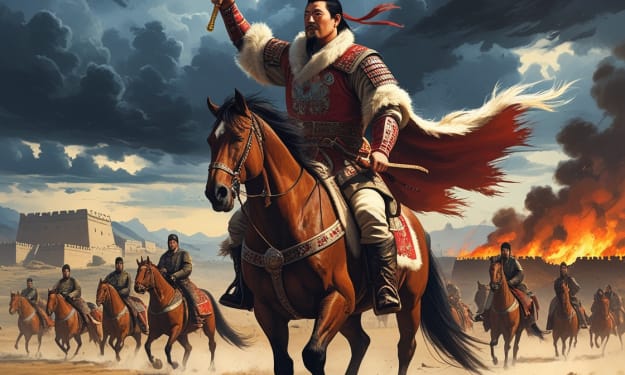
Genghis Khan: The Equine-Born Tempest – Tactics of the Mongolian Warlord Who Dominated the Globe . AI-Generated.
The Ascendancy of a Nomadic Fighting Man Temujin was born circa 1162 into a tribal environment fragmented by familial conflicts and fluctuating alliances. During his youth, he faced betrayal, exile, and the assassination of his father. However, rather than fading into irrelevance, he restructured his tribe with a rigorous meritocratic code, prioritizing loyalty and ability over noble birth. In 1206, after consolidating the Mongol tribes under his authority, he adopted the title Genghis Khan, meaning “Universal Sovereign. ” His metamorphosis from pariah to monarch was merely the commencement. Genghis Khan would proceed to establish an empire that extended from the Pacific Ocean to the fringes of Europe. Tactic 1: Consolidation Through Meritocracy and Discipline Before Genghis Khan could dominate the world, he had to unify Mongolia. His insight lay in recognizing that tribal discord weakened his people. To counter this: He dismantled tribal allegiances and reorganized his military into decimal formations (units of 10, 100, 1,000, and 10,000), integrating fighters from various clans. He advanced officers based on capability, not heritage. Discipline was rigorous, and defection or treason was dealt with promptly. This tactic forged an army of unparalleled loyalty and effectiveness, with each soldier perceiving themselves as part of a grander entity. Tactic 2: Velocity, Mobility, and Communication Mongolian warriors were adept equestrians. Each soldier rode with multiple horses, facilitating swift travel across extensive distances. Their cavalry could traverse 100 miles per day, an extraordinary pace for the era. Genghis Khan further implemented: A courier relay network (Yam), equipped with stations and fresh mounts every 20-40 miles. Signal flags and horns for battlefield coordination. These advancements enabled synchronized assaults, even across significant distances, and facilitated rapid adjustments in real-time, crucial to his triumphs. Tactic 3: Intelligence, Spies, and Psychological Manipulation Prior to engaging in battle, Genghis Khan consistently gathered intelligence: He dispatched spies and traders to survey landscapes, pinpoint weaknesses, and analyze local governance. He employed double agents and misinformation, prompting adversaries to underestimate or misjudge Mongol strength. His strategies of psychological manipulation were equally effective: Towns that opposed were obliterated, and survivors were annihilated, instilling dread ahead of the Mongol forces. Cities that capitulated were often spared and even rewarded. This notoriety preceded the Mongols, frequently resulting in cities yielding without resistance. Tactic 4: Innovation in Siege Warfare Although nomadic, the Mongols swiftly mastered siege methodologies by: Recruiting engineers from China and Persia to construct catapults, battering rams, and explosives. Exploiting Chinese gunpowder to develop early grenades and bombs. Surrounding cities with total encirclement, obstructing supplies and water. The Mongols captured cities once deemed unconquerable, including Zhongdu (Beijing) and the formidable strongholds of the Khwarazmian Empire. Strategy 5: Fragment and Conquer In extensive campaigns, Genghis Khan frequently separated his troops, attacking numerous objectives simultaneously: In Central Asia, he dispatched distinct armies into Transoxiana and Persia, overwhelming the Khwarazmian Sultan. Against the Jin dynasty in China, he employed pincer maneuvers and multi-front offensives. This multifaceted approach disoriented adversaries and undermined coalitions before they could consolidate. Strategy 6: Flexibility and Ruthless Effectiveness Unlike many conquerors, Genghis Khan was not constrained by convention: He incorporated weapons, strategies, and technologies from every civilization he encountered. He integrated defeated foes’ soldiers and engineers into his own forces. He was brutally practicalif a city resisted, it was annihilated. If it surrendered, it became part of his administration. His armies gleaned insights from every confrontation, progressing as they advanced westward into Russia and Europe.
By Say the truth 2 years ago in History