World History
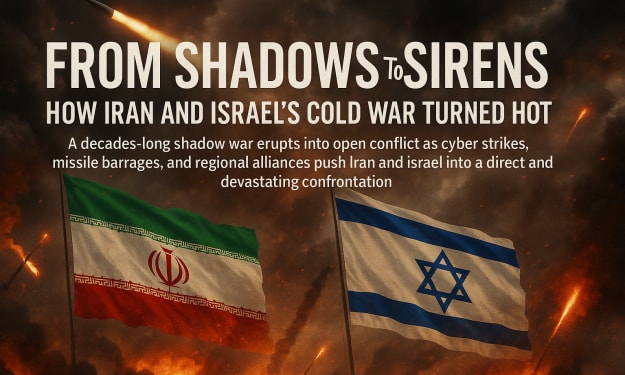
From Shadows to Sirens: How Iran and Israel’s Cold War Turned Hot. Content Warning. AI-Generated.
The Long Fuse of Hostility For over four decades, Iran and Israel have engaged in a clandestine war fought far from the battlefield—through assassinations, proxy militias, cyberattacks, sabotage, and disinformation. This shadow conflict, sustained by deep ideological opposition and strategic rivalry, simmered across the Middle East without ever boiling over into a direct state-to-state war. But that changed dramatically in 2025. In the span of a few weeks, the conflict spiraled into open warfare. What was once whispered in intelligence briefings is now screamed by air raid sirens across Tel Aviv and Tehran. The decades of brinkmanship, covert operations, and geopolitical maneuvering have collapsed into an era-defining war. --- A Cyber Spark in a Powder Keg The immediate trigger was a sophisticated cyberattack on Iran’s Natanz nuclear enrichment facility, followed by a retaliatory breach of Israel’s electrical grid that left parts of the country in darkness. While both sides had long engaged in cyber warfare, this exchange was different—more public, more destructive, and followed by a flurry of accusations and counter-threats at the United Nations. Iranian leadership, pressured by hardliners and emboldened by recent military advancements, launched a missile strike on Israeli intelligence infrastructure in Haifa. Israel responded within hours with airstrikes targeting IRGC (Islamic Revolutionary Guard Corps) positions in Syria and western Iran. Suddenly, the war was no longer invisible. --- Proxy No More: A Regional Firestorm Historically, Iran and Israel have fought through intermediaries: Hezbollah in Lebanon, Hamas in Gaza, Shia militias in Iraq and Syria, and covert Israeli operations in Iran. But in 2025, the gloves came off. Israel's direct strikes on Iranian soil marked a significant shift. Iran responded with ballistic missile launches from its western provinces, targeting Israeli military sites in the Negev Desert. Air defense systems intercepted some, but not all. Simultaneously, Iranian-aligned militias across the region—especially in Lebanon, Iraq, and Yemen—opened secondary fronts. Rockets poured into northern Israel from Hezbollah-controlled areas, while Israeli jets bombarded suspected launch sites. For the first time, the war transcended the realm of limited engagements and became a true regional conflagration. --- Civilian Costs and Global Tremors As in all modern conflicts, it is civilians who suffer most. In Iran, Israeli airstrikes targeted suspected weapons factories near populated areas. In Israel, daily sirens have driven millions into bomb shelters. Casualties mount as critical infrastructure crumbles under the weight of sustained attacks. Oil prices have skyrocketed. International shipping through the Strait of Hormuz—the world’s most vital energy chokepoint—has slowed dramatically. Western powers scramble to mediate, while regional actors pick sides or try desperately to stay neutral. Russia and China have cautiously supported Iran, condemning Israel’s air campaigns. The United States, though initially hesitant to intervene, has increased arms shipments to Israel and deployed additional naval forces to the eastern Mediterranean. The United Nations, as expected, remains paralyzed. --- Ideology Meets Realpolitik At the heart of this war lies more than territorial or strategic concerns—it’s an ideological chasm. Iran’s Islamic Republic sees Israel as an illegitimate, colonial state. Israel sees Iran as an existential threat bent on nuclear capability and regional dominance. But ideology alone cannot explain the timing and scale of the escalation. Domestic politics played a role. Both Israeli and Iranian leadership were facing internal unrest and economic discontent. War, tragically, provided both a distraction and a rallying cry. --- The World Watches—and Waits Diplomatic backchannels continue to operate, but trust has evaporated. Calls for ceasefire are drowned out by airstrikes and retaliatory barrages. Humanitarian corridors are proposed and often denied. With neither side willing to accept the appearance of weakness, the war grinds on. In cities across the world, protests erupt—some in support of Israel, others for Iran, many simply pleading for peace. Analysts warn of potential spillover: conflict dragging Saudi Arabia, Turkey, or even NATO into the fray. And yet, no one truly knows how this war will end—or if it will. --- Conclusion: A New Middle East? This is not merely another flare-up in the troubled history of the region. The Iran–Israel war marks a new chapter, where former rules no longer apply, and the balance of power could be fundamentally reshaped. Whether it ends in negotiated peace, catastrophic escalation, or prolonged regional instability, one thing is certain: the age of shadows is over. Sirens now define the Middle East's new reality.
By 🇲 🇮 🇳 🇩 🇺 🇳 🇫 🇴 🇱 🇩 🇪 🇩 about a year ago in History
5 Hoaxes That Had People Fooled
Missing Link. Charles Darwin was the first person to propose evolution, even publishing a book on his findings entitled On the Origins of Species. Ever since, people have been trying to find the missing link. And it was found in 1912 by amateur geologist and archeologist Charles Dawson. The skull was given the name Piltdown Man. While many people did buy into it, there were still skeptics. Those who didn’t believe it said it looked exactly what it was: a human skull with an ape jaw. There was a ceremony in December 1912 hosted by the Geological Society of London, where Dawson could present his findings. Then, in 1917, believers felt a little vindication. Another skull was found, given the title Piltdown II. As more and more early human skulls were found in China and Africa, the legitimacy of the Piltdown skulls came under scrutiny. These new skulls had an apelike skull and humanlike jaw, the exact opposite of the Piltdown ones. Finally, in 1953, the Piltdown Man was run through some tests, which exposed the skull as a fraud. The nonbelievers were on the right track! It was revealed that it was a combination of human (skull), orangutan (jaw), and chimp (teeth). To top it all off, the fluorine dating shows the skull to be no more than 100,000 years old. While that it old, it’s still not old enough to be a missing link. There is still no answer to who the perpetrator of the hoax is, though it’s suspected it was Charles Dawson himself. Indecent Animals. A man by the name of Clifford Prout Jr. was fed up with animals just walking around in the nude. So much so that in the 1950s and 60s, he started a group called SINA: the Society for Indecency to Naked Animals. Clifford believed that animals deserved some modesty just as much as humans. According to Prout, allowing animals to wander around with their genitals out contributed to moral decay. The public took SINA so seriously that Clifford Prout received a $40,000 donation to continue his efforts. But in 1964, the truth finally came out. Clifford Prout Jr. wasn’t a real man, and SINA wasn’t a real group. The person behind this was actually career hoaxer Alan Abel, who would later impersonate Howard Hughes and offered a “euthinasia cruise” for those who were ready to go. Hoax Unintended. This one is a little bit up for debate when it comes to calling it a hoax, as it could fall under the mass hysteria umbrella as well. And that is the radio presentation of H.G. Wells’ sci-fi novel War of the Worlds. There were a few things that led to this hysteria/hoax. Prior to the radio show, there was a disclaimer that would have helped avoid the whole trouble. However, there were many people who were listening to another station and didn’t tune in until 8:12, thus missing the disclaimer. There was another thing that lent to the believability of the broadcast. The alien invasion started with a weather report and a concert. This was followed by “reports” of explosions on Mars, a meteorite touching ground in New Jersey, and finally with aliens actually invading. With the reporters starting to become more frantic, the one million people who tuned in also started to panic. People were arming themselves and crowding highways. When CBS got wind of the hysteria, Wells himself had to get onto the radio and remind everyone that it was all fiction. The Cardiff Giant. Giants have been a big part of mythology all over the world, and on October 10, 1869, two men seemingly found evidence of their existence. Gideon Emmons and Henry Nichols dug up a 10-foot petrified man while digging a well on a New York farm for owner William Newell. As word spread, Newell decided to put up a tent and charged a quarter for a peek at the giant (and eventually charged $0.50 as more and more people came). Some claimed that this body was an ancestor of the Onondaga people while others claimed that this was evidence of the Biblical giants. And many still believed its authenticity despite professionals saying that this giant was a fake. William Newell eventually sold this “mummy” to two businessmen, who took the body on tour. PT Barnum offered these men $50,000 for the giant for his own collection. When they declined, Barnum created a knockoff for his New York museum. Eventually, a man named George Hull came forward and admitted that this was a get-rich-quick scheme. He commissioned a German stone cutter to create this man and asked his cousin William Newell to bury the body. Even after the hoax was revealed, the Cardiff Giant still made its rounds before making its way to the Farmers’ Museum in Cooperstown in 1947, where he still lives today. Feejee/Fiji Mermaid. Nowadays, it’s more widely known that PT Barnum wasn’t super honest about all of his attractions and performers. So it was hard to choose just one, but one of his more famous “real” discoveries was something he dubbed the “Feejee Mermaid.” He claimed that these were the remains of a real mermaid found in the Bay of Bengal. Eventually, staff from the Peabody Museum of Archeology and Ethnology got their hands on a specimen called the Java Mermaid. While it’s not known if this is the Feejee Mermaid, at the very least it is very similar to the one Barnum had. The museum wanted to get to the bottom of the mystery. After all, if Barnum was telling the truth, then this would have been a brand new discovery. It was found that this wasn’t really a mermaid. In fact, it was just a souvenir handcrafted by Southeast Asian fishermen and sold to tourists as a mermaid. These creatures are a mix of paper-mache and fish bones and fins.
By Micah Jamesabout a year ago in History
The History of Motor Insurance. AI-Generated.
Motor insurance has become an essential part of modern transportation. Whether you're driving through city streets or rural roads, insurance coverage provides the financial protection and legal assurance that drivers depend on. But how did this crucial industry evolve? The history of motor insurance is a fascinating journey that reflects the evolution of automobiles themselves — from early experimentation to the complex systems of regulation and risk management we see today.
By social xpertsolutionsabout a year ago in History
Timeless Citadel of Aleppo Stands Strong"
Citadel of Aleppo – A Timeless Guardian of Syrian Heritage Perched on a prominent hill in the center of Aleppo’s ancient city, the Citadel of Aleppo is a majestic symbol of Syria’s historical legacy, architectural brilliance, and cultural resilience. One of the oldest and largest castles in the world, this UNESCO World Heritage Site has witnessed the rise and fall of empires, brutal wars, and the enduring spirit of a city and its people.
By Mukhtiar Ahmadabout a year ago in History
The Giants of Peru: Conquistadors' Eyewitness Accounts and the Mystery of Ancient Skeletons
The Giants of Peru When the Spanish conquistadors arrived in South America in the 16th century, they anticipated discovering gold, spices, and strange civilizations. However, they did not expect to encounter legends of giants, and even more surprisingly, reports of actual giant skeletons unearthed by the native people that they claimed to have seen with their own eyes.
By The Secret History Of The Worldabout a year ago in History
“From Allies to Adversaries:
his y Introduction Once allies in a complex and unstable Middle East, Iran and Israel’s relationship has shifted dramatically over the past several decades. From covert military cooperation and oil deals during the reign of Iran’s Shah to today's deadly standoffs, cyberattacks, and proxy wars — their history is one of trust shattered, secrets unearthed, and a silent war that has shaped the very structure of the region.
By Qaisar iqbal about a year ago in History