World History
Natural Gas, WTI Oil, Brent Oil Forecasts – Oil Soars 5% As Trump Demands Iran’s Surrender.
**Natural Gas, WTI Oil, Brent Oil Forecasts – Oil Soars 5% As Trump Demands Iran’s Surrender** Oil prices skyrocketed by more than 5% as Middle Eastern geopolitical tensions escalated, causing a significant shift in global energy markets. The dramatic rise was as a result of the former U.S. President Donald Trump’s strong rhetoric against Iran, demanding what he called the regime’s “complete and unconditional surrender.” West Texas Intermediate (WTI) and Brent crude prices shot up as traders quickly reacted to the news, reviving the debate about supply risks and long-term price stability. WTI crude oil prices surged past the \$81 per barrel mark, while Brent crude crossed \$85, marking one of the most significant single-day increases in recent months. Natural gas also rose by nearly 2%, though it did so at a slower rate than the oil benchmarks. Geopolitical risk premiums were largely responsible for the rally because market participants had priced in the possibility of oil flows from the region being disrupted. Iran is an important OPEC member that has a lot of influence over the Strait of Hormuz, which is a crucial chokepoint for shipping oil around the world. Trump’s remarks, made during a press event and widely broadcast across global media, sent a clear message to Tehran. Framing Iran as a destabilizing force, he called for the international community to back what he termed a final effort to "remove the threat of terrorism and nuclear ambition from the region." Even though Trump is not in office right now, his statements are important, especially to right-wing leaders and Washington policymakers. As the 2024 U.S. presidential election cycle continues, energy traders are increasingly paying attention to how foreign policy rhetoric might influence market behavior.
By GLOBAL NEWSabout a year ago in History
Glass spheres in Florida clams - evidence of a meteor impact
In the fossil-rich sediments of Florida’s Gulf Coast, a peculiar and compelling mystery has emerged—one that blends paleontology, geology, and the vast forces of space. Deep within the layers of ancient fossil beds near Sarasota County, hundreds of fossilized clam shells were found to contain tiny, nearly invisible glass spheres. These minute spheres, each no wider than a grain of salt, are smooth, perfectly rounded, and chemically distinct from typical natural sediment grains. Their origin has fascinated researchers, as growing evidence suggests they may be remnants of an ancient meteorite impact—possibly a previously undocumented event that occurred millions of years ago.
By History Seekerabout a year ago in History
☢️Mohenjo‑daro “nuclear blast” theory - Ancient Indus Valley city
In the 1920s, deep in the floodplains of the Indus River in what is now Sindh, Pakistan, the ancient city of Mohenjo‑daro was rediscovered beneath centuries of silt and agricultural soil. Built around 2500 BCE at the height of the Mature Harappan phase, it was a marvel of urban planning, sanitation, and civil engineering—a testament to one of the world’s earliest great civilizations. Its bricks were sculpted, its bathhouses communal, its streets laid out in orderly grids. At its peak Mohenjo‑daro housed perhaps 40,000 people, all supported by an elaborate system of wells, drains, granaries, workshops, and public baths. It rivaled in sophistication the contemporary societies of Egypt and Mesopotamia.
By History Seekerabout a year ago in History
🎭Sanxingdui Mask and the Lost Civilization of Shu in Ancient China
🪨 The Earth Opens – A Discovery Beneath Sichuan's Soil In the summer of 1929, the course of Chinese archaeology was forever altered when a humble farmer named Yan Daocheng, while digging an irrigation trench near the small village of Sanxingdui in Guanghan, Sichuan Province, struck something solid just beneath the surface. What emerged was not stone or wood but smooth, polished jade—an intricately carved object unlike anything local villagers had seen. The discovery passed quietly at first, filed away as a strange curiosity. But it hinted at something enormous and long-buried under the rolling plains of western China.
By History Seekerabout a year ago in History
UK Travel Firm Collapses
A major travel company in the United Kingdom has collapsed, leaving thousands of people without their holidays and many travelers stuck abroad. The sudden closure shocked customers and the travel industry. This collapse has raised questions about how safe it is to book holidays with smaller travel firms and what protections travelers really have.
By Farhan Sayedabout a year ago in History
The Silent Revolution: How the Spice Trade Reshaped the World. AI-Generated.
The Origins of the Spice Trade The story of the spice trade begins thousands of years ago in the tropical regions of Asia, particularly in India, Indonesia, and Sri Lanka. Spices were initially prized for their culinary uses, but they also held medicinal, religious, and preservation value.
By uzair hadiabout a year ago in History
The Forgotten Queen of Persia: The Woman Who Changed an Empire’s Fate. AI-Generated.
Introduction When we think of ancient Persia, the spotlight often falls on figures like Cyrus the Great, Darius, or Xerxes — kings who built vast empires, waged wars, and shaped the course of history. Yet, history is not only shaped by kings but also by those who dared to defy them. One such figure is Queen Tomyris, a fierce and fearless leader of the Massagetae, a nomadic tribe of Central Asia, who not only resisted Persia’s most powerful conqueror but decisively defeated him.
By uzair hadiabout a year ago in History
The Emperor Who Banned Time. AI-Generated.
Introduction: A Tale Lost in Time The Mughal Empire of 16th-century India was one of the most magnificent empires the world has ever seen. Under the reign of Jalal-ud-din Muhammad Akbar, commonly known as Akbar the Great, the empire reached unprecedented heights in culture, architecture, and governance. Akbar was a ruler of vision, a man who forged unity across faiths and backgrounds and established a legacy that echoes centuries later.
By uzair hadiabout a year ago in History
Surviving Two Atomic Bombs: The Incredible True Story of Tsutomu Yamaguchi
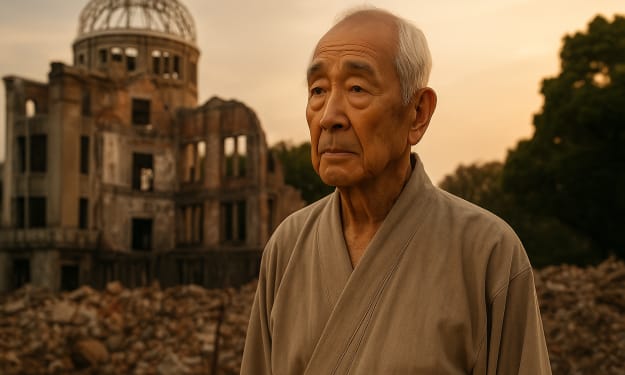
✦ Life Before the Bombs ✦ Tsutomu Yamaguchi worked as a shipbuilding engineer for Mitsubishi Heavy Industries. In late July 1945, he traveled from his home city of Nagasaki to Hiroshima on business. He planned to return after completing work that lasted only a day or two. At that time, many Japanese cities were facing shortages and hardship, but Yamaguchi’s work continued amid wartime pressures. ✦ The First Blast: Hiroshima ✦ On the morning of August 6, 1945, Yamaguchi was in Hiroshima, standing near the city center. Around 8:15 a.m., a sudden, blinding flash lit the sky. The world shook with a deafening roar. The atomic bomb “Little Boy” exploded overhead. Yamaguchi, approximately two miles from ground zero, was thrown by the blast, knocked unconscious, and seriously burned. When he regained consciousness, he found himself bleeding, scorched, and disoriented. He managed to return to his lodging, applied makeshift first aid, and—despite his injuries—boarded a train to Nagasaki that evening to return home and warn others. ✦ Return to Nagasaki and Second Blast ✦ Just three days later, on August 9, 1945, Yamaguchi was back at work in Nagasaki. At around 11:02 a.m., another atomic bomb—“Fat Man”—was dropped. He was once again engulfed in a blinding flash and massive blast wave. The explosion devastated the city and wounded Yamaguchi again. He survived the second bombing with further burns and trauma, experiencing the rare and unimaginable: surviving two nuclear blasts in one week. ✦ Physical and Emotional Recovery ✦ In the aftermath, Yamaguchi faced severe radiation sickness, chronic pain, and lasting health problems like cataracts and liver damage. Emotionally, he was haunted by memories of two shattered cities and the deaths of many friends and co-workers. Still, he continued to work, support his family, and help others. His quiet strength was reflected in small acts of resilience and kindness. ✦ Speaking Out for Peace ✦ In later years, Yamaguchi began publicly sharing his experience. As one of the very few officially recognized survivors of both bombings (a nijū hibakusha), he used his voice to campaign for nuclear disarmament. He described the horrors: sudden silence, shadows burned into walls, skin melted from heat, and the cries of the injured. His message was clear—no one should experience what he had lived through. ✦ Legacy and Lessons ✦ Tsutomu Yamaguchi passed away in 2010 at the age of 93. His story remains a testimony to survival, courage, and the importance of peace. He transformed personal trauma into public advocacy, calling on the world to remember the human cost of war. Key Lessons: Nuclear destruction is instant, but its trauma lasts forever. Resilience is real—but scars remain. Peace must be pursued actively to prevent future tragedies. ✦ Reflection ✦ Yamaguchi’s extraordinary journey is not just a historical curiosity—it is a moral lesson. In a time of global tension, his voice reminds us that hope can emerge from horror, and healing is possible through remembrance and responsibility. This remarkable journey continues to resonate in today’s world, reminding us that individual stories carry immense power to shape collective action. By honoring Yamaguchi’s legacy, communities can foster dialogue about the lasting impact of conflict and the importance of empathy across generations. His willingness to share pain and hope offers a template for addressing contemporary challenges—whether in advocating for nuclear disarmament, supporting survivors of trauma, or nurturing resilience in times of crisis. Remembering his voice encourages each person to reflect on personal responsibility: how can one contribute to a culture of peace, understanding, and solidarity? As we face new global uncertainties, Yamaguchi’s example teaches that bearing witness to history demands both remembrance and proactive engagement. In embracing his message, readers are invited to transform empathy into action, ensuring that lessons from the past guide efforts toward a more compassionate, harmonious future. > How can remembering real stories of past tragedies guide us toward a safer, more compassionate world?
By Echoes by Imadabout a year ago in History
The lead scientist was shocked when a 520 million-year-old fossil was found with its brains and guts still intact.
Around 520 million years ago, the Cambrian period was a time of experimentation. Sea life was experimenting with every body plan imaginable, looking for combinations that would function.
By Francis Damiabout a year ago in History