World History
"Anne Frank: The Girl Who Wrote Through the War"
🌸 The Secret Diary: The True Story of Anne Frank (Emotional Storytelling Version) 🌸 Have you ever been so silent that you could hear your own heartbeat? So hidden, that even a creaking floorboard could cost you your life? This was the reality of a young girl named Anne Frank. The year was 1942. While Amsterdam’s streets buzzed with bicycles, trams, and chatter, a dark shadow was falling over the city. Nazi flags hung from buildings, soldiers marched through neighborhoods, and chilling signs appeared in shop windows: “No Jews Allowed.” Thirteen-year-old Anne, full of dreams and laughter, suddenly found her entire world changing overnight — just because she was Jewish. Her father, Otto Frank, saw what was coming. Jewish families were being arrested and sent away to unknown places — places from where no one returned. So one day, with a few belongings and heavy hearts, the Frank family vanished from the outside world. But they didn’t leave the country. Instead, they walked silently through the streets and slipped behind a hidden bookshelf inside Otto Frank’s office building. Behind that shelf was a secret annex — dark, cramped, and silent. It would become their home for the next two years. Imagine living in a place where you couldn’t flush the toilet during the day. Where laughter had to be swallowed, and running water was forbidden. Where children couldn’t play, and any sound could mean death. Eight people lived there — Anne, her sister Margot, her parents, and four others. Every creak of the wooden floor could be their last. Yet somehow, Anne found a way to stay alive on the inside. She began to write. In a small red-checkered diary she named “Kitty,” Anne poured out her deepest thoughts. She wrote about everything — her dreams of becoming a writer, her frustrations with life in hiding, her thoughts on love, her longing for freedom. The pages became her safe space, her therapy, her voice in a world that wanted to silence her. > “I can shake off everything as I write; my sorrows disappear, my courage is reborn,” she once wrote. In the midst of fear and war, Anne still believed in beauty. She still believed in hope. She still believed in people. > “In spite of everything, I still believe that people are really good at heart.” But her diary was not destined to end in peace. In August 1944, someone betrayed them. The Nazis stormed the annex, dragging everyone out. Anne was sent to Auschwitz, and then to Bergen-Belsen — a brutal concentration camp. There, in the cold, with barely any food, no medicine, and surrounded by death, Anne and her sister Margot caught typhus. Both died. Anne was just 15 years old. The war ended months later. The Nazis were defeated. But only Otto Frank returned. He was the sole survivor from the annex. And when he came back to Amsterdam, one of their helpers — Miep Gies — handed him a small object. It was Anne’s diary. Otto read it slowly, painfully — every word, every line. It was his daughter’s voice, speaking from the grave, filled with innocence, heartbreak, and courage. He knew he had to share it with the world. And so, “The Diary of a Young Girl” was published — Anne’s wish of becoming a writer had come true.
By Khan Afzalabout a year ago in History
The Heart of the Lion: The Emotional Legacy of Sultan Salahuddin Ayyubi. AI-Generated.
In the golden twilight of the 12th century, amid the dust of conflict and the roar of empires clashing, rose a man whose name would echo across history—not for his cruelty or conquest, but for his mercy and unwavering spirit. He was Sultan Salahuddin Ayyubi, known to the West as Saladin, and his story is not just of battles and victories, but of a soul relentlessly tested by war, faith, and compassion.
By Super Starabout a year ago in History
"Jinnah: The Man Behind the Myth"
Jinnah “the Quaid” By Waseem Altaf While a case is still pending in the Sindh High Court, filed by the Ismaili family of Jinnah that he was an Ismaili, court witness, Sharifuddin Pirzada claimed that he converted to Twelver Shia in 1901. On the other hand, I.H Ispahani, his private secretary, informed that Jinnah himself told him in 1936 that he had converted to Shia Twelver in 1898. However, he himself preferred not to openly declare his sect and beat about the bush. The result is that a debate is still going on in Pakistan to prove whether he was an Ismaili or a Shia or a Sunni. However, he cherished ham sandwiches and high-quality liquor; nevertheless, he made sure that the vast Muslim community remained unaware of it.
By Hamza khanabout a year ago in History
Genghis Khan: The Life, Legacy, and Legend of the World's Greatest Conqueror
In the vast, unforgiving steppes of 12th-century Mongolia, a child was born who would change the world forever. His name was Temüjin—known to history as Genghis Khan. A brilliant strategist, a ruthless conqueror, and a visionary ruler, Genghis Khan rose from tribal obscurity to forge the largest contiguous empire the world has ever seen. But who was the man behind the legend? This article offers a complete, deeply researched journey through the life of Genghis Khan—from birth to death—examining the trials, triumphs, reforms, and conquests that shaped the destiny of millions across continents.
By DRE Explainsabout a year ago in History
The Middle East: A Tinderbox of Empires, Wars, and Unending Conflict. AI-Generated.
The Middle East: A Tinderbox of Empires, Wars, and Unending Conflict The Middle East has always been more than just a geographical region—it’s a crucible of civilizations, a battleground of empires, and a vortex of geopolitical rivalries that have shaped world history. From the ancient wars of Mesopotamia to the modern-day clashes between Israel and Iran, this land has rarely known lasting peace. Today, as tensions escalate once again, the Middle East stands at the brink of another catastrophic conflict, threatening not just regional stability but global security.
By Muhammad Salman Akbarabout a year ago in History
Why Putin Eyes Europe Beyond Ukraine
It began not with tanks, but with silence. In the cold early months of 2025, as the world slowly turned its eyes away from Ukraine—numb from years of footage of ruined cities and displaced families—Vladimir Putin was already staring further west.
By Hasnain khanabout a year ago in History
The Queen Who Burned Her City
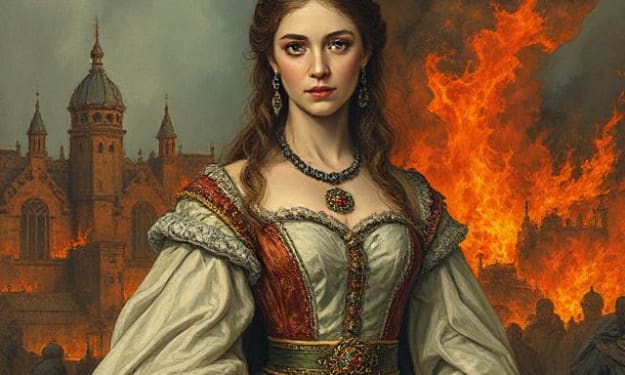
I. The Fire Beneath the Crown She was not born with fire in her hands—but when the time came, she wielded it like a sword. Boudica, Queen of the Iceni tribe, had long lived in uneasy peace with the mighty Roman Empire. Her husband, King Prasutagus, ruled as a Roman ally in what is now eastern England. The arrangement was simple: they kept their thrones, the Romans got their taxes, and the people of Britannia bent the knee—if not in body, then in silence. But when Prasutagus died, he left behind only daughters, and a will begging Rome to protect his family. Rome answered with iron. --- II. The Breaking of a Queen When Roman officials came to claim the kingdom, they did not take it peacefully. They seized Iceni lands, enslaved nobles, and—by some accounts—publicly flogged Boudica and assaulted her daughters. This was not just conquest. It was humiliation. It was betrayal. And it was war. What the Romans failed to realize was that Boudica was not a queen content to mourn in silence. She was a leader with the voice of a goddess and the rage of a storm. She would not plead. She would burn. --- III. The Gathering Storm Boudica called upon the other British tribes, long weary of Roman taxes, forced labor, and brutality. They came—not for politics, but for vengeance. Under Boudica’s leadership, a massive force rose. Some estimates say as many as 100,000 warriors rallied to her side. She was described as tall, fierce-eyed, and wild-haired. She rode a chariot, her daughters beside her, and carried not just weapons—but the memory of every insult Rome had ever carved into British skin. Their first target: Camulodunum—modern-day Colchester, the Roman capital of Britain. --- IV. Cities in Ashes The assault was swift. The Roman inhabitants of Camulodunum barely had time to flee before Boudica’s forces destroyed the city. Temples, homes, and soldiers fell to the fire and blade. Survivors were few. Then came Londinium—modern-day London. Knowing he could not defend it, the Roman governor Gaius Suetonius Paulinus abandoned the city. Boudica’s army entered and razed it. The same fate came to Verulamium (modern St Albans). The death toll across the three cities is estimated at over 70,000. Roman records speak of horrific slaughter—but one must remember: this was not senseless violence. This was rebellion, long suppressed and now unleashed. Boudica’s war was not just against Rome. It was against an empire built on injustice. --- V. The Final Stand But Rome did not build its empire by folding under pressure. Suetonius regrouped with his legion—about 10,000 well-trained soldiers. Boudica’s force, by then swollen with new recruits and tribes, still outnumbered them at least 10 to 1. They met in an unknown location—possibly Watling Street, in the English Midlands. Despite being outnumbered, the Romans used strategy and terrain to their advantage. In a narrow valley flanked by forests, they could not be surrounded. Roman discipline won over chaos. The Britons were crushed. Tens of thousands died. And Boudica? Some say she drank poison. Others say she disappeared into the forest, never to be seen again. But her legend had already been born. --- VI. Aftermath and Legacy Rome regained control—but never again underestimated the ferocity of Britain’s tribes. The revolt led to changes in Roman policy: fewer taxes, more tolerance, and a cautious respect for the people they ruled. Boudica’s name faded for centuries, buried under Roman records and forgotten kingdoms. But in the Victorian era, she was reborn as a national symbol of resistance. A statue of her now stands near the Houses of Parliament in London—a reminder that even in defeat, the human spirit can rise to challenge empires. She lost the battle. But she won immortality. --- VII. The Lesson in Fire Boudica’s story is not one of simple revenge or nationalism. It’s a story of how trauma becomes revolution, how grief becomes resistance. It's about how the oppressed can rise, even if only briefly, and remind the powerful that they rule not by right, but by fear—and that fear has limits. She was a woman against an empire. A mother turned warrior. And though the flames she lit were eventually extinguished, the smoke of her story still lingers, carried by the wind, whispered through time. She was not the first to rise against tyranny—and she will not be the last
By Soul Draftsabout a year ago in History
The Boy King’s Secret (Egypt)
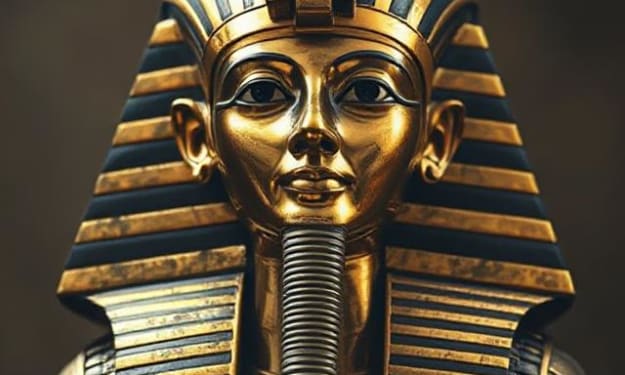
In the dry heart of ancient Egypt, under the golden sun and endless sky, a boy once sat on a throne too large for his feet to reach the floor. His name was Tutankhamun. He was only nine years old when he became Pharaoh of Egypt, the most powerful kingdom in the world. In his hands rested a scepter and a flail—symbols of power he barely understood. Around him stood priests, advisors, and generals—each bowing low, each whispering plans behind his back. But to his people, he was divine. The living son of the gods. Yet Tutankhamun was not born to rule. --- 👑 The Shadow of Akhenaten Tutankhamun’s father was the controversial pharaoh Akhenaten, a ruler who shattered traditions by replacing Egypt’s gods with just one: Aten, the sun disk. Under his rule, temples were destroyed, priests cast out, and a new capital city—Amarna—was built from dust. But Akhenaten’s reign left Egypt weak and fractured. When he died, his revolution died with him. His son, Tutankhaten (“Living Image of Aten”), was placed on the throne as a child king. But Egypt’s elders had a plan. They restored the old gods, moved the capital back to Thebes, and changed the boy’s name from Tutankhaten to Tutankhamun—“Living Image of Amun,” god of kings. He was a symbol of healing. Of return. Of tradition. But he was also a child caught in a game of power. --- 💔 A Short Life in Golden Silence Tutankhamun was married young, to his half-sister Ankhesenamun. Their love was real, but their time was brief. Together, they suffered tragedy—two daughters, both stillborn, buried in tiny coffins beside their father. The young king had health issues—he walked with a cane, had a curved spine, and likely suffered from genetic disorders due to royal inbreeding. Despite this, he tried to rule. Records show he ordered the restoration of temples and participated in rituals to please the gods. But behind the scenes, the real power belonged to his advisors—Ay, the grand vizier, and Horemheb, the general. At just 18 or 19 years old, Tutankhamun died suddenly. The cause is still debated: Was it malaria? A broken leg that led to infection? Or… was it murder? Some theories suggest Ay or Horemheb wanted the throne. After Tutankhamun’s death, Ay married his widow and declared himself Pharaoh. The boy king’s name was erased from records, as if he had never existed. His tomb, too, was forgotten. But history has a strange way of remembering the forgotten. --- ⚱️ The Tomb That Changed the World Over 3,000 years later, in 1922, a British archaeologist named Howard Carter discovered a sealed doorway buried beneath rubble in the Valley of the Kings. Inscribed with Tutankhamun’s name. Carter and his team opened the tomb in awe. Inside was a miracle: over 5,000 treasures, untouched for millennia. Golden chariots, ivory statues, perfumes, weapons, games, jewelry—and at the center, a series of nested shrines and coffins, ending in a solid gold sarcophagus. Within it, lay Tutankhamun, wearing a golden mask that became the face of ancient Egypt itself. The discovery shocked the world. Never before had a pharaoh’s tomb been found intact. Newspapers called it the “Greatest Archaeological Find in History.” But the tomb brought more than riches. --- ☠️ The Curse of the Pharaoh? Soon after the tomb was opened, rumors of a curse began to spread. Lord Carnarvon, the financier of the dig, died mysteriously after an infected mosquito bite. Other team members suffered accidents, illnesses, or deaths. Some believed Tutankhamun had cursed those who disturbed his rest. Others called it coincidence. Or ancient mold in the tomb. But the myth stuck. It added to Tutankhamun’s mystery. A boy once forgotten had become immortal in legend. --- 🌍 His Legacy Lives On Today, Tutankhamun is one of the most famous pharaohs in history—not because of what he did in life, but because of what his tomb revealed in death. His story teaches us that: Even the briefest lives can echo through time. Power doesn’t guarantee legacy—memory does. History hides treasures—not just gold, but truth. Tutankhamun never built pyramids. He never conquered lands. But he left behind something more valuable: a window into the soul of ancient Egypt. --- ✨ The Final Note In 2019, Tutankhamun’s treasures began a world tour, drawing millions of visitors. The fragile artifacts were returned to Egypt and will rest in the Grand Egyptian Museum—not far from where the boy king once ruled. And somewhere, under the hot Egyptian sun, in the dust of the past and the gold of memory, Tutankhamun sleeps on… Not forgotten.
By Soul Draftsabout a year ago in History
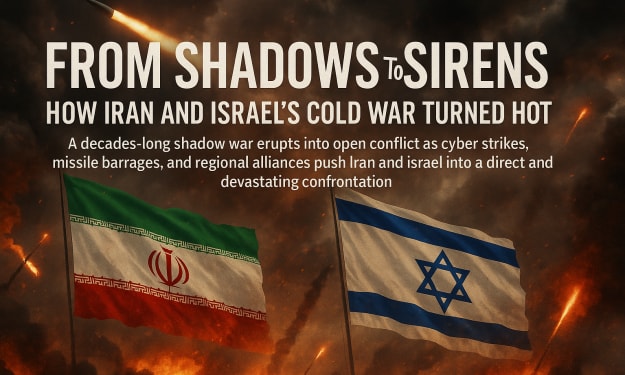
From Shadows to Sirens: How Iran and Israel’s Cold War Turned Hot. Content Warning. AI-Generated.
The Long Fuse of Hostility For over four decades, Iran and Israel have engaged in a clandestine war fought far from the battlefield—through assassinations, proxy militias, cyberattacks, sabotage, and disinformation. This shadow conflict, sustained by deep ideological opposition and strategic rivalry, simmered across the Middle East without ever boiling over into a direct state-to-state war. But that changed dramatically in 2025. In the span of a few weeks, the conflict spiraled into open warfare. What was once whispered in intelligence briefings is now screamed by air raid sirens across Tel Aviv and Tehran. The decades of brinkmanship, covert operations, and geopolitical maneuvering have collapsed into an era-defining war. --- A Cyber Spark in a Powder Keg The immediate trigger was a sophisticated cyberattack on Iran’s Natanz nuclear enrichment facility, followed by a retaliatory breach of Israel’s electrical grid that left parts of the country in darkness. While both sides had long engaged in cyber warfare, this exchange was different—more public, more destructive, and followed by a flurry of accusations and counter-threats at the United Nations. Iranian leadership, pressured by hardliners and emboldened by recent military advancements, launched a missile strike on Israeli intelligence infrastructure in Haifa. Israel responded within hours with airstrikes targeting IRGC (Islamic Revolutionary Guard Corps) positions in Syria and western Iran. Suddenly, the war was no longer invisible. --- Proxy No More: A Regional Firestorm Historically, Iran and Israel have fought through intermediaries: Hezbollah in Lebanon, Hamas in Gaza, Shia militias in Iraq and Syria, and covert Israeli operations in Iran. But in 2025, the gloves came off. Israel's direct strikes on Iranian soil marked a significant shift. Iran responded with ballistic missile launches from its western provinces, targeting Israeli military sites in the Negev Desert. Air defense systems intercepted some, but not all. Simultaneously, Iranian-aligned militias across the region—especially in Lebanon, Iraq, and Yemen—opened secondary fronts. Rockets poured into northern Israel from Hezbollah-controlled areas, while Israeli jets bombarded suspected launch sites. For the first time, the war transcended the realm of limited engagements and became a true regional conflagration. --- Civilian Costs and Global Tremors As in all modern conflicts, it is civilians who suffer most. In Iran, Israeli airstrikes targeted suspected weapons factories near populated areas. In Israel, daily sirens have driven millions into bomb shelters. Casualties mount as critical infrastructure crumbles under the weight of sustained attacks. Oil prices have skyrocketed. International shipping through the Strait of Hormuz—the world’s most vital energy chokepoint—has slowed dramatically. Western powers scramble to mediate, while regional actors pick sides or try desperately to stay neutral. Russia and China have cautiously supported Iran, condemning Israel’s air campaigns. The United States, though initially hesitant to intervene, has increased arms shipments to Israel and deployed additional naval forces to the eastern Mediterranean. The United Nations, as expected, remains paralyzed. --- Ideology Meets Realpolitik At the heart of this war lies more than territorial or strategic concerns—it’s an ideological chasm. Iran’s Islamic Republic sees Israel as an illegitimate, colonial state. Israel sees Iran as an existential threat bent on nuclear capability and regional dominance. But ideology alone cannot explain the timing and scale of the escalation. Domestic politics played a role. Both Israeli and Iranian leadership were facing internal unrest and economic discontent. War, tragically, provided both a distraction and a rallying cry. --- The World Watches—and Waits Diplomatic backchannels continue to operate, but trust has evaporated. Calls for ceasefire are drowned out by airstrikes and retaliatory barrages. Humanitarian corridors are proposed and often denied. With neither side willing to accept the appearance of weakness, the war grinds on. In cities across the world, protests erupt—some in support of Israel, others for Iran, many simply pleading for peace. Analysts warn of potential spillover: conflict dragging Saudi Arabia, Turkey, or even NATO into the fray. And yet, no one truly knows how this war will end—or if it will. --- Conclusion: A New Middle East? This is not merely another flare-up in the troubled history of the region. The Iran–Israel war marks a new chapter, where former rules no longer apply, and the balance of power could be fundamentally reshaped. Whether it ends in negotiated peace, catastrophic escalation, or prolonged regional instability, one thing is certain: the age of shadows is over. Sirens now define the Middle East's new reality.
By 🇲 🇮 🇳 🇩 🇺 🇳 🇫 🇴 🇱 🇩 🇪 🇩 about a year ago in History