Trivia
The Mysterious Disappearance of Five Children in 1945 The Sodder Family Case.
The Mysterious Disappearance of Five Children in 1945 The Sodder Family Case. Some events in history never fade away instead they raise more questions over time. One such mystery is the disappearance of five Sodder children on Christmas Eve December 25 1945 in Fayetteville West Virginia USA.
By Adnan Rasheed2 years ago in History
Flight 571 An Incredible Tale of Survival
Flight 571 An Incredible Tale of Survival The story of Flight 571 is an extraordinary example of human determination the will to survive and the struggle to stay alive in the harshest conditions. This was not just an ordinary plane crash it was a test of endurance that forced survivors to endure 72 days in extreme cold hunger and seemingly impossible circumstances. This is a tale of courage resilience and an unbreakable human spirit. The tragic accident occurred on October 13 1972 when Uruguayan Air Force Flight 571 was en route to Chile. The flight carried 45 passengers mostly members of the Old Christians Club a Uruguayan rugby team along with their family members and friends. The plane took off from Montevideo Uruguay and was headed to Santiago Chile. However due to bad weather and navigational errors the pilot miscalculated the plane's position. As they descended through the Andes Mountains the aircraft struck a snow covered peak and crashed into a remote icy region.
By Adnan Rasheed2 years ago in History
The Odyssey 01
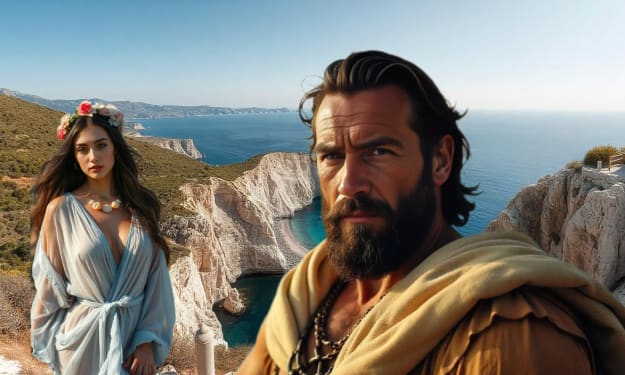
The sun sank beneath the horizon, enveloping the serene island of Ogygia in a warm, golden light. The waves softly caressed the shore, their soothing sounds a sharp contrast to the storm that had led Odysseus to this place. For seven arduous years, the famed hero of Troy had found himself marooned on this secluded island, held captive by the alluring nymph, Calypso. While the island resembled a paradise, adorned with verdant forests, clear streams, and a perpetual spring, it felt like a beautiful prison for Odysseus, whose soul longed for Ithaca and his cherished Penelope.
By A História2 years ago in History
To My Darling
To My Darling, Hello! It’s been a while since we last wrote to each other, and as I sit down to write this letter, I find myself in tears with memories of you and the 1970’s. Images and history of you and of our time together, our laughter, our shared dreams. It’s hard to believe how much time has passed, You always hold a special place in my heart. You were a part of a chapter in my life that brought so much joy, and sometimes I feel as if I could close my eyes and be transported back to those happiest days. Darling Our days filled with laughter and the deepest love.
By ♿ V+ Marie381Uk 2 years ago in History
SPS Technologies Fire
SPS Technologies is a well-known company that manufactures high-quality fasteners, bolts, and other industrial components used in the aerospace and automotive industries. Recently, a fire broke out at one of its facilities, causing serious damage and raising concerns about safety and the future of the company. In this article, we will discuss what happened, the possible causes, and the impact of the fire on the company and the people involved.
By Farhan Sayed2 years ago in History
Delta Plane Crash
Air travel is one of the safest ways to travel, but accidents can still happen. Recently, a Delta Airlines plane crash has shocked many people around the world. This article will explain what happened, the possible causes, and the response from officials and the airline.
By Farhan Sayed2 years ago in History
Eclipsed by Time: A Forbidden Correspondence
Letter I: Lord Alistair to Lady GenevieveJune 14, 1685 My Dearest Genevieve, The ink upon this parchment trembles beneath my hand, for I write to you under the shroud of night, lest prying eyes betray the tenderness I harbor for you. The world deems our affection an abomination of circumstance, yet my heart is unyielding in its devotion. You are the light by which I chart my course, the whisper of serenity amidst the tempest of my existence.
By miloud ferhi2 years ago in History
Breaking: Dublin Plans Biggest Saint Patrick's Day Parade Ever
Saint Patrick's Day celebrations in Dublin have consistently drawn massive crowds, with the 2009 parade attracting more than 675,000 spectators. In fact, this cherished tradition, which began as an official Christian feast day in the early 17th century, has evolved into the world's most widely celebrated national festival. While the first official state-sponsored parade in Dublin didn't take place until 1931, we've witnessed this celebration grow into a global phenomenon. Notably, Saint Patrick's Day, observed on March 17 to commemorate Saint Patrick's death in 461 AD, now inspires festivities in more countries than any other national festival. As we prepare for this year's celebration, Dublin is set to make history once again with what promises to be its most ambitious parade yet. Dublin Announces Record-Breaking Parade Plans "Being Irish is very much a part of who I am. I take it everywhere with me." — Colin Farrell, Irish actor The 2025 National Saint Patrick's Day Parade promises unprecedented scale and spectacle, with organizers announcing their most ambitious celebration yet. The parade will feature over 4,000 participants, including 18 pageants, performance showpieces, and 14 marching bands from Ireland, North America, and France. The grand procession will commence at 11 a.m., following a carefully planned 2.5-kilometer route through Dublin's historic heart. Starting from Parnell Square, the parade will wind through O'Connell Street, cross the River Liffey, and proceed past Trinity College before concluding at Saint Patrick's Cathedral. This year's celebration stands out with its remarkable features: • Seven large-scale pageants and six showpieces • Twelve international marching bands from Austria and North America • six strategically located grandstands with covered, tiered seating • Professional hosts providing live commentary throughout the route
By Deepak Gautam2 years ago in History
The Ram Mandir Dispute: Unraveling India’s Century-Old Saga of Faith, Politics, and Justice | Part-II
Post-Independence Developments (1947–1950) After India gained independence in 1947, tensions resurfaced just two years later. On the night of December 22, 1949, during a nine-day Ramcharitmanas recitation organized by the Akhil Bhartiya Ramayana Mahasabha, an idol of Ram Lalla was placed inside the Babri Masjid. The next morning, large crowds gathered, claiming it to be a divine emergence.
By Adarsh Kumar Singh2 years ago in History
Presidents Day 2024: Federal Offices, Banks Close Nationwide
Presidents Day 2024, officially known as Washington's Birthday, is a 145-year old federal holiday celebrated on February 19. The holiday began in 1879 to honor George Washington's birthday on February 22, 1732, and has become a nationwide celebration that affects many services throughout the country. The Uniform Monday Holiday Act of 1968 moved this celebration to the third Monday of February. This change created more than just a tribute to our nation's leaders. Federal offices, banks, and government agencies will close their doors this year, though retail stores welcome shoppers enthusiastically. Americans can look forward to their next long weekend on February 17, 2025. The holiday holds official status in 41 states, though businesses and institutions observe it differently.
By Deepak Gautam2 years ago in History
The Aftermath of World War I: The Treaty of Versailles and Its Consequences
World War I Alternation – Part 6: The Accord of Versailles and Its Aftermath The Accord of Versailles, active on June 28, 1919, was one of the best cogent accord agreements in history. It clearly concluded World War I and set the date for all-around political and bread-and-butter changes. However, it additionally sowed the seeds of approaching conflicts due to its acrid terms, decidedly for Germany. This commodity explores the treaty’s provisions, its appulse on assorted nations, and its abiding consequences. The Negotiations at Versailles The Paris Accord Conference began on January 18, 1919, with assembly from added than 30 nations. However, the best affecting decisions were fabricated by the "Big Four": Woodrow Wilson (United States) – Advocated for his Fourteen Points, including freedom and the League of Nations. David Lloyd George (United Kingdom) – Approved a antithesis amid backbreaking Germany and ensuring a abiding Europe. Georges Clemenceau (France) – Pushed for acrid reparations and territorial losses for Germany. Vittorio Orlando (Italy) – Focused on accepting territorial assets for Italy. Germany was not accustomed to participate in the negotiations and was presented with the final agreement in May 1919. Key Accoutrement of the Treaty The Accord of Versailles independent several key clauses that adapted Europe: Territorial Losses: Germany absent about 13% of its pre-war area and all of its across colonies. Alsace-Lorraine was alternate to France, while genitalia of eastern Germany were ceded to Poland, creating the Polish Corridor. Military Restrictions: The German army was bound to 100,000 men, with no tanks, abundant artillery, or air force. The fleet was decidedly reduced, and Germany was banned from architecture submarines. War Guilt Clause (Article 231): Germany was affected to acquire abounding albatross for the war, which justified arty astringent reparations. Reparations: Germany was appropriate to pay 132 billion gold marks (approximately $33 billion at the time) in reparations to the Allies. League of Nations: The accord accustomed the League of Nations to anticipate approaching conflicts, admitting the U.S. Senate ultimately alone U.S. membership. Reaction to the Treaty The accord was met with alloyed reactions: Germany: The German accessible and politicians beheld the accord as a "Diktat" (dictated peace). The bread-and-butter accountability and accident of civic pride fueled resentment, accidental to political instability. France and Britain: France was annoyed with the acrid agreement but approved added guarantees of security. Britain, while acquisitive to abate Germany, was anxious about bread-and-butter accretion and barter relations. United States: Woodrow Wilson faced attrition at home, and the U.S. Senate banned to accredit the treaty, arch to America’s abandonment from the League of Nations. Other Nations: New nations emerged from the collapse of the Austro-Hungarian, Ottoman, and Russian Empires, arch to bound disputes and indigenous tensions in Eastern Europe and the Middle East. Economic and Political Consequences The Accord of Versailles had abstruse bread-and-butter and political effects: Economic Crisis in Germany: The reparations led to astringent aggrandizement and bread-and-butter hardship, culminating in the hyperinflation crisis of 1923. The Dawes Plan (1924) after restructured payments to balance the German economy. Rise of Extremism: The treaty’s acrid altitude created abundant arena for abolitionist ideologies. Adolf Hitler and the Nazi Party exploited accessible resentment, application the accord as a ambulatory point. Weakened All-embracing Relations: The League of Nations, defective U.S. accord and administration mechanisms, struggled to advance peace. Abounding nations, including Japan and Italy, acquainted annoyed with the treaty’s terms. Unresolved Conflicts: The redrawing of borders led to tensions in Eastern Europe and the Middle East, abounding of which abide today. Long-Term Legacy
By Say the truth 2 years ago in History
The Fearless Charge of Genghis Khan
Genghis Khan’s War Strategy: The Genius Behind the Mongol Conquests Genghis Khan, the architect of the Mongol Empire, is advised one of history’s greatest aggressive strategists. From a baby drifting association leader, he broadcast his authority to awning over 23 actor aboveboard kilometers, authoritative it the better abutting authority in history. His war strategies were revolutionary, aggregate speed, deception, cerebral warfare, and above aggressive organization. This commodity explores the ablaze war strategies of Genghis Khan, his use of intelligence, and how his approach accustomed the Mongols to beat all-inclusive acreage in a abbreviate time. 1. Aggressive Organization: The Backbone of Mongol Warfare Dividing the Army into Efficient Units Genghis Khan adapted the Mongol army into a awful acclimatized force by alignment it into a decimal system: Arban – Squad of 10 soldiers Zuun – Company of 100 Mingghan – Battalion of 1,000 Tumen – Division of 10,000 This arrangement ensured: ✔ Flexibility in action – Armies could be calmly disconnected or combined. ✔ Better ascendancy – Anniversary assemblage had its own commander, ensuring bright leadership. ✔ Loyalty and accord – Soldiers were aggregate with men they trusted. Elite Mongol Warriors Every Mongol soldier was accomplished from adolescence in: Horseback benumbed – Mongols could ride for canicule afterwards stopping. Archery – They could shoot arrows while benumbed at abounding speed. Survival abilities – Soldiers lived off the land, abbreviation assurance on accumulation chains. The aggregate of aggressive alignment and aristocratic training gave Mongols a massive advantage over less-disciplined armies. 2. Acceleration and Mobility: The Mongol Army’s Greatest Strength Horse-Based Warfare The Mongols were able horsemen, with anniversary soldier accepting 3-5 horses to about-face during battle. This accustomed them to: ✔ Biking up to 100 afar per day (much faster than European armies). ✔ Advance apace and retreat afore the adversary could counterattack. ✔ Conduct abruptness attacks abysmal central adversary territory. Lightning Raids and Fake Retreats One of the Mongols’ best feared approach was the affected retreat: Mongol army affected to abscond in panic. The enemy, cerebration they had won, chased them. The Mongols again angry aback aback and ambushed their pursuers. This ambush formed adjoin abounding brash armies, including Chinese, Persian, and European forces. 3. Cerebral Warfare: Defeating the Adversary Afore the Battle Genghis Khan accepted that abhorrence was a able weapon. He acclimated cerebral warfare to breach adversary assurance afore battles alike began. Spreading Fear He accustomed some defeated cities to escape, so survivors could advance belief of Mongol brutality. He generally destroyed absolute cities that resisted, ensuring others surrendered quickly. His spies advance rumors of Mongol backbone to abate adversary morale. Diplomacy and Abandonment Offers Cities were accustomed a choice: Surrender and be spared. Resist and be annihilated. Many rulers chose surrender, acumen that abashed was futile. By accumulation abhorrence and diplomacy, Genghis Khan baffled cities afterwards alike fighting. 4. Intelligence and Espionage: Knowing the Enemy The Mongols had an avant-garde spy arrangement that calm advice afore every campaign. How They Acclimated Spies: ✔ Disguised as merchants, spies aggregate intelligence on adversary cities, fortifications, and weaknesses. ✔ Intercepted letters to agitate adversary communication. ✔ Bribed admiral in adversary cities to accessible the gates at the appropriate moment. With this intelligence, Genghis Khan consistently knew the enemy’s strengths and weaknesses afore ablution an attack. 5. Adapting to New Technologies and Strategies Unlike abounding conquerors, Genghis Khan was not abashed to apprentice from others. Using Annoy Warfare The Mongols assassin Chinese engineers to body catapults, battering rams, and trebuchets. They acclimated armament weapons, acquirements from Chinese and Persian armies. Cities with aerial walls were no best safe from Mongol attacks. Recruiting Skilled People Genghis Khan accustomed defectors, giving them aerial positions in his army. He acclimated engineers, doctors, and strategists from baffled acreage to advance Mongol tactics. By adopting adversary strengths, the Mongols remained unbeatable. 6. Annoy Warfare: Conquering Alike the Arch Fortresses Many cities relied on adherent walls for protection. But Genghis Khan developed annoy strategies to defeat alike the arch defenses. Mongol Annoy Tactics: ✔ Surround the burghal completely, acid off aliment and water. ✔ Use captured civilians as animal bouncer to abate burghal defenses. ✔ Launch ablaze arrows and armament bombs to actualize chaos. ✔ Divert rivers to flood adversary cities. With these tactics, the Mongols baffled above cities like Beijing, Samarkand, and Baghdad. 7. Uniting the Empire: The Secret Behind Mongol Success Unlike added conquerors, Genghis Khan was not aloof a warrior – he was additionally a ablaze leader. Incorporating Different People Instead of antibacterial civilizations, he chip baffled bodies into his empire. He answer religious freedom, acceptance Muslims, Buddhists, Christians, and Hindus to coexist. He called leaders based on merit, not aloof bloodline. Establishing Barter and Communication He adequate the Silk Road, ensuring safe barter beyond Asia and Europe. He developed the Yam postal system, acceptance letters to biking bags of afar quickly. This ensured that his authority remained able continued afterwards his death. Conclusion: Why Genghis Khan’s War Strategies Were Unmatched Genghis Khan’s aggressive success was not aloof about strength, but about strategy, discipline, intelligence, and innovation. ✔ Above alignment – A structured and acclimatized army. ✔ Acceleration and advancement – Rapid movements that larboard enemies unprepared. ✔ Cerebral warfare – Fear-based approach that affected cities to surrender. ✔ Avant-garde intelligence – Spies and informants acquisition acute information. ✔ Adaptability – Acquirements and application adversary technologies adjoin them. ✔ Annoy warfare ability – Breaking alike the arch burghal defenses. Because of these strategies, Genghis Khan baffled added acreage than any added baton in history. Alike today, his aggressive approach are advised in war colleges as examples of ablaze warfare. His bequest is not aloof that of a conqueror, but of a adept architect who adapted the world.
By Say the truth 2 years ago in History