Places
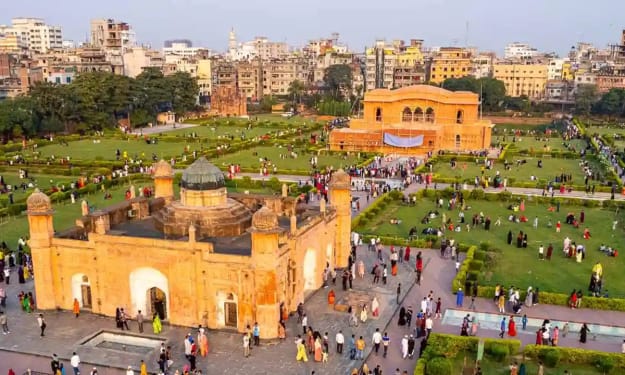
Lalbagh Fort
Lalbagh Fort or Fort Aurangabad, an incomplete Mughal palace fortress at Dhaka on the river Buriganga in the southwestern part of the old city. The river now flows quite a ways from the fort because it has moved further south. D'Oily's painting (1809-11) shows that more than half of this east-west oblong fortress touched the water of the river on its south and southwestern sides.
By Md. Mohorom Aliabout a year ago in History
Bangladesh
The History and Culture of Bangladesh: A Tapestry of Resilience and Rich Tradition Bangladesh, a country located in South Asia, boasts a rich and diverse history along with a vibrant cultural heritage. Nestled on the northern coast of the Bay of Bengal and bordered by India and Myanmar, Bangladesh has long been a crossroads of civilizations, religions, and trade. The history and culture of this land reflect centuries of change, struggle, creativity, and resilience. Ancient and Medieval History The region now known as Bangladesh has been inhabited for thousands of years. It was part of ancient kingdoms such as Vanga, Pundra, and Gauda. During the 3rd century BCE, it became part of the Maurya Empire under Emperor Ashoka, who spread Buddhism throughout the region. Later, the Gupta Empire (4th–6th century CE) brought a golden age of culture, science, and learning. By the 8th century, Bengal was ruled by the Pala dynasty, a Buddhist empire that contributed significantly to art, architecture, and education. The Pala period was followed by the Hindu Sena dynasty. In the 13th century, Muslim rulers from the Delhi Sultanate began to expand into Bengal, introducing Islam, which eventually became the dominant religion. The Mughal Era and Colonial Rule The Mughal Empire (16th–18th century) brought prosperity, architectural beauty, and urban development to Bengal. Dhaka, the capital of modern Bangladesh, flourished as a center of trade and administration under the Mughals. In the 18th century, as the Mughal Empire weakened, the British East India Company gained control of Bengal after the Battle of Plassey in 1757. This marked the beginning of nearly two centuries of British colonial rule. Under British control, Bengal became a major center for jute production and trade, but the colonial economic policies also led to poverty and famines. Language Movement and the Birth of Bangladesh In 1947, British India was divided into two nations: India and Pakistan. Bangladesh became East Pakistan, part of the new state of Pakistan, despite being geographically separated from West Pakistan by over a thousand miles. Cultural and linguistic differences soon led to tensions. The people of East Pakistan spoke Bengali, while the government of Pakistan attempted to impose Urdu as the sole national language. This led to the historic Language Movement of 1952, during which several students were killed while protesting for the recognition of Bengali as an official language. This movement played a crucial role in shaping national identity and is commemorated every year on February 21 as International Mother Language Day. In 1971, following years of political and economic discrimination, East Pakistan declared independence, leading to the Bangladesh Liberation War. After a nine-month struggle and immense human cost, Bangladesh emerged as an independent nation on December 16, 1971. Cultural Heritage The culture of Bangladesh is deeply rooted in its language, literature, music, and traditional arts. Bengali literature has a long and rich history, with figures like Rabindranath Tagore (who composed the national anthem) and Kazi Nazrul Islam shaping the cultural landscape with their poetry and songs of freedom. Music and dance play an integral role in Bangladeshi life. Folk traditions such as Baul songs, Bhawaiya, and Jari are popular, especially in rural areas. Classical and modern music, including Rabindra Sangeet and Nazrul Geeti, continues to thrive. Bangladeshi festivals are colorful and diverse, reflecting the country’s multi-religious society. Pohela Boishakh, the Bengali New Year, is celebrated with processions, music, and food. Religious festivals like Eid, Durga Puja, and Buddha Purnima are also widely observed. Traditional clothing, such as the saree for women and panjabi for men, reflects both elegance and regional identity. Bangladeshi cuisine is known for its use of rice, lentils, and spices, with dishes like biryani, hilsa fish curry, and pithas being especially popular. Conclusion The history and culture of Bangladesh are marked by a unique blend of tradition, struggle, and resilience. From ancient empires to modern nationhood, Bangladesh’s journey is one of identity, creativity, and the enduring spirit of its people. Today, it continues to honor its past while embracing the promise of a dynamic and diverse future.
By Nabir Mondolabout a year ago in History
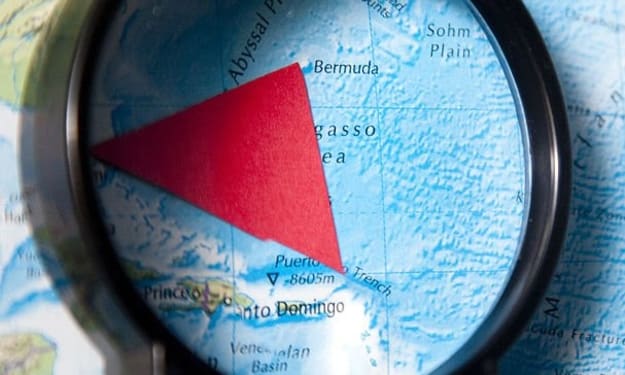
The Mysteries of the Bermuda Triangle: Fact, Fiction, and Fascination. AI-Generated.
The Bermuda Triangle, also referred to as the Devil's Triangle, is one of the most fascinating and enigmatic places on Earth. Spanning a loosely defined area in the Atlantic Ocean between Bermuda, Florida, and Puerto Rico, it has captivated the imagination of adventurers, scientists, and conspiracy theorists alike. Stories of mysterious disappearances, strange phenomena, and legends have built an aura of intrigue around this triangular stretch of ocean. While the Bermuda Triangle's reputation is partially based on myths, it continues to inspire curiosity and debate.
By Noob Hackerabout a year ago in History
Japanese Retailers Trying to Overcome Soaring Rice Prices.
In Japan, rice is a staple food that is ingrained in its culture and daily diet. However, a number of factors, including climate change, rising production costs, and disruptions to the global supply chain, have caused rice prices to soar in recent years for Japanese retailers. Retailers have been compelled to employ novel strategies as a result of this price increase in order to maintain affordability for customers and ensure sustainable business operations. Reasons for the Rise in the Price of Rice Changes in the climate and natural disasters Rice crops are damaged by typhoons, heavy rains, and droughts, all of which occur frequently in Japan. For instance, in the year 2023, unanticipated floods in important rice-producing regions like Niigata and Akita resulted in significant yield losses, resulting in a decrease in supply and an increase in prices. Rising Costs of Production Global inflation and geopolitical tensions (such as the Russia-Ukraine war) have led to significant increases in the prices of fertilizers, fuel, and labor. Price fluctuations have a direct impact on the costs of domestic rice farming because Japan purchases a significant amount of its fertilizers from abroad. Domestic consumption of rice is declining. Despite rising rice prices, Japan's per capita rice consumption has been falling for decades due to shifting eating habits. Farmers and retailers are put under pressure as a result of this paradox because lower demand results in higher production costs per unit. Issues in the Global Supply Chain Despite the fact that Japan is mostly self-sufficient in rice, price volatility is caused by disruptions in the global food supply chains, such as export restrictions imposed by major rice-producing nations like India.
By Md.Atiqul Islam Emonabout a year ago in History
The Philosopher Who enlightened Europe: The Legacy of Ibn Rushd (Averroes)
How a Muslim think laid the foundation of Western philosophy and reason in the 1100s Andalusia. In the center of Islamic Spain, in the city of Cordoba - a place where mosques resonated with Koran text and libraries were tampered with old texts - whether a person was born, whose talent would cross centuries, religions and civilizations. His name was Ibn Rushad, known as Evero in the West.
By Md Ajmol Hossainabout a year ago in History
Ancient Thebes History Myths and Legacy of the Powerful Greek City State
Ancient Thebes History Myths and Legacy of the Powerful Greek City State Explore the rise mythological roots and historical significance of Thebes one of ancient Greece’s most influential and legendary city states.
By Adnan Rasheedabout a year ago in History
What’s Open and Closed on Easter Sunday 2025? Walmart, Target, Grocery Stores, Pharmacies & More . AI-Generated.
On Easter Sunday, 2025, what places are open and closed? Target, pharmacies, grocery stores, and more Easter Sunday has a profound spiritual significance for billions of Christians worldwide. On April 20 in 2025, Easter will be celebrated as a day of joy, family get-togethers, worship, and reflection. While many people spend the day at church or at Easter brunch, others might find that they need to pick up something last-minute. Knowing which stores are open can save time and alleviate stress, whether you're looking for dinner ingredients or an Easter gift at the last minute. This comprehensive list of grocery stores, pharmacies, department stores, and other establishments that will be open and closed on Easter Sunday 2025 is provided below. ---
By BILLAL HOSSEN ZIHADabout a year ago in History
The Secret Garden Awakens
The Arrival on the First Day When Elara got out of the creaky carriage and onto the cobbled walk leading to Wrenmoor Manor, the sky was heavy with early spring mist. It was a place she had never seen before, not even in pictures. She only knew that it had been bequeathed to her in an unexpected inheritance by her late great-aunt Isolde. Elara saw it as an opportunity to start over because she was exhausted from years of city life and dealing with a shattered heart.
By MD SHAMIM RANAabout a year ago in History