Places
The Sunrise of the Lighthouse Keeper
First Day The waves were restless and hissed like ancient secrets, and the water was a somber slate-gray. The lighthouse, a lone sentinel rising above ragged rocks and storm-salted air, remained steadfast on the brink of the cliff as usual. Wexley Point lighthouse keeper Jonathan Hale observed the horizon with the silent awe of a man who had mastered the language of solitude.
By MD SHAMIM RANA2 years ago in History
Stars, Waves, and Wisdom
The narrative of human history is characterized by remarkable accomplishments that distinguish our species on Earth. We have adapted to survive in diverse environments, including deserts, mountains, jungles, and the coldest regions of the planet. However, one achievement surpasses all others—the domination of the seas. Throughout the ages, humans have honed their skills and developed technologies to navigate extensive oceanic distances, revealing new territories and possibilities. Among the most skilled navigators in history were the Polynesians, whose exceptional maritime abilities enabled them to inhabit nearly every livable island across the Pacific Ocean.
By A História2 years ago in History
Did Dire Wolves Really Return from Extinction? Shocking DNA Discovery Revealed.
Did Dire Wolves Really Return from Extinction? Shocking DNA Discovery Revealed. The dire wolf, a name that sends chills down the spine of any fan of prehistoric predators or “Game of Thrones” enthusiasts is one of the most iconic extinct creatures of the last Ice Age. These massive powerful canines once roamed North and South America hunting large prey and dominating the landscape. But after disappearing around 10,000 years ago they were considered lost to history until recently. Rumors and viral social media posts have stirred up a controversial question Did dire wolves just come back from extinction.
By Adnan Rasheed2 years ago in History
Mystery of Non – Corrosion of Iron Pillar – Qutub Minar
According to the reports, in 1912, researchers from India and abroad began investigating the iron pillar in Delhi to determine how it has remained corrosion-resistant. In 2003, researchers at the Indian Institute of Technology (IIT) in Kanpur solved the mystery by publishing their findings in the journal Current Science. They revealed that the pillar, primarily composed of wrought iron, possesses a high phosphorus content (approximately 1%) and lacks sulphur and magnesium, unlike modern iron.
By ANISH MARIK2 years ago in History
A day at Uranus just got 28 seconds longer
**A Day at Uranus Just Got 28 Seconds Longer: What Does This Mean for the Gas Giant? ** Uranus, the icy blue gas giant located in the outer reaches of our solar system, has long fascinated scientists due to its unique tilt, mysterious weather systems, and elusive nature. However, astronomers recently made an unexpected discovery: the length of a day on Uranus has increased by 28 seconds. While this may seem like a trivial change, it opens up intriguing questions about the planet's behavior and the dynamics of its atmosphere.
By Writer John2 years ago in History
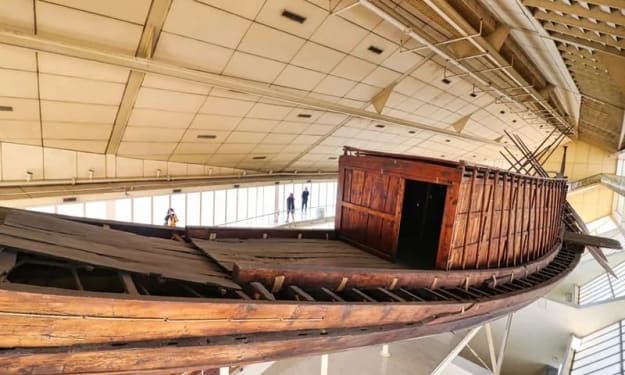
Why Did Pharaoh Khufu Bury Two Giant Solar Boats Next to the Great Pyramid? The Mystery Explained.
Why Did Pharaoh Khufu Bury Two Giant Solar Boats Next to the Great Pyramid? The Mystery Explained. The Egyptian pyramids have long fascinated the world standing as colossal reminders of a civilization that blended incredible architectural achievements with deep spiritual beliefs. Among the most iconic of these monuments is the Great Pyramid of Giza, built during the reign of Pharaoh Khufu (also known as Cheops) around 2600 BCE. While the pyramid itself continues to attract global attention one of the most intriguing archaeological finds associated with Khufu is not the structure but what was buried beside it: two massive solar boats. These wooden vessels found disassembled in pits near the pyramid have puzzled historians and archaeologists for decades. Why were they built? What was their purpose And why did Khufu the mighty pyramid builder want them buried with him?
By Adnan Rasheed2 years ago in History
The Khoisan
Humanity has expanded into almost every part of the globe, influenced by factors such as migration, conquest, climate change, and colonization. However, few groups have maintained a consistent presence in one location as prominently and persistently as certain indigenous communities in Africa. The Khoisan, in particular, are notable—potentially the oldest human population in Africa and possibly the entire world.
By A História2 years ago in History
Israel Controls 50% of Gaza After Razing Land to Expand Its Buffer Zone
Israel Controls 50% of Gaza After Razing Land to Expand Its Buffer Zone Introduction The ongoing conflict between Israel and Hamas has taken a devastating toll on Gaza, with recent reports indicating that Israel now controls approximately 50% of the Gaza Strip following extensive military operations. Satellite imagery and on-the-ground accounts reveal that large swaths of land have been bulldozed and razed to create an expanded buffer zone, further shrinking Palestinian territory and displacing thousands.
By pulok kumar2 years ago in History