Narratives
The Civil Rights Movement in the USA: A Turning Point in American History. AI-Generated.
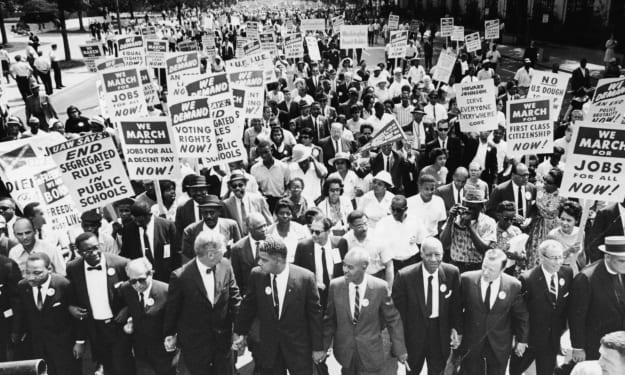
The Civil Rights Movement in the USA: A Story of Courage and Change There was a time in America when people with dark skin were not treated equally. They could not sit where they wanted, go to the same schools, or even drink from the same water fountains as white people. This was called racial segregation, and it was unfair. But things did not stay like this forever. A powerful movement started — made of brave people who stood up and said, **"Enough is enough."** This was the **Civil Rights Movement**, and it changed the face of the United States forever. Where It All Began Let’s go back to the **1950s and 1960s** — a time when America was full of rules that separated people by skin color. This was especially common in the southern states. One day in **1955**, in Montgomery, Alabama, a Black woman named **Rosa Parks** was riding a bus. When a white man asked her to give up her seat, she said **"No."** That one word was small — but it shook the world. Her arrest led to the **Montgomery Bus Boycott**, where thousands of Black people stopped riding buses for over a year. This peaceful protest hurt the bus companies financially, and finally, the courts said, “segregation on buses is illegal.” > **Highlight:** Rosa Parks’ quiet courage became a loud call for change. The Rise of Dr. Martin Luther King Jr. During the Montgomery Bus Boycott, a young preacher named **Dr. Martin Luther King Jr.** became a leader. He believed in **non-violence**, inspired by Mahatma Gandhi. He said: > “Hate cannot drive out hate. Only love can do that.” Dr. King and others led **peaceful marches**, gave **powerful speeches**, and organized **boycotts** — all to demand **equal rights for Black Americans.** One of his most famous moments was the **March on Washington in 1963**, where he stood in front of the Lincoln Memorial and said: > “**I have a dream**... that one day... children will not be judged by the color of their skin, but by the content of their character.” More than 250,000 people stood and listened that day. > **Highlight:** Dr. King’s dream became a message of hope for all generations. --- Brave Children and the Power of Schools In 1954, the **Supreme Court** ruled in **Brown v. Board of Education** that separating children in schools based on race was wrong. But many schools still refused to allow Black children. One of the bravest stories is of **Ruby Bridges**, a six-year-old Black girl who, in 1960, walked into an all-white school in New Orleans. People shouted at her, but she kept walking — protected by U.S. Marshals. She didn’t cry. She just wanted to learn. > **Highlight:** A little girl with a big heart taught America what courage really looks like. Bloody Sunday and the Fight for Voting Rights In 1965, many Black Americans still couldn’t vote due to unfair laws. To protest, activists marched from **Selma to Montgomery, Alabama.** But on **“Bloody Sunday,”** police attacked peaceful marchers on a bridge — beating them with sticks and spraying tear gas. The pictures shocked the nation. After that, President **Lyndon B. Johnson** signed the **Voting Rights Act of 1965**, which gave Black citizens the right to vote without fear. > **Highlight:** Their pain on the bridge opened the road to justice. - Civil Rights Laws That Changed America** Because of the Civil Rights Movement, the U.S. government passed powerful laws: * **Civil Rights Act of 1964** – No more discrimination in schools, jobs, or public places. * **Voting Rights Act of 1965** – Protected every citizen’s right to vote. * **Fair Housing Act of 1968** – Stopped racial discrimination in housing. These laws helped break down the legal walls that kept people apart. > **Highlight:** Protest turned into policy, and policy brought change. Not Just Black and White While the movement began to fight for **African Americans**, it inspired many others: * **Women** began fighting for equal rights in the workplace. * **Latinos**, **Asians**, and **Native Americans** started their own justice movements. * **Disabled people**, **LGBTQ+ communities**, and others found hope through civil rights actions. > **Highlight:** The Civil Rights Movement lit a flame that spread across America. Why This story matters Today Even today, the fight for justice and equality continues. People still march for **Black Lives Matter**, for **fair treatment**, and for **human dignity**. The spirit of Dr. King, Rosa Parks, and Ruby Bridges still walks in today’s streets. > **Highlight:** The movement may have started in the past — but its heart beats in the present. Conclusion: A Story of the People The Civil Rights Movement was not just about laws or leaders — it was about **people**. Ordinary people. Mothers, students, teachers, and workers. They changed the world with their voices, their marches, and their courage. It’s a story of pain, yes — but also of power. A story of hate — but answered with love. And most of all, a story that reminds us: > *When we stand together, change is possible.*
By Tanushree Dasabout a year ago in History
How Close Was the Roman Empire to an Industrial Revolution? 🏛️⚙️
When we think about ancient Rome, we picture majestic architecture, powerful legions, and sophisticated roads. But one question often pops up among history lovers and alternative history fans alike: Could the Roman Empire have had its own Industrial Revolution? 🤔
By Toader Adelinabout a year ago in History
The Great Underground Pyramid of Alaska: Secrets Beneath the Frozen Tundra
Beneath the Frost, a Hidden Legacy Beneath the endless expanse of Alaska's tundra lies an enigma that has puzzled explorers, researchers, and conspiracy theorists for decades. For years, the whispers have circulated, tales of a massive underground pyramid, an ancient structure far older than anything recorded in history. Hidden deep within the wild, remote regions of the state, this pyramid is said to be a relic of an advanced civilization, one that predates all known ancient cultures.
By The Secret History Of The Worldabout a year ago in History
Cratippus of Athens
Within the intricate landscape of ancient Greek philosophy, prominent figures such as Plato, Aristotle, and Socrates often take center stage. Yet, numerous lesser-known philosophers have made substantial contributions to the evolution of Western thought. One notable individual is Cratippus of Athens, a Peripatetic philosopher from the 4th century BCE. Although his writings have not survived, remnants of his thoughts and accounts from subsequent scholars indicate a philosopher deeply involved in metaphysics, ethics, and natural philosophy. This essay delves into Cratippus' life, his philosophical impact, and his significance for later thinkers. By analyzing ancient texts, we can reconstruct the legacy of a philosopher who connected the ideas of Aristotle with those of subsequent Hellenistic philosophy.
By A Históriaabout a year ago in History
A Candle Called Hope
The Beginning of Darkness In a small, forgotten village surrounded by endless hills and thick forests, there was a girl named Lina, just twelve years old, with eyes full of dreams. Her village, once full of joy, was now covered in shadows. The sun rarely peeked through the clouds, the trees stopped blooming, and people had started to lose their smiles. Something strange had happened a deep sadness had spread, and no one knew why.
By Muhammad Hayatabout a year ago in History
Google CEO Sundar Pichai's Education, Salary, and Net Worth
Sundar Pichai: The Influential CEO of Google's Education, Salary, and Net Worth In the world of technology, Sundar Pichai, CEO of Google and Alphabet Inc., is a name associated with leadership and innovation. Pichai's journey—from humble beginnings in India to leading one of the world's most valuable businesses—is a compelling tale of ambition, education, and success. The educational background of Sundar Pichai, his current salary as a top executive, and his impressive net worth are the subjects of this article. Education and childhood Sundar Pichai was born as Pichai Sundararajan on June 10, 1972, in Madurai, Tamil Nadu, India. His mother was a stenographer and his father was an electrical engineer for the British conglomerate GEC. He was raised in a Chennai middle-class household. Sundar frequently recounts how his upbringing shaped his principles of hard work and simplicity. The family lived in a modest two-room apartment. From a young age, Pichai excelled academically. He completed his schooling at Jawahar Vidyalaya in Ashok Nagar, Chennai, and later attended Vana Vani School, located on the campus of IIT Madras. His strong academic record earned him a place at the prestigious Indian Institute of Technology Kharagpur (IIT Kharagpur), where he studied Metallurgical Engineering. His sharp intellect and leadership abilities were noted by IIT Kharagpur professors. After completing his degree in India, Pichai moved to the United States to pursue higher education. Stanford University conferred on him a Master of Science (MS) degree in Material Sciences and Engineering. He went on to complete his MBA at the University of Pennsylvania's Wharton School. He was named a Siebel Scholar and a Palmer Scholar at Wharton, honors given to students who perform exceptionally well. Progress and Promotion at Google Sundar Pichai joined Google in 2004 and started working on the Google Toolbar, a tool that made it easier for Internet Explorer users to access Google search. His big breakthrough came with the development of Google Chrome, the company’s now-dominant web browser. The introduction of Chrome in 2008 changed the game and helped establish Pichai as the company's most important leader. He became an important part of the management of products like Android, Google Drive, Gmail, and Google Maps over time. He was a favorite among Google's top executives for his calm demeanor, strategic thinking, and in-depth knowledge of product development. Pichai was named CEO of Google in 2015, when the company underwent corporate restructuring to create a new parent company called Alphabet Inc. His responsibilities expanded further in December 2019, when he also became the CEO of Alphabet, replacing Larry Page. Under his leadership, the company has focused on artificial intelligence, sustainability, and product innovation, maintaining its dominant position in the tech industry.
By GLOBAL NEWSabout a year ago in History
Antarctica's Hidden Caves: A Secret World of Mysterious Species Revealed by Scientists
In the icy, desolate expanse of Antarctica, there lies a hidden world beneath the frozen surface. While most people associate Antarctica with endless glaciers and harsh, cold conditions, scientists have uncovered something extraordinary: warm, subterranean caves that harbor a surprising diversity of life forms. These caves are not just places of shelter but ecosystems teeming with species unknown to science. The discovery of this hidden world raises new questions about life on Earth, survival in extreme conditions, and the potential for similar environments in other parts of the universe.
By The Secret History Of The Worldabout a year ago in History
Top 10 Surprising Facts About the World's Oldest Bible
Top 10 Surprising Facts About the World’s Oldest Bible – A Glimpse into Sacred History. The Bible is the most widely read and distributed book in the world, but few people know about the Codex Sinaiticus, the oldest surviving complete manuscript of the Christian Bible. Dating back to the 4th century, this ancient text reveals fascinating insights into early Christianity, biblical history, and manuscript preservation. Here are the top 10 surprising facts about the world’s oldest Bible that will leave you amazed.
By Ramesh Mahato about a year ago in History
Knight Rider: The Tale of a Mysterious Car
Dhaka was getting into the nighttime. A warm breeze carried the faint hum of rickshaws and motorbikes weaving through crowded alleys, and streetlights flickered dimly. However, a new sound that was low, mechanical, and potent emerged amid this urban pulsation. The empty bypass road was traversed by a black vehicle like a shadow. The Knight Industries Two Thousand, a self-aware, AI-driven supercar, was more than just a machine. Michael Knight, an agent for FLAG (Foundation for Law and Government), its iconic driver, was seated inside.
By Md. Mominul Islamabout a year ago in History