Narratives
21 Sikh soldiers vs. 10,000 Afghan tribesmen, who won? - The Battle of Saragarhi (1897)
21 Sikh soldiers vs. 10,000 Afghan tribesmen, who won? - The Battle of Saragarhi (1897) The Ultimate Last Stand In the rugged mountains along the North-West Frontier of British India, a tiny outpost named Saragarhi became the stage for one of history’s most astonishing acts of military bravery. On September 12, 1897, 21 Sikh soldiers, part of the 36th Sikh Regiment of the British Indian Army, faced off against an estimated 10,000 Pashtun tribesmen. Outnumbered nearly 500 to 1, these men fought to the last breath, their sacrifice echoing through time as a symbol of courage, loyalty, and the unbreakable human spirit.
By History Seekerabout a year ago in History
🪖Top 5 Best Tanks of World War II
World War II was a watershed moment in the history of armored warfare, fundamentally changing how wars were fought and accelerating tank development at an unprecedented pace. Tanks became the spearhead of offensives, the backbone of mechanized infantry, and a symbol of industrial power and military innovation. Among the thousands of tanks produced by various nations during this global conflict, a handful emerged as icons of their era, epitomizing design excellence, battlefield effectiveness, and strategic impact. This article examines the five best tanks of World War II, weaving their stories continuously with in-depth analysis of their design philosophies, production challenges, battle performance, and lasting legacy.
By History Seekerabout a year ago in History
World tour to world war
My grandfather, Lorenzo, arrived in Australia from the small alpine village of Zorzoi, community of Sovramonte, province of Belluno in Northern Italy on June 16, 1914. He was always very particular about letting us know exactly where we came from.
By Michèle Nardelliabout a year ago in History
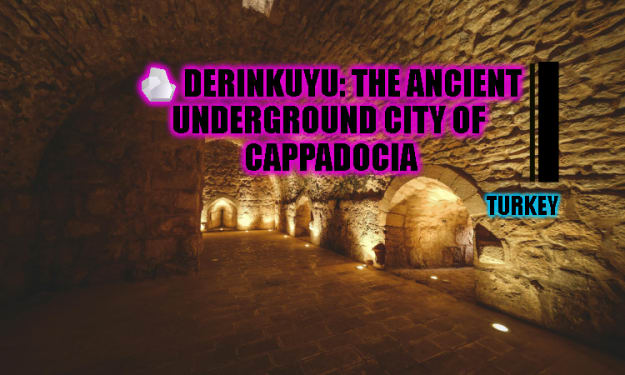
🪨Derinkuyu: The Ancient Underground City of Cappadocia in Turkey
🪨Derinkuyu: The Ancient Underground City of Cappadocia in Turkey 🌍 Deep beneath the arid plains of central Turkey, in the heart of the Cappadocia region, lies one of the most remarkable feats of ancient engineering ever discovered: the underground city of Derinkuyu. This vast subterranean complex, carved into soft volcanic rock, descends more than 85 meters (approximately 280 feet) below the earth’s surface and contains a network of tunnels, chambers, staircases, wells, and ventilation shafts that once served as a fully functioning city. It could house up to 20,000 people, along with their food, livestock, and belongings. The scale, complexity, and historical significance of Derinkuyu make it one of the most fascinating archaeological discoveries of the modern era.
By History Seekerabout a year ago in History
⚔️ The Lindisfarne Raid of 793: The Thunder Before the Storm of the Viking Age 🛡️
In the year 793 CE, a catastrophe unfolded on the eastern shores of Anglo-Saxon England that would echo across the continent and mark the beginning of one of the most transformative eras in European history: the Viking Age. This event, the violent raid on the monastic island of Lindisfarne, was not the first Scandinavian incursion into the British Isles, but it was the first to shock contemporary chroniclers so deeply that it made its way into the annals of medieval history as a moment of divine terror and political warning. It is now recognized by historians as the symbolic start of nearly three centuries of Norse expansion, violence, exploration, and cultural exchange.
By History Seekerabout a year ago in History
🛡️The Viking Shield Wall Which Changed The Viking Age
🛡️The Viking Shield Wall Which Changed The Viking Age The Viking shield wall stands as one of the most iconic military formations in medieval warfare, a symbol of Norse martial prowess and tactical discipline that played a crucial role in the Viking Age (c. late 8th to 11th centuries). More than just a static defensive line, the shield wall was a dynamic and adaptable formation that allowed Viking warriors to excel in varied combat scenarios—from brutal open-field battles and lightning raids to sieges, urban warfare, and even amphibious landings. This article explores the shield wall’s construction, tactical function, and its pivotal role in key Viking battles that shaped European history.
By History Seekerabout a year ago in History
🛡️ The Greek Phalanx: The Shield Wall That Changed the Ancient World
The Greek phalanx stands as one of the most iconic and influential military formations in world history, epitomizing the unique fusion of military innovation and societal structure that defined classical Greece. Emerging from the gradual militarization and social development of Greek city-states (poleis) during the early Archaic period (circa 8th century BCE), the phalanx embodied a collective approach to warfare, based on discipline, unity, and the combined strength of heavily armed infantry known as hoplites. This formation was not merely a tactical arrangement but a reflection of the social and political dynamics of Greek society, where military service and citizenship were deeply intertwined.
By History Seekerabout a year ago in History
Truth in the Oval Office: The Enduring Dilemma of Presidential Deception
Presidential lies are as old as the republic itself. They span affairs of state, personal scandals, wars, and political survival, weaving a complex tapestry of ethical ambiguity that challenges America’s democratic ideals. Drawing on historical analysis from sources such as CNN’s real-time fact-checking of Trump, scholarly examinations from James Pfiffner, and retrospective pieces from The New York Times and The Conversation, we uncover the ten core subjects that define this enduring phenomenon. These themes reveal not only that presidents lie, but also why, and what it costs us all.
By Only Incredibleabout a year ago in History
Beyond the Binary: Katharine Hepburn’s Queerness
She rebelled against Hollywood's idea of what a woman should be.Katharine Hepburn hated being a woman, or rather, she hated the box that society forced around her for being a woman. She despised the expectations, the constraints, the performative femininity she was expected to don every day. Hepburn was famously quoted as saying,
By C.M.Dallasabout a year ago in History