Narratives
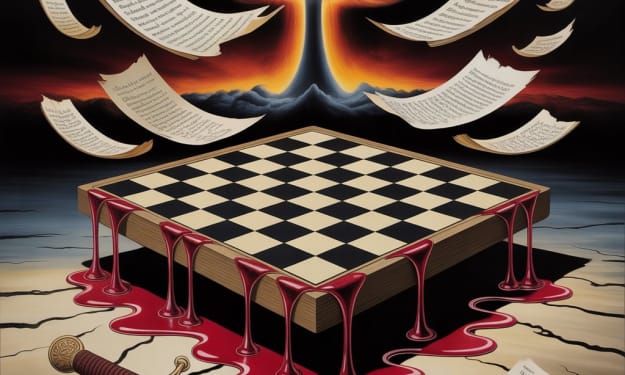
The Middle East: A Tinderbox of Empires, Wars, and Unending Conflict. AI-Generated.
The Middle East: A Tinderbox of Empires, Wars, and Unending Conflict The Middle East has always been more than just a geographical region—it’s a crucible of civilizations, a battleground of empires, and a vortex of geopolitical rivalries that have shaped world history. From the ancient wars of Mesopotamia to the modern-day clashes between Israel and Iran, this land has rarely known lasting peace. Today, as tensions escalate once again, the Middle East stands at the brink of another catastrophic conflict, threatening not just regional stability but global security.
By Muhammad Salman Akbarabout a year ago in History
The Giants of Peru: Conquistadors' Eyewitness Accounts and the Mystery of Ancient Skeletons
The Giants of Peru When the Spanish conquistadors arrived in South America in the 16th century, they anticipated discovering gold, spices, and strange civilizations. However, they did not expect to encounter legends of giants, and even more surprisingly, reports of actual giant skeletons unearthed by the native people that they claimed to have seen with their own eyes.
By The Secret History Of The Worldabout a year ago in History
The Eight Kings Who Ruled Before the Flood: Unveiling the Sumerian King
A Forgotten Record of Impossible Reigns: Unraveling the Enigma of the Sumerian King List In the cradle of civilization, where the first written words were penned, and society took its earliest steps, ancient scribes inscribed a remarkable document into clay tablets: the Sumerian King List. This cuneiform text, over 4,000 years old, lists the names of kings who reigned in ancient Mesopotamia.
By The Secret History Of The Worldabout a year ago in History
Girl Who Survived a Plane Crash in the Jungle 🌿✈️
❖ A Normal Flight on Christmas Eve It was December 24, 1971—Christmas Eve. Juliane Koepcke, a 17-year-old girl from Peru, boarded LANSA Flight 508 with her mother. They were flying from Lima to visit Juliane’s father in another city. The plane was almost full, with 92 people on board. The sky looked cloudy. As the flight continued, they flew into a big thunderstorm. The plane began shaking badly. People were scared. Lightning flashed all around. Then, suddenly, there was a loud noise. The plane had been hit by lightning. It started breaking apart in the air. Juliane remembers falling through the sky, still tied to her seat, spinning and surrounded by wind and clouds. She fell from over 10,000 feet—almost 3 kilometers high—into the Amazon rainforest. ❖ Waking Up in the Jungle Juliane woke up the next day on the ground. She was alone. Her arm hurt, one eye was swollen shut, and she had deep cuts on her legs and shoulders. Her glasses were gone. She had only one sandal on her foot and a torn summer dress. There was no sign of her mother or anyone else. Only trees, insects, and silence. She was in the middle of the rainforest—a place full of wild animals, snakes, and insects. But Juliane didn’t panic. She remembered what her parents had taught her: follow water. Small streams usually lead to rivers, and rivers may lead to people ❖ Eleven Days of Survival For the next 11 days, Juliane walked through the jungle. She followed a small stream, hoping it would take her somewhere safe. She had no food, just a small bag of candy she had found near the crash site. She drank water from the stream to stay alive. Flies laid eggs inside the cuts on her arm. She could feel them moving under her skin. She pulled out as many as she could. She was tired, in pain, and scared. But she kept going. At night, it was cold. During the day, the jungle was hot and full of biting insects. She had to walk carefully, afraid of snakes or other animals. But she didn’t give up. ❖ The Rescue On the 11th day, Juliane saw something—a small wooden hut near the river. It was empty, but it had a path nearby. She waited. Soon, local lumber workers arrived. They were shocked to see a skinny, weak girl, covered in wounds, standing alone in the jungle. They took her in, cleaned her wounds, and gave her food. Later, a helicopter came to fly her to a hospital. She found out she was the only survivor of the crash. All 91 other people, including her mother, had died. ❖ Life After the Crash Juliane recovered from her injuries. She later became a scientist, just like her parents. Years later, she returned to the crash site with a film crew and told her story. She said she never thought she would survive—but something inside her told her to keep walking. ❖ Reflection Juliane Koepcke’s story is one of the most amazing survival stories ever told. A teenage girl fell from the sky, landed in one of the wildest places on Earth, and survived for 11 days on her own. She didn’t have special tools or equipment. She didn’t have help. She had only courage, knowledge from her parents, and a strong will to live. Her story reminds us that even when things seem impossible, hope and strength can help us get through anything. Juliane’s story is still taught today in survival courses, documentaries, and books. It shows that even in the most hopeless situations, calm thinking and determination can save lives. Her experience not only inspired millions but also raised awareness about jungle survival, aviation safety, and the importance of mental strength in life-threatening situations.
By Echoes by Imadabout a year ago in History
The Soul of the White House Foundation. AI-Generated.
The White House is more than stone and story, it is a living breath of the Republic. Behind its neoclassical gaze and beneath the arching porticos lies a foundation not only of mortar and marble, but of ideas, unyielding, storm-tested, and ever-renewing.
By taylor lindaniabout a year ago in History
Time Walker . AI-Generated.
The year was 2129, and the world had entered its “Restoration Age.” After centuries of climate crises, wars, and near collapse, humanity turned back to its roots — both figuratively and, thanks to the invention of the Aeon Lens, literally.
By Atifa Iqbalzadaabout a year ago in History
Xolotl: The Dog God of the Aztec Underworld
A Shadow in the Twilight In the depths of Aztec mythology, a figure is cloaked in mystery amid the gods of the sun, rain, war, and death. Unlike the shining warriors and celestial kings, he is a god, a companion of the dead, and a guide through the shadows. Half-man, half-dog, he is the guardian of twilight.
By The Secret History Of The Worldabout a year ago in History
Natural Gas, WTI Oil, Brent Oil Forecasts – Oil Soars 5% As Trump Demands Iran’s Surrender.
**Natural Gas, WTI Oil, Brent Oil Forecasts – Oil Soars 5% As Trump Demands Iran’s Surrender** Oil prices skyrocketed by more than 5% as Middle Eastern geopolitical tensions escalated, causing a significant shift in global energy markets. The dramatic rise was as a result of the former U.S. President Donald Trump’s strong rhetoric against Iran, demanding what he called the regime’s “complete and unconditional surrender.” West Texas Intermediate (WTI) and Brent crude prices shot up as traders quickly reacted to the news, reviving the debate about supply risks and long-term price stability. WTI crude oil prices surged past the \$81 per barrel mark, while Brent crude crossed \$85, marking one of the most significant single-day increases in recent months. Natural gas also rose by nearly 2%, though it did so at a slower rate than the oil benchmarks. Geopolitical risk premiums were largely responsible for the rally because market participants had priced in the possibility of oil flows from the region being disrupted. Iran is an important OPEC member that has a lot of influence over the Strait of Hormuz, which is a crucial chokepoint for shipping oil around the world. Trump’s remarks, made during a press event and widely broadcast across global media, sent a clear message to Tehran. Framing Iran as a destabilizing force, he called for the international community to back what he termed a final effort to "remove the threat of terrorism and nuclear ambition from the region." Even though Trump is not in office right now, his statements are important, especially to right-wing leaders and Washington policymakers. As the 2024 U.S. presidential election cycle continues, energy traders are increasingly paying attention to how foreign policy rhetoric might influence market behavior.
By GLOBAL NEWSabout a year ago in History
Glass spheres in Florida clams - evidence of a meteor impact
In the fossil-rich sediments of Florida’s Gulf Coast, a peculiar and compelling mystery has emerged—one that blends paleontology, geology, and the vast forces of space. Deep within the layers of ancient fossil beds near Sarasota County, hundreds of fossilized clam shells were found to contain tiny, nearly invisible glass spheres. These minute spheres, each no wider than a grain of salt, are smooth, perfectly rounded, and chemically distinct from typical natural sediment grains. Their origin has fascinated researchers, as growing evidence suggests they may be remnants of an ancient meteorite impact—possibly a previously undocumented event that occurred millions of years ago.
By History Seekerabout a year ago in History
☢️Mohenjo‑daro “nuclear blast” theory - Ancient Indus Valley city
In the 1920s, deep in the floodplains of the Indus River in what is now Sindh, Pakistan, the ancient city of Mohenjo‑daro was rediscovered beneath centuries of silt and agricultural soil. Built around 2500 BCE at the height of the Mature Harappan phase, it was a marvel of urban planning, sanitation, and civil engineering—a testament to one of the world’s earliest great civilizations. Its bricks were sculpted, its bathhouses communal, its streets laid out in orderly grids. At its peak Mohenjo‑daro housed perhaps 40,000 people, all supported by an elaborate system of wells, drains, granaries, workshops, and public baths. It rivaled in sophistication the contemporary societies of Egypt and Mesopotamia.
By History Seekerabout a year ago in History
🎭Sanxingdui Mask and the Lost Civilization of Shu in Ancient China
🪨 The Earth Opens – A Discovery Beneath Sichuan's Soil In the summer of 1929, the course of Chinese archaeology was forever altered when a humble farmer named Yan Daocheng, while digging an irrigation trench near the small village of Sanxingdui in Guanghan, Sichuan Province, struck something solid just beneath the surface. What emerged was not stone or wood but smooth, polished jade—an intricately carved object unlike anything local villagers had seen. The discovery passed quietly at first, filed away as a strange curiosity. But it hinted at something enormous and long-buried under the rolling plains of western China.
By History Seekerabout a year ago in History