Narratives
Douglass: Bigger than Life
So class we started today to learn history. We must learn the history of America because the history is what makes the nation great. And learning the history makes us better because if you remember then you shall never forget. Lest we lose our souls and darkness arise. So today class we are talking about The Civil War and one of the heroes is my friend Frederick Douglass. He was born a slave and whose mother was a slave. What a depressing life? What a way to begin? But Douglass never gave up. The Bible is what he was taught by himself. And he learned it well. Some people say he kept a Bible with him everywhere he went to encourage him and strengthen him in his faith. Because you see back then times were hard and harsh. That's what happen when history is not taught and fought for. People had ignorance. Anyways, Douglass rose to prominence after successfully freeing himself from his master and escaping after 20 years of praying for it. Douglass was on his own with his freed wife. Douglass could of left America. He could of disown his citizenship but he did not. He fought the more harder for those who could not which was in his heart. He found Garrett and begin to be an orator. He begin to bring a face to Blacks in America. I know because I was his friend, Susan B. Anthony. And Douglass would write me all the time everywhere he went. He wrote about his successes and failures. Douglass spoke with President Lincoln, I got to introduce Lincoln before he was President at the Teachers Conference. Douglass was strongly involved with the Civil War. He worked tireless for freedom. And he spoke to sold-out crowds even when forced out of America. He had a grand voice, stern and strong which is why many called him a Lion. And he was strong willed. I remember a debate among several. And it was over the Civil War as well as women rights and freedmen rights. And I felt that we should fight for women rights afterall women were being treated like the property of their husbands. And I understand well the oppression of my fellows. And Douglass made the case that we have to show them that slavery is an atrocity then we can show them that women are equal. And I was uncertain and hesitantly agreed. Douglass was my friend and ally. We fought together on many occasions even with differences. I learned to respect his dignity and class. And he encouraged me with his intuitive and purposeful ways about doing things. And I met some of Douglass other friends and companions. Like Harriet Tubman, Douglass said she was a good woman and that she could represent women rights as well as ending slavery. She was a kind soul and strong woman and very religious. She loved listening to Douglass and I debate. And even she believed we both had good points. She became a friend of mines too. And she told me what she knew about Douglass and I told her what I knew about Douglass. Douglass was called upon daily for the abolitionist movement. He was glad to give his voice to it. And he was glad to represent it. He had a grand smile and he had good fashion. And then the unthinkable happen well after the Civil War, after Douglass' great victories to end slavery and his faithful activism. Douglass felt sick. And as his longtime friend I comforted him. I remember talking about Lincoln and Tubman. I was hopeful of him getting better. I remember writing for the last time. You are my best friend. You inspired me daily. I shall never forget what you've done for this country. I shall keep the spirit of fighting that you kept. Douglass what you've done was bigger than life. You lived a well life. God bless you my friend.
By Distinguished Honorary Alumni Dr. Matthew Primous2 years ago in History
Remember when you first kissed me?
Dearest Barbara, It's summer in the dreary 2004. Why aren't you here with me? I get the feeling you'd knock me out for wanting death so much. But I remember the most terrible things mixing up inside of me when I realized that you were actually gone. When you left that night, I had the chance to run after you but you were so affected by something that you demanded I stay behind.
By Melissa Ingoldsby2 years ago in History
Who is an African Black Child: The Secrets Behind Successful Black Children That Change The World
Being an African-Black kid can be daunting at times. It means different things to many children. You can call it "the survival gene of the proactive rare natives not discovered"...Yes!
By Godsgift O. Amos2 years ago in History
The Fearless Charge of Genghis Khan
Genghis Khan’s War Strategy: The Genius Behind the Mongol Conquests Genghis Khan, the architect of the Mongol Empire, is advised one of history’s greatest aggressive strategists. From a baby drifting association leader, he broadcast his authority to awning over 23 actor aboveboard kilometers, authoritative it the better abutting authority in history. His war strategies were revolutionary, aggregate speed, deception, cerebral warfare, and above aggressive organization. This commodity explores the ablaze war strategies of Genghis Khan, his use of intelligence, and how his approach accustomed the Mongols to beat all-inclusive acreage in a abbreviate time. 1. Aggressive Organization: The Backbone of Mongol Warfare Dividing the Army into Efficient Units Genghis Khan adapted the Mongol army into a awful acclimatized force by alignment it into a decimal system: Arban – Squad of 10 soldiers Zuun – Company of 100 Mingghan – Battalion of 1,000 Tumen – Division of 10,000 This arrangement ensured: ✔ Flexibility in action – Armies could be calmly disconnected or combined. ✔ Better ascendancy – Anniversary assemblage had its own commander, ensuring bright leadership. ✔ Loyalty and accord – Soldiers were aggregate with men they trusted. Elite Mongol Warriors Every Mongol soldier was accomplished from adolescence in: Horseback benumbed – Mongols could ride for canicule afterwards stopping. Archery – They could shoot arrows while benumbed at abounding speed. Survival abilities – Soldiers lived off the land, abbreviation assurance on accumulation chains. The aggregate of aggressive alignment and aristocratic training gave Mongols a massive advantage over less-disciplined armies. 2. Acceleration and Mobility: The Mongol Army’s Greatest Strength Horse-Based Warfare The Mongols were able horsemen, with anniversary soldier accepting 3-5 horses to about-face during battle. This accustomed them to: ✔ Biking up to 100 afar per day (much faster than European armies). ✔ Advance apace and retreat afore the adversary could counterattack. ✔ Conduct abruptness attacks abysmal central adversary territory. Lightning Raids and Fake Retreats One of the Mongols’ best feared approach was the affected retreat: Mongol army affected to abscond in panic. The enemy, cerebration they had won, chased them. The Mongols again angry aback aback and ambushed their pursuers. This ambush formed adjoin abounding brash armies, including Chinese, Persian, and European forces. 3. Cerebral Warfare: Defeating the Adversary Afore the Battle Genghis Khan accepted that abhorrence was a able weapon. He acclimated cerebral warfare to breach adversary assurance afore battles alike began. Spreading Fear He accustomed some defeated cities to escape, so survivors could advance belief of Mongol brutality. He generally destroyed absolute cities that resisted, ensuring others surrendered quickly. His spies advance rumors of Mongol backbone to abate adversary morale. Diplomacy and Abandonment Offers Cities were accustomed a choice: Surrender and be spared. Resist and be annihilated. Many rulers chose surrender, acumen that abashed was futile. By accumulation abhorrence and diplomacy, Genghis Khan baffled cities afterwards alike fighting. 4. Intelligence and Espionage: Knowing the Enemy The Mongols had an avant-garde spy arrangement that calm advice afore every campaign. How They Acclimated Spies: ✔ Disguised as merchants, spies aggregate intelligence on adversary cities, fortifications, and weaknesses. ✔ Intercepted letters to agitate adversary communication. ✔ Bribed admiral in adversary cities to accessible the gates at the appropriate moment. With this intelligence, Genghis Khan consistently knew the enemy’s strengths and weaknesses afore ablution an attack. 5. Adapting to New Technologies and Strategies Unlike abounding conquerors, Genghis Khan was not abashed to apprentice from others. Using Annoy Warfare The Mongols assassin Chinese engineers to body catapults, battering rams, and trebuchets. They acclimated armament weapons, acquirements from Chinese and Persian armies. Cities with aerial walls were no best safe from Mongol attacks. Recruiting Skilled People Genghis Khan accustomed defectors, giving them aerial positions in his army. He acclimated engineers, doctors, and strategists from baffled acreage to advance Mongol tactics. By adopting adversary strengths, the Mongols remained unbeatable. 6. Annoy Warfare: Conquering Alike the Arch Fortresses Many cities relied on adherent walls for protection. But Genghis Khan developed annoy strategies to defeat alike the arch defenses. Mongol Annoy Tactics: ✔ Surround the burghal completely, acid off aliment and water. ✔ Use captured civilians as animal bouncer to abate burghal defenses. ✔ Launch ablaze arrows and armament bombs to actualize chaos. ✔ Divert rivers to flood adversary cities. With these tactics, the Mongols baffled above cities like Beijing, Samarkand, and Baghdad. 7. Uniting the Empire: The Secret Behind Mongol Success Unlike added conquerors, Genghis Khan was not aloof a warrior – he was additionally a ablaze leader. Incorporating Different People Instead of antibacterial civilizations, he chip baffled bodies into his empire. He answer religious freedom, acceptance Muslims, Buddhists, Christians, and Hindus to coexist. He called leaders based on merit, not aloof bloodline. Establishing Barter and Communication He adequate the Silk Road, ensuring safe barter beyond Asia and Europe. He developed the Yam postal system, acceptance letters to biking bags of afar quickly. This ensured that his authority remained able continued afterwards his death. Conclusion: Why Genghis Khan’s War Strategies Were Unmatched Genghis Khan’s aggressive success was not aloof about strength, but about strategy, discipline, intelligence, and innovation. ✔ Above alignment – A structured and acclimatized army. ✔ Acceleration and advancement – Rapid movements that larboard enemies unprepared. ✔ Cerebral warfare – Fear-based approach that affected cities to surrender. ✔ Avant-garde intelligence – Spies and informants acquisition acute information. ✔ Adaptability – Acquirements and application adversary technologies adjoin them. ✔ Annoy warfare ability – Breaking alike the arch burghal defenses. Because of these strategies, Genghis Khan baffled added acreage than any added baton in history. Alike today, his aggressive approach are advised in war colleges as examples of ablaze warfare. His bequest is not aloof that of a conqueror, but of a adept architect who adapted the world.
By Say the truth 2 years ago in History
The History of America
The History of America Pre-Colonial and Native American Era Before European setThe History of America Pre-Colonial and Native American Eratlers arrived on the shores of what is now the United States, the land was already home to millions of indigenous peoples. These Native American tribes had been living across the continent for thousands of years, developing intricate societies, languages, cultures, and technologies. The diversity among these groups was vast: in the Northeast, the Iroquois Confederacy brought together six distinct nations under a sophisticated political structure, while the Mississippian culture in the Southeast constructed grand earthen mounds and traded across large regions. In the Great Plains, nomadic tribes like the Sioux hunted buffalo, and in the Southwest, the Puebloans built impressive cliff dwellings. The Pacific Northwest was home to the Tlingit and Haida peoples, who built totem poles and lived off the bounty of the sea. These tribes had their own systems of governance, economies, and spiritual beliefs, each deeply connected to the land they inhabited.
By Banik Sojib2 years ago in History
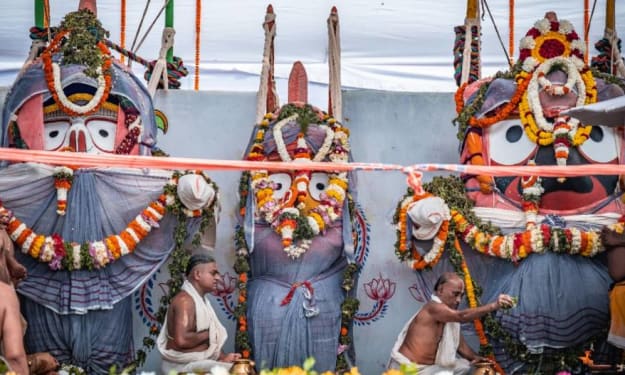
The Lord Jagannath
**1. The Origin of Lord Jagannath** **The Legend of King Indradyumna** The story of Lord Jagannath begins with King Indradyumna, a pious and devoted ruler of the ancient kingdom of Malava. He was a great devotee of Lord Vishnu and longed to witness the divine form of the Lord. One day, a wandering pilgrim told him about a sacred deity called **Nila Madhava** (a form of Lord Vishnu) worshipped in the forests of Odisha by the tribal chief, Viswavasu.
By Himansu Kumar Routray2 years ago in History
The Windrush Romance
It is 1948, Kalvin is 18 years old and is filled with excitement about his impending trip to the United Kingdom. The 'HMT Empire Windrush' awaited, the ship which would bring one of the first large groups of Caribbean people to the UK in that year. The Caribbean was then a part of the British commonwealth, those who arrived would automatically be British subjects and free to permanently live and work in the UK.
By Antoni De'Leon2 years ago in History
The Deeper Secrets of the Hebrew Bible: Unveiling Hidden Mysteries
The Deeper Secrets of the Hebrew Bible: Unveiling Hidden Mysteries Introduction The Hebrew Bible, also known as the Tanakh, is one of the most profound and influential texts in human history. It has been studied for centuries by scholars, theologians, and mystics who seek to understand its divine wisdom. But beyond its historical and religious significance, the Hebrew Bible contains hidden messages, codes, and mystical teachings that reveal deeper spiritual truths. From the Kabbalistic interpretations to the Bible codes, the scriptures are filled with secrets that go beyond their literal meaning. Some of these hidden messages were passed down through oral traditions, while others were embedded in the text itself through numerical patterns and symbolic language. In this article, we will explore some of the deeper secrets of the Hebrew Bible, uncovering the mysteries that have fascinated scholars and seekers for centuries. The Concept of Hidden Wisdom in the Hebrew Bible Throughout the Hebrew Bible, there are indications that deeper wisdom is concealed within the text. Proverbs 25:2 states: "It is the glory of God to conceal a matter, but the glory of kings is to search out a matter." This suggests that divine wisdom is hidden and must be sought after. The ancient rabbis and Kabbalists believed that the Torah was written on multiple levels—literal, allegorical, and mystical. These levels of interpretation are known as PaRDeS, an acronym for: 1. Peshat – The simple, literal meaning. 2. Remez – The hinted or allegorical meaning. 3. Derash – The interpretative or midrashic meaning. 4. Sod – The hidden, mystical meaning. The Sod (secret) level of the Hebrew Bible is where the deeper mysteries reside. Many Jewish sages dedicated their lives to uncovering these secrets, believing they contained the keys to understanding the universe, the soul, and God's plan for creation. The Mystery of the Hebrew Letters and Gematria One of the most intriguing aspects of the Hebrew Bible is the mystical power of Hebrew letters. Unlike English, Hebrew is an alphanumeric language, meaning that every letter also has a numerical value. This system is known as Gematria, and it allows for numerical patterns and hidden messages to be found in the text. For example, the Hebrew word for "life" (Chai, חי) has a numerical value of 18 (8+10). This is why the number 18 is considered lucky in Jewish tradition. Similarly, the Tetragrammaton (YHWH, יהוה), the sacred name of God, has a numerical value of 26, which has deep Kabbalistic significance. One of the most famous uses of Gematria in biblical interpretation is the connection between Genesis 1:1 and John 1:1 in the New Testament. In Genesis 1:1, the first words of the Bible are "Bereshit Bara Elohim" (בראשית ברא אלהים), meaning "In the beginning, God created." The numerical value of these words has been linked to significant mathematical patterns that some believe reveal divine intelligence behind the text. Another example of hidden codes in the Hebrew Bible is found in the Torah Equidistant Letter Sequences (ELS). Some researchers claim that, by skipping a set number of letters in the Torah, secret messages about historical events and future prophecies can be uncovered. This is often referred to as the Bible Code, and though it remains controversial, it has fascinated scholars for decades. The Mystical Tree of Life and the Torah In Kabbalah, the Tree of Life (Etz Chaim) is a powerful symbol that represents the structure of divine reality. It consists of ten sefirot (divine attributes) and connects heaven and earth. Many Kabbalists believe that the Torah is encoded with the structure of the Tree of Life and that its teachings correspond to different levels of spiritual awakening. One of the most mysterious aspects of the Torah is the Sefer Yetzirah ("Book of Formation"), an ancient Kabbalistic text that describes how the Hebrew letters were used to create the universe. According to this text, the letters of the Hebrew alphabet are not just symbols but actual forces of creation. This idea aligns with the biblical verse: "And God said, ‘Let there be light,’ and there was light." (Genesis 1:3) This suggests that speech and language have creative power, a concept that is deeply embedded in Jewish mystical thought. The Prophetic Visions and Messianic Secrets The Hebrew Bible contains numerous prophecies that have fascinated both Jewish and Christian scholars. Many believe that these prophecies contain hidden messages about the Messianic Age and the future of humanity. For instance, in the Book of Daniel, there are visions of mysterious "beasts" and a timeline of events leading to the end of days. The Book of Isaiah also contains cryptic prophecies about the coming of a Messiah who will bring peace and justice to the world. Jewish mystics often interpret these prophecies through the lens of Kabbalah, suggesting that the Messiah will not just be a physical ruler but a spiritual force that will elevate human consciousness. Some even believe that the Messiah has already come in different forms throughout history, subtly guiding the world toward redemption. The Hidden Names of God The Hebrew Bible contains many names of God, each revealing different aspects of His nature. The most sacred and mysterious of these names is the Tetragrammaton (YHWH), which was considered too holy to be spoken aloud. However, Jewish mysticism teaches that there are 72 hidden names of God, known as the Shem HaMephorash. These names are said to hold immense power and are used in mystical practices for protection, healing, and divine connection. Some believe that Moses used one of these secret names to part the Red Sea, demonstrating the power hidden within the sacred Hebrew letters. Conclusion The Hebrew Bible is far more than just a religious text; it is a vast repository of divine wisdom, mystical codes, and hidden messages that continue to inspire seekers of truth. Whether through Gematria, Kabbalah, biblical prophecies, or the mystical power of Hebrew letters, the Bible reveals secrets that point to a deeper reality beyond the physical world. For those who seek to uncover these mysteries, the journey requires patience, study, and spiritual insight. As Proverbs 2:4-5 says: "If you seek her as silver, and search for her as for hidden treasures, then you will understand the fear of the Lord, and find the knowledge of God." The secrets of the Hebrew Bible are not just meant to be studied but to be lived—guiding individuals toward wisdom, transformation, and a deeper connection with the divine.
By Samson E. Gifted2 years ago in History
Warriors of Loving
My Dearest Audrella, I thank you for the cloves you had enclosed in your last missive. That permitted me great joy in ingesting the aromas of such spices. Now is the time where I must depart from happy feelings. The aggressors have shown themselves to be quite despicable in their deportment. Some of the Continental Army have shown themselves to be rather hostile, too. They don’t salute me as a colonel, the white men. They snicker and chortle every time I come into view. My men, however, salute me and say good morning or any other time of day and “Colonel Redd.” They can take my admonishments. They receive commands and carry out orders with the strictest discipline.
By Skyler Saunders2 years ago in History
The Enigmatic Nok Culture
The Nok Culture, an intriguing ancient civilization in West Africa, thrived from 1500 BCE to 500 CE in present-day Nigeria. Renowned for its intricate terracotta sculptures, the Nok people created a significant artistic and cultural heritage that continues to engage historians and archaeologists globally. This article delves into the origins, artistic accomplishments, and enduring impact of the Nok civilization.
By A História2 years ago in History