Modern
Modern Science and Its Impact on the Future. Content Warning. AI-Generated.
Modern science is one of the most powerful tools shaping the world today. It helps us understand the universe, solve real-world problems, and improve the quality of human life. From medicine and technology to environmental solutions and space exploration, science is playing a key role in building a better future.
By Sadik rockerabout a year ago in History
AI in Cybersecurity: A game changer or a double-edged sword?
Artificial intelligence has utterly transformed cybersecurity in diverse manners, both remarkable and multifold. Its skills—including scouring immense datasets, searching for anomalies and systematising retaliation—have propelled protective tactics to unprecedented heights.
By Abjol Hussain Laskarabout a year ago in History
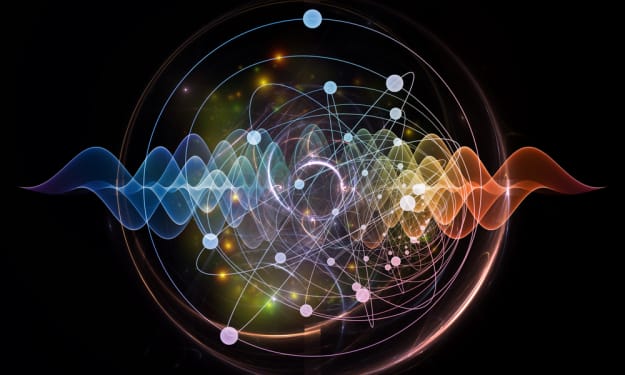
Quantum Physics: Unlocking the Mysteries of the Universe
Quantum physics: a mind-bending journey into the subatomic realm Quantum mechanics – the study of the ridiculously tiny – is, frankly, a head-scratcher. It's a field that's both utterly fascinating and profoundly weird, governing the behavior of things like atoms, electrons, and photons. Forget your everyday, intuitive physics; this is a whole different ball game. Yet, this bizarre world underpins much of modern technology, from the lasers in your barcode scanner to the MRI machine that might one day save your life. It all started brewing in the early 1900s. Scientists, feeling a bit like detectives on a cosmic case, started noticing some serious inconsistencies in classical physics. Max Planck, for instance, stumbled onto the idea that energy isn't a continuous flow, but comes in discrete packets – he called them "quanta," which, incidentally, is where the whole "quantum" thing gets its name. Einstein then took the baton, explaining the photoelectric effect – how light knocks electrons loose from materials – by suggesting light acts like both a wave and a particle. Think of it as a chameleon of the cosmos, changing its appearance depending on how you look at it. The 1920s saw a flurry of activity, with Werner Heisenberg and Erwin Schrödinger leading the charge. Heisenberg's Uncertainty Principle basically threw a wrench into our ability to precisely know both a particle's position and momentum simultaneously. It's like trying to pinpoint a hummingbird in flight – the act of looking changes its trajectory. Schrödinger, meanwhile, gave us a mathematical framework – his famous wave equation – to model all this quantum weirdness, introducing the concept of probability waves. It's as if the subatomic world is a blurry watercolor painting, rather than a sharp photograph. The core principles of quantum mechanics are downright bonkers: 1. **Superposition:** Quantum particles can exist in multiple states at once – like a coin spinning in the air, neither heads nor tails until it lands. Schrödinger's cat thought experiment, a ludicrous but illustrative example, perfectly captures this paradoxical state. 2. **Entanglement:** This is where things get truly bizarre. Entangled particles are linked, regardless of distance. Measuring the state of one instantly tells you the state of the other – a phenomenon Einstein famously called "spooky action at a distance." It's like having two magic coins that always land on the same side, no matter how far apart they are. 3. **Quantum Tunneling:** Particles can seemingly pass through barriers they shouldn't be able to overcome classically. It's like a ghost slipping through a wall. This phenomenon is crucial for things like nuclear fusion and the semiconductors in your phone. 4. **The Observer Effect:** The very act of observing a quantum system changes it. It's as if the universe is playing a cosmic game of peek-a-boo, and our observation is part of the rules. But this isn't just theoretical mumbo-jumbo. Quantum physics has real-world applications, and some pretty impactful ones at that: * **Quantum Computing:** Forget bits (0s and 1s); quantum computers use qubits, which can be in superposition, allowing them to tackle problems that would take classical computers eons to solve. * **Medical Imaging (MRI):** MRIs rely on quantum principles to create detailed images of our insides. * **Lasers and Semiconductors:** The technology underpinning our smartphones, fiber optics, and countless other devices is fundamentally quantum. * **Cryptography:** Quantum encryption promises ultra-secure communication using the magic of entanglement. Quantum physics: a mind-bending journey into the subatomic realm Quantum mechanics – the study of the ridiculously tiny – is, frankly, a head-scratcher. It's a field that's both utterly fascinating and profoundly weird, governing the behavior of things like atoms, electrons, and photons. Forget your everyday, intuitive physics; this is a whole different ball game. Yet, this bizarre world underpins much of modern technology, from the lasers in your barcode scanner to the MRI machine that might one day save your life. It all started brewing in the early 1900s. Scientists, feeling a bit like detectives on a cosmic case, started noticing some serious inconsistencies in classical physics. Max Planck, for instance, stumbled onto the idea that energy isn't a continuous flow, but comes in discrete packets – he called them "quanta," which, incidentally, is where the whole "quantum" thing gets its name. Einstein then took the baton, explaining the photoelectric effect – how light knocks electrons loose from materials – by suggesting light acts like both a wave and a particle. Think of it as a chameleon of the cosmos, changing its appearance depending on how you look at it. The 1920s saw a flurry of activity, with Werner Heisenberg and Erwin Schrödinger leading the charge. Heisenberg's Uncertainty Principle basically threw a wrench into our ability to precisely know both a particle's position and momentum simultaneously. It's like trying to pinpoint a hummingbird in flight – the act of looking changes its trajectory. Schrödinger, meanwhile, gave us a mathematical framework – his famous wave equation – to model all this quantum weirdness, introducing the concept of probability waves. It's as if the subatomic world is a blurry watercolor painting, rather than a sharp photograph. The core principles of quantum mechanics are downright bonkers: 1. **Superposition:** Quantum particles can exist in multiple states at once – like a coin spinning in the air, neither heads nor tails until it lands. Schrödinger's cat thought experiment, a ludicrous but illustrative example, perfectly captures this paradoxical state. 2. **Entanglement:** This is where things get truly bizarre. Entangled particles are linked, regardless of distance. Measuring the state of one instantly tells you the state of the other – a phenomenon Einstein famously called "spooky action at a distance." It's like having two magic coins that always land on the same side, no matter how far apart they are. 3. **Quantum Tunneling:** Particles can seemingly pass through barriers they shouldn't be able to overcome classically. It's like a ghost slipping through a wall. This phenomenon is crucial for things like nuclear fusion and the semiconductors in your phone. 4. **The Observer Effect:** The very act of observing a quantum system changes it. It's as if the universe is playing a cosmic game of peek-a-boo, and our observation is part of the rules. But this isn't just theoretical mumbo-jumbo. Quantum physics has real-world applications, and some pretty impactful ones at that: * **Quantum Computing:** Forget bits (0s and 1s); quantum computers use qubits, which can be in superposition, allowing them to tackle problems that would take classical computers eons to solve. * **Medical Imaging (MRI):** MRIs rely on quantum principles to create detailed images of our insides. * **Lasers and Semiconductors:** The technology underpinning our smartphones, fiber optics, and countless other devices is fundamentally quantum. * **Cryptography:** Quantum encryption promises ultra-secure communication using the magic of entanglement. The future of quantum physics is as vast and unexplored as the universe itself. Scientists are delving into quantum gravity, quantum teleportation (yes, really!), and even the mind-bending concept of the multiverse. The development of powerful quantum computers could revolutionize fields like medicine, artificial intelligence, and materials science, potentially ushering in an era of technological advancement we can barely imagine. In short, quantum physics is a field that consistently challenges our understanding of reality. It's a testament to the universe's boundless strangeness and a driving force behind some of humanity's most significant technological leaps. It's a journey into a world that's both baffling and breathtaking, and one that’s only just beginning.
By Habibulla Mesbaabout a year ago in History
Marvel Doesn't Have to Try So Hard: Why Thunderbolts Signals a Promising Shift
For years, the Marvel Cinematic Universe (MCU) has operated on a seemingly unwavering principle: bigger is better. Each phase escalated in scale, culminating in universe-altering events with casts of dozens and stakes that threatened all of reality. While these grand narratives have undeniably delivered moments of thrilling spectacle, a sense of fatigue has begun to settle in for some viewers. The sheer weight of interconnected storylines and the constant pressure to raise the stakes have occasionally overshadowed character development and nuanced storytelling.
By Arif Islamabout a year ago in History
Rolls-Royce Phantom Turns 100: A Look at the Luxury Icon’s History
when a car brand turns 100, it’s a big deal. Crossing the century mark is huge for any company, in any market. But Rolls-Royce has been around for so long that it now has a product turning 100 years old: The Phantom. That makes the luxury icon older than most other brands.
By Emon Mollaabout a year ago in History
The title of the article in English is: The Power of Words: Stories of How Our Language Shapes Our World.
The Power of Words: Stories of How Ou Language Shapes Our World Hey friend, have you ever really thought about the amazing power our words hold? They're not just sounds that come out of our mouths or letters we scribble on paper or a screen. To me, words are more like tiny seeds that we plant in the minds and hearts of others. They can grow into towering trees or troublesome weeds, depending on the kind of seed we choose.
By Omar Mohammed about a year ago in History
Trump mocks trans athletes in women's sports to roaring applause at Alabama commencement speech. AI-Generated.
The reported incident of Donald Trump mocking transgender athletes during a commencement speech in Alabama aligns with his longstanding public stance on the issue, though specific details of such a speech would require verification against recent events (post-October 2023, beyond my knowledge cutoff). Here's a contextual summary based on his known positions and the broader debate:
By Sazidul Islam about a year ago in History
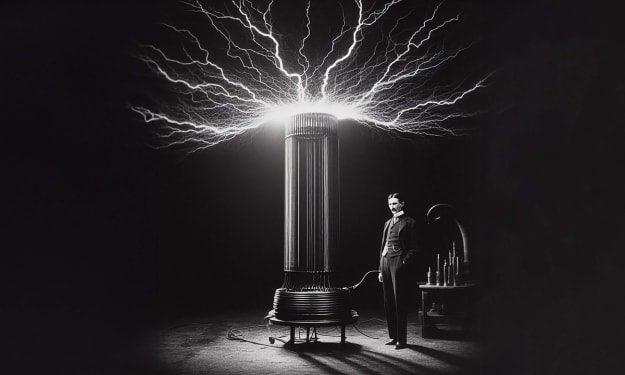
The Death Ray: Tesla’s Lost Weapon to End War
The Death Ray: Tesla’s Lost Weapon to End War When we think of Nikola Tesla, most of us envision a genius inventor whose contributions changed the world in ways we are still discovering today. His name is synonymous with revolutionary ideas, from alternating current (AC) electricity to wireless communication. Yet, one of Tesla’s most controversial and mysterious inventions remains shrouded in secrecy: the so-called "Death Ray."
By The Secret History Of The Worldabout a year ago in History