Modern
Unraveling the Enigma of the Amazon: From Ancient Mysteries to Modern Discoveries. Content Warning.
In the heart of the Amazon rainforest lies a realm of mystery, where secrets of the past intertwine with the challenges of the present. Spanning over 2.6 million square miles, this vast expanse of dense jungle has long captivated explorers, scientists, and adventurers alike. Yet, amidst its towering trees and winding waterways, lies a hidden world waiting to be uncovered.
By Alexander Mensah2 years ago in History
Unraveling the Mind-Blowing Theories of Our Universe. Content Warning.
In the vast expanse of our cosmos, where mysteries swirl and realities bend, scientists continue to push the boundaries of understanding. Each day brings new revelations, unveiling layers of complexity and wonder that challenge our very perceptions of existence. From the inception of the universe to the fabric of reality itself, here are five mind-blowing theories that promise to stretch the limits of your imagination.
By Alexander Mensah2 years ago in History
The Whispering Forest
In a land far beyond the reaches of modern maps, there lay a forest untouched by time. The Whispering Forest, as it was known to the few who dared speak of it, was a place where the trees sang ancient songs and the air was thick with magic. It was a forest where dreams could come alive, and reality often bent to the will of those who believed in the impossible.
By Som Gorgor2 years ago in History
The Evolution of Early Indian Civilization
The Pre-Formation of Indian Civilization Human habitation in the Indian subcontinent dates back approximately 500,000 years, as evidenced by stone age sites ranging from the southern regions of Kerala and Tamil Nadu to the Soan and Beas river valleys in northern Punjab. These early sites are scattered across the subcontinent, with some estimated to be between 400,000 and 150,000 years old. The presence of these early human communities indicates a rich and prolonged period of prehistory in the region. Middle Stone Age societies emerged between 40,000 and 10,000 years ago, followed by communities using microlithic tools around 15,000 years ago. Some of these microlithic communities coexisted with the first Neolithic communities around 7000 BCE. Both cultural types, along with hunting-gathering and nomadic pastoral economies, persisted across the subcontinent. The rich rock art found at sites like Bhimbetka in Madhya Pradesh, which includes Middle Stone Age as well as microlithic representations, provides a window into the lives and practices of these early humans. The Neolithic Transition Around 7000 BCE, Neolithic communities began forming in the valleys that drained the mountains separating the Indian subcontinent from Afghanistan and continental Asia. By 4000 BCE, these hunter-gatherer societies had evolved into more complex communities of farmers and artisans. These Neolithic communities lived in settlements characterized by circular mud-covered bamboo huts. The earliest known of these settlements were in Baluchistan, soon followed by similar communities in the Gangetic plain and on the Deccan plateau. Archaeological discoveries in these regions have unearthed Neolithic assemblages that include domesticated cattle, sheep, goats, and plants like rice. The transition from Stone Age cultures to Iron Age communities by 1000 BCE marked a significant evolution in early Indian civilization. This period saw distinct developments in different parts of the subcontinent, reflecting a diversity of cultural practices and technological advancements. The Mesopotamian Connection The microlithic tool-makers who settled in Mehrgarh, in the Bolan River basin in Baluchistan, initiated a transformative phase in early Indian society. This challenged the earlier beliefs held by European scholars, who posited that an urban civilization in northwestern India emerged suddenly in the mid-third millennium BCE, influenced by Mesopotamian colonists. They believed this urban culture was static, uniform, and collapsed due to Indo-Aryan invasions from Central Asia. This view, dominant until the 1950s, was based on limited field data and neglected the ecological variations and earlier human occupations. The accidental discovery of Mohenjo-Daro shifted scholarly focus from the antiquity of Indo-European languages to the urban ruins of the Indus basin. The emphasis on Sanskrit and the Vedic hymns had long overshadowed the indigenous origins of early Indian civilization. Revisions in Understanding Recent decades have significantly revised this understanding. Evidence of farming communities in the northwest, predating the urban phase by millennia, showed a continuous evolution from agricultural to urban societies. Mehrgarh, the earliest of these communities, provides substantial evidence for this long developmental period. This evidence suggests a gradual and indigenous process leading to the pre-formation of Indian civilization by around 500 BCE. The comprehensive archaeological findings at Mehrgarh reveal that its inhabitants, as early as the seventh millennium BCE, constructed multi-room mud-brick buildings, crafted stone tools, and cultivated barley and wheat. They buried their dead with tools and ornaments, and practiced goat sacrifice, indicating complex social and cultural practices. By 5000 BCE, buildings had grown larger and some served communal storage purposes. The increase in specialized crafts, such as basketwork, textiles, pottery, and copperware, points to significant indigenous advancements. Technological and Urban Developments By the mid-fourth millennium BCE, new technologies emerged in Mehrgarh, including wheel-thrown pottery, larger copper ingots, and advanced mining and smelting techniques. These developments illustrate a significant, indigenous evolution towards urbanization. These technological advancements challenge earlier assumptions that early Indian civilization was heavily influenced by external factors. In summary, the pre-formation of Indian civilization was a complex, multi-millennial process involving a gradual transition from simple stone age societies to advanced urban communities. This evolution was marked by significant indigenous innovations and cultural practices, laying the foundation for the rich and diverse civilization that would emerge in the Indian subcontinent.
By Abdulsab Hunnur2 years ago in History
Hollywood: The Heartbeat of Global Entertainment. AI-Generated.
### Hollywood: The Heartbeat of Global Entertainment Hollywood, a district in Los Angeles, California, is more than just a geographic location; it's a cultural phenomenon and the epicenter of the global entertainment industry. Known worldwide as the home of the American film industry, Hollywood has shaped modern cinema and continues to influence global pop culture. With its storied history, iconic landmarks, and continual evolution, Hollywood remains a beacon of creativity, innovation, and entertainment.
By Suman Nath2 years ago in History
The Plague of Civilization
Introduction Civilization, with its sprawling cities, advanced technologies, and complex societies, stands as a testament to human ingenuity and ambition. However, the journey of civilization has been marred by numerous plagues—both literal and metaphorical—that have shaped the course of history. These plagues are not merely outbreaks of disease, but also social, economic, and environmental crises that have threatened to unravel the fabric of human societies. This article explores the multifaceted concept of the "plague of civilization," examining how various plagues have influenced and been influenced by the development of human civilization.
By Alohan I Rowland2 years ago in History
A Journey of Heritage. Content Warning. AI-Generated.
A Journey of Heritage: Rediscovering My Grandmother's Legacy It was a rainy afternoon when I first discovered the box. I was helping my parents clean out my late grandmother's attic, a task that had been postponed for months due to the overwhelming sense of loss we all felt. As I sifted through dusty books and old trinkets, my hand brushed against a worn, wooden box tucked away in a corner. Intrigued, I carefully lifted the lid, revealing a treasure trove of letters, photographs, and keepsakes that seemed to whisper stories from a time long past.
By Light Drop2 years ago in History
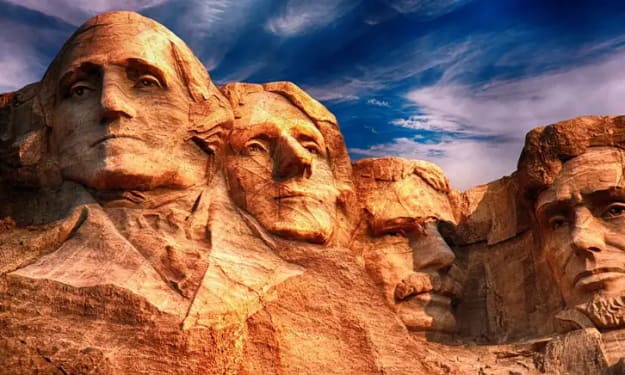
A Monument of American Greatness
Perched majestically amidst the rugged terrain of the Black Hills in South Dakota, Mount Rushmore stands as a testament to American ingenuity, perseverance, and the enduring spirit of democracy. Carved into the granite face of this iconic mountain are the stoic visages of four of the nation's most revered presidents: George Washington, Thomas Jefferson, Theodore Roosevelt, and Abraham Lincoln. Completed in 1941, this colossal sculpture is not merely a marvel of engineering and craftsmanship but also a profound symbol of national identity and unity.
By Santosh Sahu2 years ago in History