Medieval
The Main Reason Behind the Israel-Iran Conflict
The conflict between Israel and Iran is one of the most dangerous tensions in the Middle East. It is not just about religion or politics—it’s a mix of historical distrust, security concerns, nuclear weapons, and regional influence. To understand why Israel and Iran are enemies today, we must look at real events, official statements, and international reports that clearly explain the reasons.
By Engr. Mansoor Ahmadabout a year ago in History
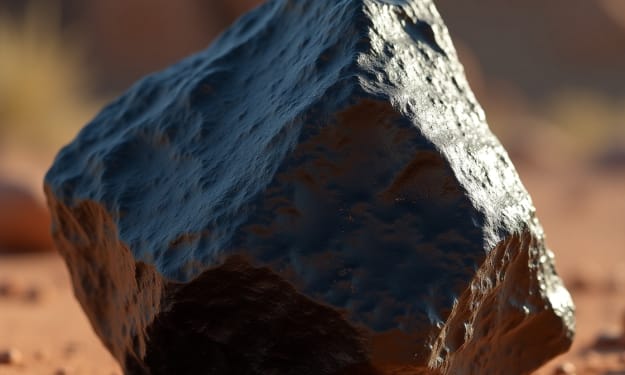
The largest Martian rock ever found on Earth,
In a landmark moment for space enthusiasts and collectors alike, a rare Martian meteorite known as NWA 16788 has been sold for a staggering $5.3 million at a recent Sotheby’s auction in New York, setting a new world record for the highest price ever paid for a Martian rock. Weighing 25 kilograms, NWA 16788 is the largest Martian rock ever found on Earth and a scientific marvel in its own right. Unearthed in Nigeria’s Sahara Desert in 2023, the meteorite is now being hailed as one of the most significant extraterrestrial finds of the 21st century. A Giant Among Space Rocks NWA 16788’s sheer size alone makes it a standout. It is 70% larger than any previously discovered Martian meteorite, placing it in a category of its own. Of the estimated 400 known Martian meteorites that have made their way to Earth, none approach the mass or preservation quality of this specimen. Most Martian meteorites are fragments, broken and scattered either during their descent through Earth’s atmosphere or upon impact. In contrast, NWA 16788 is remarkably intact. Scientists believe it was ejected from the surface of Mars millions of years ago, most likely as a result of a massive asteroid or comet collision that sent debris flying into space. Its journey from Mars to Earth, and its preservation in the Sahara’s arid conditions, makes it a geological time capsule offering insights into the Red Planet’s history. A Meteorite with a Story Named according to its classification — "NWA" standing for Northwest Africa — the rock was reportedly discovered by local meteorite hunters and verified by planetary scientists soon after. Its composition was analyzed using spectroscopy and isotopic analysis, confirming its Martian origin. Key indicators include the presence of certain gas isotopes trapped inside the rock, which match atmospheric readings taken by NASA’s rovers on Mars. Sotheby’s, the renowned auction house, described the meteorite as “a once-in-a-generation discovery.” Ahead of the sale, it was displayed in a climate-controlled glass case, drawing crowds of collectors, scientists, and curious onlookers. The final bid of $5.3 million shattered previous auction records for meteorites and planetary specimens. While the buyer’s identity remains anonymous, experts suggest the meteorite may end up in a private collection or museum, where it can be further studied and displayed. Scientific and Cultural Significance Beyond its size and monetary value, NWA 16788 represents a scientific treasure trove. Martian meteorites are incredibly rare, offering one of the few direct ways for scientists to study Mars without sending missions to the planet itself. These rocks allow researchers to analyze Mars’s geologic and atmospheric history, shedding light on everything from ancient volcanic activity to the possibility of past water — and even life. Some meteorites have been found to contain microscopic bubbles of Martian atmosphere, providing data that complements the findings of rovers like Perseverance and Curiosity. In the case of NWA 16788, its large mass increases the potential for multiple scientific analyses without damaging the integrity of the rock. "Having a sample this large gives researchers room to perform deeper investigations," says Dr. Lena Khatri, a planetary geologist at the University of Chicago. "This could improve our understanding of Martian mineralogy and the planet’s evolution." A Meteorite Market on the Rise The booming interest in space collectibles has driven up prices for meteorites and other extraterrestrial materials in recent years. Lunar samples, asteroid fragments, and now Martian rocks are being bought not just by museums and universities, but also by wealthy private collectors and investors. According to Sotheby’s, interest in the Martian meteorite was global, with bids coming in from multiple continents. The auction house’s specialists say that space rocks are increasingly seen as both scientific artifacts and cultural icons, symbolizing humanity’s enduring fascination with the cosmos. Final Thoughts As telescopes and rovers continue to explore Mars, and as space agencies prepare for eventual crewed missions to the Red Planet, pieces like NWA 16788 serve as tangible links between our world and Mars. The record-breaking sale not only marks a new chapter in meteorite collecting but also underscores the growing intersection of science, commerce, and space exploration. While the image accompanying the auction was AI-generated and provided only for reference, the rock itself is very real — a silent witness to a cosmic journey that began on another planet and ended with a multimillion-dollar bid in Manhattan.
By Israr khanabout a year ago in History
Skeleton Lake: The Himalayan Tomb of Mystery
High in the Indian Himalayas, where the air is thin and the silence feels older than time, lies a place so chilling it seems ripped from the pages of an ancient curse. Roopkund Lake... better known as Skeleton Lake, rests at an altitude of over 16,000 feet. A glacial basin. A frozen cradle of secrets. And, when the snow melts, a graveyard for hundreds of human skeletons.
By Veil of Shadowsabout a year ago in History
The Downfall of the Ottoman Empire: Causes and Consequences
The Ottoman Empire, once a vast and powerful dynasty spanning Europe, Asia, and Africa, existed for more than six centuries. At its height during the 16th and 17th centuries, it was one of the most formidable empires in history. However, by the early 20th century, it had disintegrated into political, economic, and military chaos, eventually collapsing after World War I. The fall of the Ottoman Empire was a gradual process, marked by both internal decay and external pressures. This article explores the key causes and consequences of the empire’s decline.
By Engr. Mansoor Ahmadabout a year ago in History
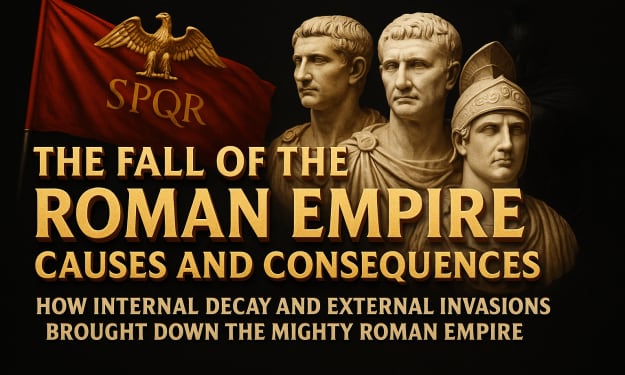
The Fall of the Roman Empire: Causes and Consequences
The Roman Empire, once the most powerful civilization in the ancient world, ultimately fell after centuries of domination across Europe, North Africa, and the Middle East. Its collapse is one of history's most significant turning points, signaling the end of classical antiquity and the beginning of the Middle Ages in Europe. Understanding the fall of the Roman Empire involves a complex combination of internal weaknesses and external pressures that eroded Rome’s ability to sustain itself. This article explores the key causes behind the downfall of the Roman Empire and the enduring consequences of its demise.
By Engr. Mansoor Ahmadabout a year ago in History
Christopher Columbus – The Man Who Changed the Map of the World
🔹 Born: 1451 – Genoa, Italy 🔹 Died: 1506 – Valladolid, Spain 🔹 Fame: The first European to officially discover the American continent --- 🧭 Who Was Christopher Columbus? Christopher Columbus was an Italian explorer, navigator, and maritime adventurer who earned global recognition for being the man who led Europe to the New World—what we now call the Americas. But it wasn’t originally his goal. Columbus set out to discover a sea route to Asia—specifically India and China—by sailing westward across the Atlantic Ocean. At the time, European nations were desperate to find new trade routes to the East for spices, gold, and silk. But instead of reaching Asia, Columbus stumbled upon lands previously unknown to Europeans, forever altering the world's understanding of geography. Though he died never knowing the true extent of his discovery, Columbus’ voyages marked the beginning of a new era in world history—one that connected continents and transformed civilizations. --- 🚢 The First Voyage – 1492 In the late 15th century, Columbus pitched his vision of a westward sea route to Asia to several European courts. After years of rejection, King Ferdinand and Queen Isabella of Spain finally agreed to sponsor his voyage. They provided him with three ships: Niña Pinta Santa María Columbus and his small fleet set sail westward from Spain in August 1492. After more than two months at sea, the crew spotted land on October 12, 1492. This land was one of the Bahamas islands in the Caribbean. However, Columbus believed he had reached Asia, and mistakenly referred to the native inhabitants as “Indians”—a term that remained in use for centuries. --- 🌍 Total Number of Voyages Columbus undertook four major voyages across the Atlantic Ocean, each time exploring new areas and establishing the foundation for future European colonization. 1. 1492 – Discovery of the Caribbean Islands He landed on islands such as the Bahamas, Cuba, and Hispaniola (present-day Haiti and the Dominican Republic). 2. 1493 – Second Voyage and Colonization This expedition focused on establishing settlements. He returned with more ships and men to build colonies in the New World. 3. 1498 – South America Columbus explored parts of Venezuela and the northern coasts of South America, still believing he had found parts of Asia. 4. 1502 – Final Expedition to Central America His last voyage took him to Central America, including modern-day Honduras, Nicaragua, and Costa Rica. Despite all these journeys, Columbus never realized he had discovered an entirely new continent. He believed until his death that he had found islands near India or China. --- 📌 A Fascinating Truth One of the most intriguing facts about Columbus is this: he never set foot in what is today the mainland United States. His landings were primarily on Caribbean islands and parts of Central and South America. Also, he never knew that his discovery would lead to the founding of nations like the United States, Mexico, Brazil, and Canada. To him, it was just a new trade route. --- ⚖️ Hero or Villain? Columbus is perhaps one of history’s most debated figures. On one hand: He is celebrated as a brave explorer who challenged the unknown. His courage opened up the Western Hemisphere to European exploration. He initiated a new chapter in global exchange—of culture, ideas, and commerce. On the other hand: Critics point out the devastating consequences of his voyages for native populations. His arrival marked the start of colonization, forced conversions, slavery, and the decimation of indigenous cultures. His crews committed violence, theft, and exploitation, especially in Hispaniola. So, was Columbus a hero or a villain? The answer depends on which side of history you're looking from. For some, he is a visionary. For others, he represents the beginning of centuries of suffering for native people. --- 📅 Columbus Day vs. Indigenous Peoples' Day In the United States, Columbus Day is observed on the second Monday of October every year. It was originally established as a federal holiday to honor Columbus' achievements. However, in recent years, many states and cities have renamed or replaced the holiday as “Indigenous Peoples’ Day.” This change reflects a broader recognition of the native cultures that suffered due to European colonization. The aim is not just to celebrate discovery but also to acknowledge historical truth and honor the resilience of indigenous communities. --- 🎯 Legacy and Impact Christopher Columbus’ voyages had earth-shaking effects on the world: 🌐 Global Trade His discovery paved the way for the Columbian Exchange, a massive exchange of plants, animals, cultures, and diseases between the Eastern and Western hemispheres. 🗺 Changed Geography Before Columbus, world maps had no knowledge of the Americas. After him, the globe was reimagined. 🏴☠️ Age of Exploration His success inspired other explorers like Amerigo Vespucci, Hernán Cortés, and Ferdinand Magellan to venture into the unknown. 🛶 Colonization Columbus’ expeditions began Europe’s colonization of the Americas, bringing both prosperity and tragedy to the New World. --- 📚 Conclusion: A Turning Point in Human History Whether viewed as a courageous adventurer or a flawed symbol of imperialism, Christopher Columbus undeniably changed the course of human history. He opened the door to a new world—one that would become home to hundreds of millions. His journey across the Atlantic marked the end of the medieval age and the dawn of the modern global era. The map of the world was never the same again.
By Ikram Ullahabout a year ago in History
World War 2 & Why World War 2 happened?
Introduction World War II, spanning from 1939 to 1945, was the most catastrophic and transformative conflict in human history. Involving more than 30 nations and resulting in an estimated 70 to 85 million deaths, it reshaped the political, economic, and social fabric of the modern world. But how did such a devastating war begin just two decades after the "war to end all wars"? The causes of World War II are complex and deeply rooted in the aftermath of World War I, economic instability, the rise of totalitarian regimes, and the failure of international diplomacy. This article explores the multifaceted origins of World War II, offering a clear and comprehensive account of why the world descended into another global conflict.
By Engr. Mansoor Ahmadabout a year ago in History
Why World War 1 Happened: The Spark That Ignited the World
The First World War was not just a sudden eruption of violence—it was a storm that had been brewing for decades. Often remembered for its massive scale and horrific trench warfare, World War 1 (1914–1918) was caused by a complex web of political tensions, alliances, nationalism, and a single, fatal spark. But what exactly triggered this global conflict? Why did the world plunge into war? Let’s break it down.
By Engr. Mansoor Ahmadabout a year ago in History
Ancient Warfare’s Strangest Tactics:
Warfare has always been a reflection of human ingenuity often brutal, sometimes bizarre. Long before modern weapons reshaped the battlefield, ancient generals turned to more unconventional means to gain an edge. These tactics didn’t just rely on muscle or metal they weaponized nature, fear, fire, and even disease. While some of these methods sound like they belong in a historical fantasy novel, they were very real, often surprisingly effective, and at times deeply unsettling.
By Lynn Myersabout a year ago in History