Lessons
The Lost Pages of Time
It started with an envelope. Old, yellowed, and sealed with a strange symbol Emilia Hart had never seen before. She was a quiet historian, living alone in Oxford, obsessed with ancient books and forgotten stories. Most days, she stayed buried in dusty archives — but this letter changed everything. Inside was a message written in elegant, old handwriting: “𝐒𝐨𝐦𝐞 𝐩𝐚𝐠𝐞𝐬 𝐰𝐞𝐫𝐞 𝐭𝐨𝐫𝐧 𝐟𝐫𝐨𝐦 𝐡𝐢𝐬𝐭𝐨𝐫𝐲. 𝐇𝐢𝐝𝐝𝐞𝐧. 𝐁𝐮𝐫𝐢𝐞𝐝 𝐛𝐞𝐟𝐨𝐫𝐞 𝐭𝐡𝐞 𝐟𝐢𝐫𝐞. 𝐅𝐢𝐧𝐝 𝐭𝐡𝐞𝐦, 𝐚𝐧𝐝 𝐲𝐨𝐮’𝐥𝐥 𝐟𝐢𝐧𝐝 𝐭𝐡𝐞 𝐭𝐫𝐮𝐭𝐡 𝐚𝐛𝐨𝐮𝐭 𝐭𝐢𝐦𝐞.” It didn’t say who sent it. But along with it came a single page — part of a journal — speaking of a book called the "Codex Obscura", a legendary text believed to be lost when the Library of Alexandria burned. Most believed it was a myth. Emilia believed it was her calling. She flew to Egypt within days, following the clue in the letter: “Start where the fire ended.” At the ruins of the Library of Alexandria, now a modern site, Emilia teamed up with Tariq, a young Egyptian archaeologist. Together, they explored the basement of the new library. Behind a broken wall, they discovered a sealed room, untouched for centuries. Inside, they found burnt fragments of scrolls and a stone tile with the same strange symbol from the letter. One fragment had faint writing only visible under infrared light — it was a map. A map leading to Venice. --- In Venice, beneath an old church built over Roman ruins, they discovered a hidden chamber inside a crypt. There, wrapped in silk and sealed in a metal box, was a leather-bound book — ancient, cracked, and silent. 𝐓𝐡𝐞 𝐂𝐨𝐝𝐞𝐱 𝐎𝐛𝐬𝐜𝐮𝐫𝐚. It wasn’t just a history book. Its pages described events that hadn’t happened yet — modern ones. A burning cathedral in Paris. A great flood in Asia. An eclipse predicted with perfect timing. But the page was marked: 1490. Emilia was stunned. “This book… it knows the future,” she whispered. Tariq frowned. “Or someone brought the future to the past.” --- Soon, things turned dark. They were followed. Watched. Emilia’s hotel room was searched. Then, another letter arrived: “𝐒𝐭𝐨𝐩 𝐝𝐢𝐠𝐠𝐢𝐧𝐠. 𝐒𝐨𝐦𝐞 𝐭𝐫𝐮𝐭𝐡𝐬 𝐚𝐫𝐞 𝐧𝐨𝐭 𝐦𝐞𝐚𝐧𝐭 𝐭𝐨 𝐫𝐞𝐭𝐮𝐫𝐧.” Emilia refused. Instead, the Codex revealed one last clue — a drawing of Prague’s Astronomical Clock and a line: “𝐖𝐡𝐞𝐫𝐞 𝐭𝐢𝐦𝐞 𝐬𝐭𝐚𝐧𝐝𝐬 𝐬𝐭𝐢𝐥𝐥, 𝐭𝐡𝐞 𝐌𝐢𝐫𝐫𝐨𝐫 𝐫𝐞𝐦𝐞𝐦𝐛𝐞𝐫𝐬.” They traveled to Prague, where an old librarian helped them find a hidden room behind the clock tower. Inside was a strange mirror, framed in bronze, glowing faintly. When Emilia looked into it, she didn’t see herself. She saw the past — the burning library, people running with scrolls. She saw the future — a girl holding a page of the Codex while machines marched in the streets. And then, the mirror shattered. --- On the floor lay one last page. “𝐓𝐢𝐦𝐞 𝐢𝐬 𝐚 𝐛𝐨𝐨𝐤. 𝐁𝐮𝐭 𝐧𝐨𝐭 𝐚𝐥𝐥 𝐜𝐡𝐚𝐩𝐭𝐞𝐫𝐬 𝐚𝐫𝐞 𝐛𝐨𝐮𝐧𝐝. 𝐘𝐨𝐮 𝐟𝐨𝐮𝐧𝐝 𝐭𝐡𝐞 𝐩𝐚𝐠𝐞𝐬. 𝐘𝐨𝐮 𝐚𝐫𝐞 𝐧𝐨𝐰 𝐨𝐧𝐞 𝐨𝐟 𝐭𝐡𝐞𝐦.” A man in a gray coat entered the chamber. He wasn’t surprised. He introduced himself simply: “I’m a Custodian. We protect time.” He told them the Codex wasn’t prophecy. It was a collection of future knowledge — written by those who had seen ahead, then sent backward in time to be hidden. “Why hide it?” Emilia asked. “Because too much truth too soon breaks the world,” he replied. “History needs mystery to survive.” --- Emilia returned to Oxford. The Codex was hidden again, deep in the walls of the Bodleian Library, in a box only she could find. She never spoke publicly of what she found. But each night, she copied one page by hand. Not for fame. Not for the world. But for the next person who might find a letter sealed with a strange symbol. The one that begins: “𝐒𝐨𝐦𝐞 𝐩𝐚𝐠𝐞𝐬 𝐰𝐞𝐫𝐞 𝐭𝐨𝐫𝐧 𝐟𝐫𝐨𝐦 𝐡𝐢𝐬𝐭𝐨𝐫𝐲. 𝐇𝐢𝐝𝐝𝐞𝐧…” And waits to be found again.
By Asad khan 313about a year ago in History
Guardians of the Sky: A Detailed Insight into the Pakistan Air Force and Its Powerful Fighter Jet Fleet
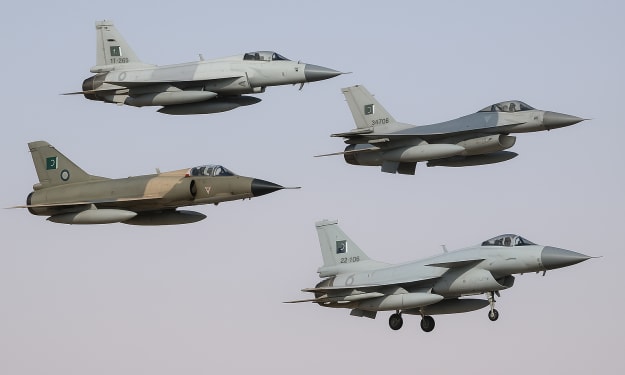
Introduction The Pakistan Air Force (PAF) is one of the most respected air forces in South Asia, known for its professionalism, combat readiness, and innovation. Since its inception in 1947, the PAF has evolved into a highly capable aerial warfare force. This article explores the history, organization, and especially the advanced fighter jets and jet engines that make up the core strength of the Pakistan Air Force. --- 1. Historical Background of the Pakistan Air Force 1.1 Birth and Early Years (1947–1965) The Pakistan Air Force was established on August 15, 1947, following the partition of British India. Initially, it inherited limited aircraft and personnel from the Royal Indian Air Force, such as Hawker Tempest and Dakota transports. 1.2 Evolution through Conflicts 1947–48 Kashmir War: The PAF played a logistical and reconnaissance role. 1965 War: The PAF performed exceptionally well, with legends like M.M. Alam gaining fame. 1971 War: Despite strategic losses, the PAF remained operationally effective. Kargil Conflict and War on Terror: The PAF adapted to modern warfare and counterinsurgency operations. --- 2. Organizational Structure of the PAF The Chief of Air Staff (CAS) currently is Air Chief Marshal Zaheer Ahmed Baber Sidhu. The PAF is organized into: Central Air Command (CAC) Northern Air Command (NAC) Southern Air Command (SAC) Training Command (TC) Main roles include air defense, ground support, ISR (intelligence, surveillance, reconnaissance), and strategic deterrence. --- 3. PAF's Modernization Strategy In recent decades, the PAF has focused on: Indigenous aircraft production (like JF-17 Thunder) Upgrading legacy aircraft (e.g., F-16s) Developing UAVs and drones Enhancing training and research capabilities Strategic collaborations with China, Turkey, and others --- 4. Fighter Jets of the Pakistan Air Force 4.1 List of Key Fighter Jets in PAF JF-17 Thunder (Pakistan-China): Multirole fighter powered by RD-93 or WS-13 engine F-16 Fighting Falcon (USA): Multirole, powered by Pratt & Whitney F100-PW engines Mirage III and V (France): Interceptor and strike roles, powered by Atar 09C engines J-10C Vigorous Dragon (China): Modern multirole fighter, powered by WS-10B engines F-7PG (China): Interceptor, powered by WP-13F engine --- 5. JF-17 Thunder – The Backbone of the PAF 5.1 Overview The JF-17 Thunder is a 4th-generation multirole fighter jointly developed by Pakistan and China. It is lightweight, cost-effective, and equipped with modern avionics. 5.2 Engine Details RD-93 Turbofan Engine (Russian) Thrust: Approx. 8,300 kgf with afterburner Max speed: Mach 1.6 WS-13 Engine (Chinese variant) Enhanced fuel efficiency and thrust Expected to replace RD-93 in future variants 5.3 Variants Block I and II: Initial production batches with operational capabilities Block III: Includes AESA radar, helmet-mounted display, and improved electronic warfare systems --- 6. F-16 Fighting Falcon – The American Powerhouse 6.1 Overview The F-16 is a high-performance multirole fighter. Pakistan operates several versions acquired from the USA, and the aircraft is used for both air-to-air and air-to-ground missions. 6.2 Engine Details Pratt & Whitney F100-PW-200/220E Engine Thrust: Approx. 23,770 lbf Capable of Mach 2+ speeds Known for high agility and combat readiness 6.3 Upgrades Mid-Life Upgrade (MLU) program Improved avionics and radar BVR missile capability Enhanced survivability systems --- 7. Mirage III and Mirage V – The Classic French Fighters 7.1 Role and Capabilities These aircraft have served in PAF for decades. They are still operational due to local upgrades and are mainly used for ground attack and reconnaissance missions. 7.2 Engine Atar 09C Turbojet Engine (French) Speed: Mach 2.2 Thrust: Approx. 14,100 lbf Modified variants in Pakistan can carry cruise missiles like RA’AD --- 8. J-10C Vigorous Dragon – A Strategic Addition 8.1 Overview The J-10C is a 4.5-generation fighter acquired from China and is considered a competitor to India’s Rafale. 8.2 Engine WS-10B Turbofan Engine (China) Thrust: Approx. 13,200 kgf Features supercruise capability and stealth airframe Equipped with PL-15 long-range missiles and AESA radar --- 9. F-7PG and Other Legacy Aircraft 9.1 F-7PG A Chinese variant of the MiG-21 Engine: WP-13F Turbojet Speed: Mach 2.0 Service Ceiling: 58,000 feet Being retired gradually 9.2 Retired Aircraft Sabre, MiG-19, MiG-21, Canberra, and others Super Mushshak used as a trainer aircraft --- 10. Future Aircraft Projects 10.1 Project AZM – Pakistan’s 5th Generation Jet Under development by Pakistan Aeronautical Complex (PAC) Expected to include stealth features, advanced radar, and twin engines Likely to be powered by WS-15 or Turkish TF6000 engines 10.2 UAVs and Drones Burraq: Armed UAV used in counter-terror operations Shahpar-II: ISR and ground attack drone Kamra Research Center is leading UAV development --- 11. Engine Summary Table Note: Plain text version for easier copying. JF-17 Thunder: RD-93 or WS-13 (Russia/China), 8,300 kgf thrust F-16 Fighting Falcon: F100-PW-200/220E (USA), 23,770 lbf thrust Mirage III/V: Atar 09C (France), 14,100 lbf thrust J-10C: WS-10B (China), 13,200 kgf thrust F-7PG: WP-13F (China), 6,220 kgf thrust --- 12. Training and Maintenance PAF Academy Risalpur and Combat Commanders School train pilots and officers Pakistan Aeronautical Complex (PAC) Kamra handles aircraft manufacturing and overhauls Collaborations exist with China, Turkey, and the USA for training and development --- 13. International Relations and Exports Joint exercises with Turkey, Saudi Arabia, Qatar, and China Exports of JF-17 to Nigeria and Myanmar Defense diplomacy to enhance regional ties --- Conclusion The Pakistan Air Force stands tall among global air forces with its commitment to innovation, excellence, and aerial supremacy. With a strong mix of foreign and indigenous fighter jets, advanced jet engines, and upcoming stealth projects, the PAF is poised to secure the skies of Pakistan for decades to come. As regional dynamics evolve, the PAF’s role in deterrence, defense, and diplomacy becomes more vital than ever.
By Ikram Ullahabout a year ago in History
The Truth About Slavery in America
When we speak about the United States of America, we often highlight liberty, democracy, and opportunity. But beneath the surface of the "American Dream" lies a dark and painful truth—the era of slavery, a chapter that continues to shape the nation’s identity, struggles, and societal divisions to this very day.
By labib hossainabout a year ago in History
Dark Shadow in the Clear Sky
"Dark Shadow in the Clear Sky: A Tragedy of the Bermuda Triangle" Writer: Aranya Chowdhury The sky was awash in a gentle blue light. Gliding over the Atlantic Ocean was a small cargo plane—“Skyline 742.” At its helm was Captain Imtiaz Rahman, a seasoned pilot who had made the skies his home for over twenty years. Beside him sat his only crew member, Tamanna Afroze, a young and courageous co-pilot.
By Books Loverabout a year ago in History
The Changeez Khan
Who Was Changeez Khan? Changeez Khan—known globally as Genghis Khan—was one of the most feared and formidable conquerors in history. Born as Temujin in the 12th century on the vast Mongolian steppes, he rose from humble beginnings to become the founder of the Mongol Empire, which eventually became the largest contiguous empire the world has ever seen.
By The Zeb Scholar about a year ago in History
Amid India-Pakistan War Fears, Citizens Stockpile Food and Medicine
Many are stockpiling food and medicine amid fears of an Indo-Pak war The political and military tensions between India and Pakistan have recently become a hot topic of discussion. Tensions along the border have been simmering for weeks.The diplomatic war of words and the spread of war-related news in the media have created a kind of anxiety among the general public. In view of this, many have started stockpiling essential items including food, water, and medicine in advance to ensure the safety and needs of themselves and their families.
By Amdadul Haq Sardarabout a year ago in History