Lessons
The First Lawmakers: How the Ancient Near East Built the Blueprint for Civilization. AI-Generated.
When we speak of law and order today, we often look westward—to Athens, Rome, or London. But before those cities dreamed in marble, dusty tablets in Sumer, Akkad, and Babylon were already echoing the weight of legal codes.
By Yand Bullosyabout a year ago in History
Which Religion Is Right. Islam or Christianity?
The question of which religion is right—Islam or Christianity—has been asked for centuries by followers of both faiths and seekers of truth. Both religions are monotheistic, believe in the same God of Abraham, and promote moral values like honesty, kindness, and charity. Yet they differ in major theological beliefs, especially regarding the nature of God, the role of Jesus, and the path to salvation. To understand which religion might be closer to the truth, it’s essential to examine their beliefs, scriptures, historical origins, and how they guide followers in life.
By USA daily update about a year ago in History
The Dust of Kabul: the USSR-Afghan War (1979–1989)
The year was 1984, and the war had already stolen too much. In a small village near the outskirts of Kabul, Aarif, a 16-year-old boy, sat on the roof of his mud-brick house, watching helicopters draw dark shapes across the sky. His village had once been a quiet place of laughter, bazaars, and old men telling stories under mulberry trees. But now, it was a place of whispers and prayers — and graves.
By Salah Uddinabout a year ago in History
The Angel Number 0100: A Divine Call for Spiritual New Beginnings
The Angel Number 0100: A Divine Call for Spiritual New Beginnings In the world of numerology, every number sequence carries a specific vibration and a message from the universe. When a number like angel number 0100 appears repeatedly, it's a powerful sign that your angels are communicating with you. This number is a beacon of divine guidance, signaling a new beginning that is deeply rooted in your spiritual journey. It's a call to trust your intuition, embrace a new path, and boldly step into the next phase of your life.
By Sthephanieabout a year ago in History
The Cradle of Civilization. AI-Generated.
The Cradle of Civilization: Unearthing the Enduring Legacy of the Ancient Near East Forget dusty textbooks and dry lectures. Step back in time – way back – to a world where the first cities rose from the mudflats, writing scratched its way onto clay, and laws were carved in stone for all to see. Welcome to the Ancient Near East, the vibrant, complex, and utterly foundational crucible where the very blueprint of Western civilization was forged. This isn't just history; it's the origin story of us.
By Yand Bullosyabout a year ago in History
The London Shadows
Shadows Over London A Historical Fiction Story Set During the Blitz Part 1: The First Siren The evening sky over London was bruised purple with smoke, the faint orange glow of distant fires smoldering like embers against the horizon. Mary Havers adjusted her wool coat as she hurried down the narrow street of terraced houses in Bethnal Green, her ration bag clutched tightly in one hand. She had just left the grocer’s, where she’d managed to barter two eggs for a tin of powdered milk. The war had turned every small victory into a treasure. It was September 1940, and London had already endured weeks of German air raids. The newspapers called it The Blitz. For Mary, it was simply survival. As she reached her front door, the wail of the air raid siren cut through the night air — a long, piercing cry that froze her blood. All around, doors burst open, and neighbors spilled onto the street. Mothers gathered children in their arms, old men grabbed torches, and young boys clutched gas masks too big for their small faces. “Quickly, Mary!” called Mrs. Price, her elderly neighbor, hobbling with a cane toward the entrance of the underground shelter. “They’re coming again!” Mary hesitated only long enough to glance at the sky, already alive with the drone of approaching bombers. Then she ran. The Bethnal Green tube station, like so many others across London, had been turned into a shelter. The air was damp and smelled faintly of coal and unwashed bodies. Families claimed their usual spots, spreading thin blankets over the concrete floor. Babies whimpered, and voices murmured in the dim light of hurricane lamps. Mary slid into her place against the wall. Beside her, her younger brother James, barely sixteen, was already waiting. His face was pale but determined, his school cap tilted stubbornly forward. “You made it,” he said, relief in his voice. “I wasn’t about to let Jerry catch me out in the open,” Mary replied, forcing a smile. The ground above them shook. Dust drifted from the ceiling. Somewhere in the distance, the thud of anti-aircraft guns echoed, followed by the high whine of falling bombs. A baby began to cry, its wails piercing through the tense silence. “They won’t get us down here,” James said quietly, though his hands trembled as he clutched his gas mask. Mary reached over and squeezed his arm. “Of course not.” But deep inside, she wasn’t sure. --- Part 2: Fire in the Streets The next morning, after a restless night, they emerged from the shelter into a city that seemed both familiar and strange. Smoke hung in the air like a shroud, and the acrid stench of burning wood and brick filled their lungs. Bethnal Green had been lucky; only a few houses had been damaged. But as Mary and James walked toward Whitechapel to check on their aunt, they saw the devastation more clearly. Entire streets had been reduced to rubble. Women picked through the remains of their homes, clutching teacups, picture frames, or bits of clothing, as if these small tokens could anchor them to the life they once knew. At Aldgate, they found a crowd gathered around a bomb crater where a double-decker bus had been torn apart. Mary turned James away before he could see the blood on the cobblestones. “Don’t look,” she whispered. “Just keep walking.” They reached their aunt’s flat — miraculously untouched — and spent the afternoon helping her board up broken windows. All the while, planes droned overhead, a constant reminder that safety was only temporary. That night, back in the shelter, Mary noticed a young man across the tunnel. He wore an RAF uniform, his dark hair neatly combed despite the dust and sweat around them. He caught her looking and offered a small smile. She looked away quickly, embarrassed, though her heart beat faster. Later, as the bombing eased and people dozed off, the young man came over. “Mind if I sit?” he asked softly. Mary nodded. James was asleep beside her, his head resting on his arm. “I’m Tom,” the man said. “Tom Whitaker. Stationed just outside London, but I visit home when I can.” “Mary Havers,” she replied, her voice low. Tom glanced around the shelter, then back at her. “You holding up all right?” “As well as anyone can.” She tried to smile, though her eyes stung with exhaustion. Tom studied her face. “You look like you haven’t slept in weeks.” She let out a small laugh. “That’s because I haven’t.” The conversation was brief, interrupted by the roar of another wave of planes. But something in his steady gaze made Mary feel, for the first time in months, that perhaps she wasn’t entirely alone. --- Part 3: Letters in the Blackout Over the following weeks, Mary and Tom crossed paths often. Sometimes he managed to bring her small comforts — a chocolate bar from the ration line, a folded newspaper, even once a fresh apple that seemed impossibly luxurious. They talked in hushed tones about everything except the war: books they’d read, favorite corners of London, dreams for after the fighting ended. One evening, as the bombs fell heavy, Tom handed her a folded scrap of paper. “In case we don’t see each other tomorrow,” he said. Mary unfolded it under the dim lantern light. It was a poem — not copied from a book, but written in Tom’s careful hand. A promise of hope, of a world where London’s streets would be lit not by flames, but by laughter. She blinked back tears. “It’s beautiful.” Tom shrugged shyly. “I just wanted you to have something to hold onto.” That night, Mary pressed the poem to her chest as she tried to sleep, even as the ceiling above them rattled with the fury of war.
By Ikk khan Khanabout a year ago in History
Demons: Reality or Fantasy? Exploring the Origins, Myths, Science, and Beliefs Behind the World's Darkest Entities
Description: Are demons real, or are they just products of myth, fear, and misunderstanding? This extensive article dissects the concept of demons across religions, cultures, and scientific perspectives. From ancient Mesopotamian spirits to Hollywood’s horror portrayals, explore how demons have shaped human imagination, belief systems, and the battle between good and evil.
By Stefano D'angelloabout a year ago in History
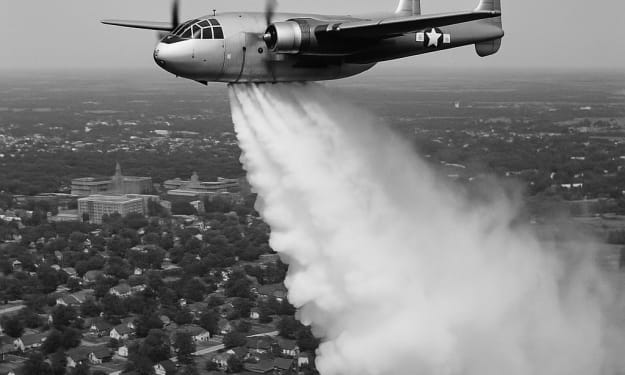
Shocking Truth Revealed: Operation LAC - How the U.S. Secretly Sprayed Its Own Citizens. AI-Generated.
Introduction to Operation LAC What Was Operation LAC? In the 1950s, amid Cold War tensions, the U.S. government launched Operation Large Area Coverage (LAC)—a military test that shockingly involved the secret aerial spraying of chemical substances over vast areas of the United States, including populated cities. Conducted without public knowledge or consent, Operation LAC aimed to study how biological agents might disperse in the event of a large-scale attack. But what started as a defense experiment raised serious questions about transparency, ethics, and public health.
By DJ for Changeabout a year ago in History